The Evolution of the Basis Trade: How Equity Perpetuals Are Outpacing Crypto
The traditional crypto basis trade, widely known as the “cash and carry” strategy, has experienced a significant compression in yields over recent years. After peaking at annualized rates of 20 to 40 percent, Bitcoin perpetual funding and futures basis have dropped dramatically to a modest 3 to 5 percent. This cooling off has prompted investors and traders to search for alternative avenues to capture delta-neutral yields, leading to a major pivot toward real-world asset perpetuals and equity-based derivatives.
Simultaneously, the market for perpetual futures tied to traditional finance assets has expanded rapidly, growing to account for a substantial share of open interest across major trading venues. With regulatory milestones opening the door for single-stock perpetuals on regulated domestic exchanges, trading platforms are increasingly transforming into comprehensive multi-asset hubs. This convergence allows market participants to trade traditional equities, commodities, and digital assets side by side, creating entirely new dynamics for leveraged speculation and hedging strategies.
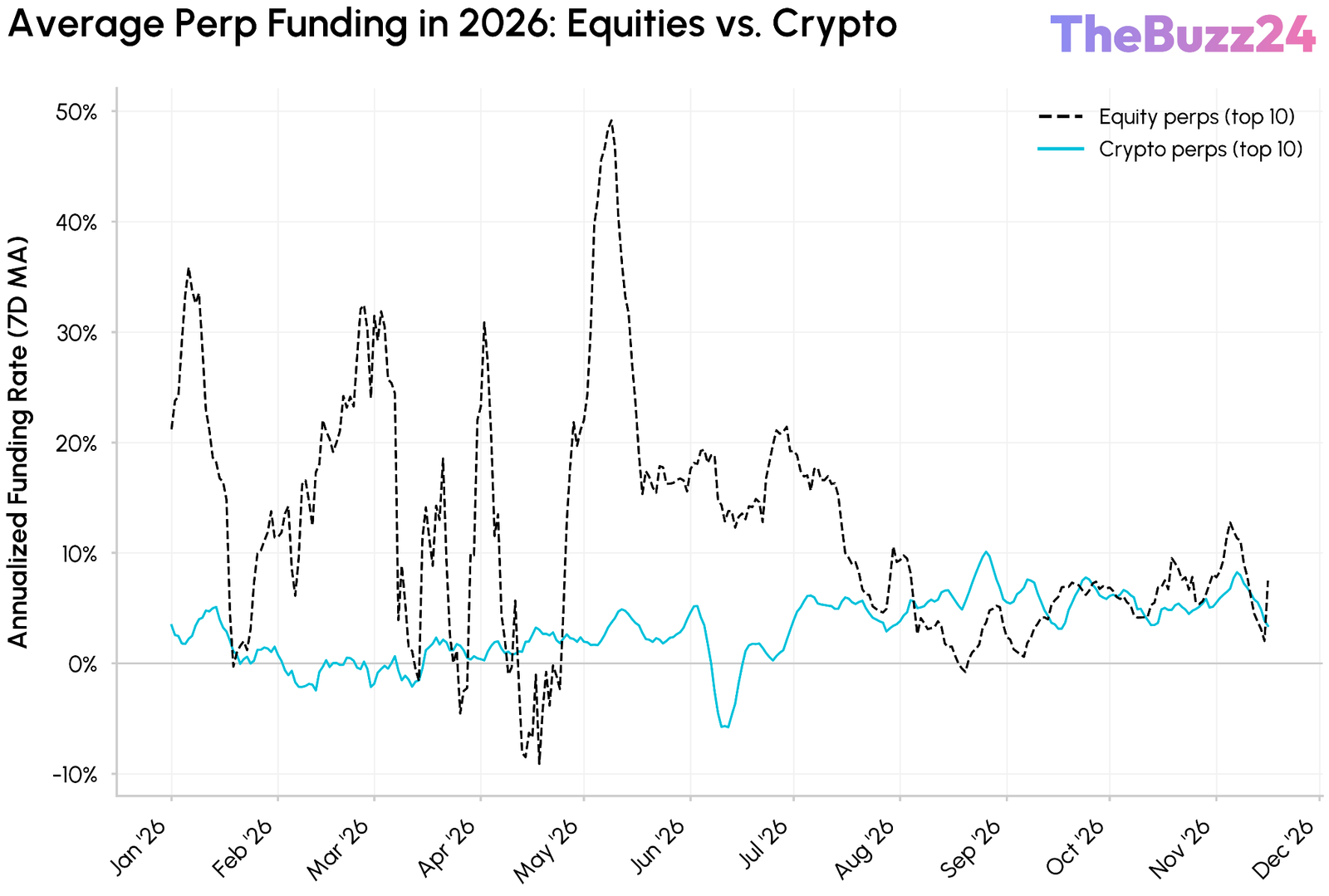
Data comparing funding rates highlights this shifting landscape. Top-tier equity perpetuals have consistently outperformed their crypto counterparts, averaging double-digit annualized funding rates driven by intense round-the-clock demand for high-growth sectors, artificial intelligence plays, and prominent memory chip manufacturers. Furthermore, wider funding spreads across different exchanges present lucrative opportunities for cross-venue arbitrage, allowing sophisticated traders to optimize their returns beyond standard digital asset strategies.
The integration of tokenized stocks with matching perpetual futures on single platforms has further streamlined the execution of these trades. By pairing long exposure in tokenized equities with short perpetual positions, market participants can successfully capture attractive net carry yields. However, navigating this emerging landscape requires careful risk management, as liquidity can fluctuate outside of traditional market hours and funding rates remain subject to rapid shifts.
Key Takeaways
- Crypto basis trade yields have compressed significantly to roughly 3-5% annually, falling in line with or below traditional Treasury yields.
- Equity perpetuals have surged in popularity, offering average annualized funding rates near 11%, outperforming traditional crypto equivalents.
- The integration of tokenized stocks and perpetual futures on single exchanges enables streamlined delta-neutral trading strategies.
Editor’s Analysis & Impact
The transition from crypto-centric carry trades to equity-based perpetuals highlights a broader maturation in alternative derivatives markets. As traditional digital asset yields normalize, institutional and retail capital is aggressively seeking out higher-yielding, around-the-clock exposure to traditional equities and high-demand sectors like AI and semiconductors. Regulatory nods toward single-stock perps in major jurisdictions will likely accelerate this trend, bridging the gap between decentralized finance and traditional equity markets. However, market participants must remain vigilant regarding cross-venue fragmentation and liquidity risks during non-traditional trading hours.
Frequently Asked Questions
Q: What is a basis trade?
A: A basis trade, or cash-and-carry strategy, involves buying a spot asset while simultaneously shorting an equivalent futures position to capture the yield difference while neutralizing directional price risk.
Q: Why have crypto basis trade yields dropped?
A: Crypto basis trade yields have compressed due to increased institutional participation, market maturation, and a significant drop in perpetual funding rates from their 2024 peaks.
Q: What are tokenized stocks?
A: Tokenized stocks are digital representations of traditional equities that trade on blockchain-enabled platforms, allowing users to gain exposure to companies outside of standard stock market hours.
AI Disclosure: This article is based on verified data and official reports. Our Team and AI have cross-referenced every financial detail with primary sources to ensure total accuracy.
More from this Category