Capturing the Cosmos: A Stunning New Look at the Horsehead and Flame Nebulas
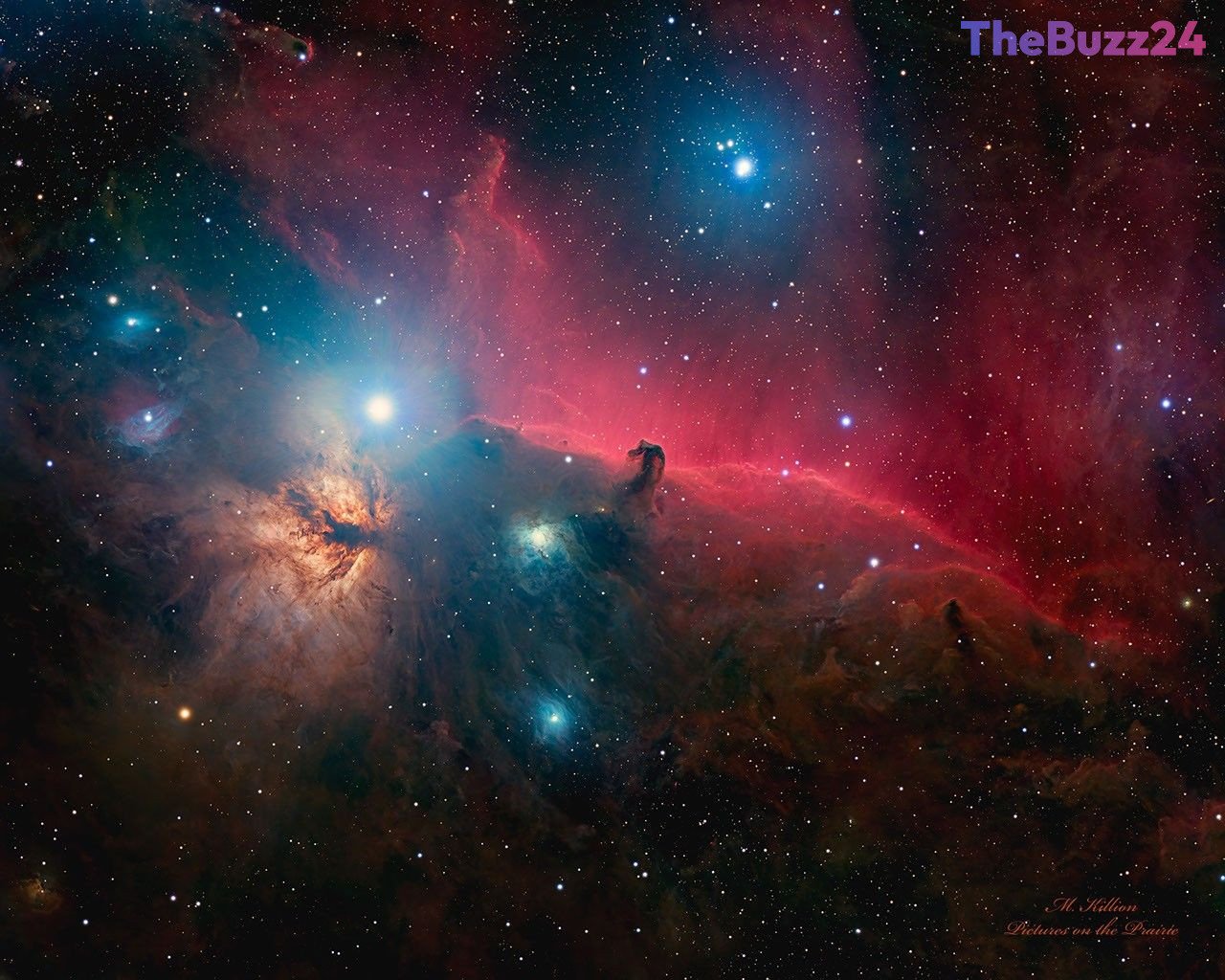
A remarkable new deep-space image has captured the intricate beauty of the Horsehead and Flame Nebulas, showcasing the complex interplay of dust, gas, and starlight in the Orion constellation. The photograph, which resembles a vibrant oil painting, highlights the iconic silhouette of the Horsehead Nebula, a dense cloud of cosmic dust standing five light-years tall and situated roughly 1,500 light-years from Earth. The dark, horse-shaped structure is silhouetted against a backdrop of ionized hydrogen gas, which glows red due to the influence of the nearby star Sigma Orionis.
To the left of the Horsehead, the Flame Nebula dominates the frame with its striking orange hues and intricate dark filaments. The composition also features the bright blue star Alnitak, a triple star system that serves as the easternmost point of Orion’s Belt, and the reflection nebula NGC 2023, a region currently active in the process of stellar birth. The image provides a vivid look at the chaotic yet beautiful star-forming regions that define this sector of the galaxy.
The data for this detailed celestial portrait was gathered over a six-hour exposure period at the Utah Desert Remote Observatories. Notably, the entire process was managed remotely by the astrophotographer from his home in Illinois, demonstrating the increasing accessibility and precision of modern amateur and semi-professional astrophotography equipment. This technological leap allows for high-fidelity imaging of deep-space objects without the need for physical presence at high-altitude or dark-sky sites.
Key Takeaways
- The Horsehead Nebula is a massive, five-light-year-tall structure composed of dust and gas located 1,500 light-years away.
- The image highlights the contrast between the dark Horsehead Nebula and the glowing ionized hydrogen gas behind it.
- Modern remote-controlled observatory technology allows high-quality astrophotography to be conducted from thousands of miles away.
Editor’s Analysis & Impact
The evolution of remote-controlled observatories represents a significant shift in the field of amateur and professional astronomy. By decoupling the physical location of the observer from the telescope, the barrier to entry for high-quality deep-space imaging has been drastically lowered. This democratization of space observation fosters greater public engagement with science and allows for a more consistent stream of data from various celestial regions. As sensor technology continues to improve and remote-access platforms become more user-friendly, we can expect an increase in the volume of high-resolution astronomical data available to the public. This trend not only aids in educational outreach but also provides a valuable resource for citizen science projects, where amateur observations can supplement professional research efforts in monitoring stellar activity and nebular changes.
Frequently Asked Questions
Q: What causes the red glow behind the Horsehead Nebula?
A: The red glow is caused by hydrogen gas being ionized by the radiation from the bright star Sigma Orionis.
Q: How was this image captured if the photographer was in Illinois?
A: The photographer used remote-controlled equipment located at the Utah Desert Remote Observatories, allowing them to capture the data from over 2,000 kilometers away.
AI Disclosure: This article is based on verified data and official reports. Our Team and AI have cross-referenced every financial detail with primary sources to ensure total accuracy.
More from this Category