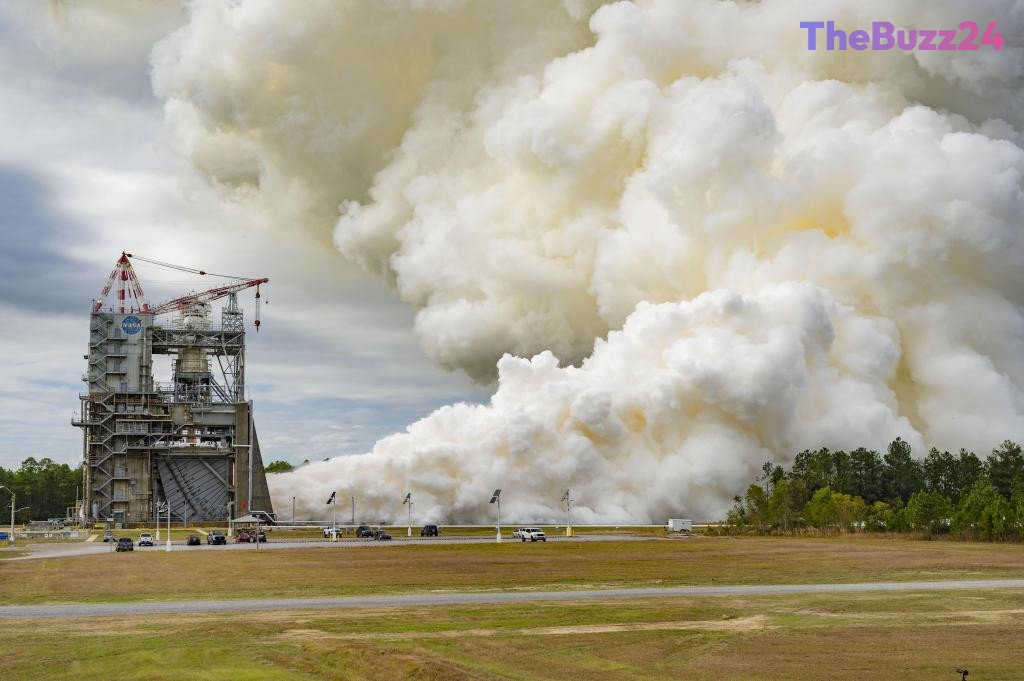
NASA Advances Artemis Propulsion Tech with Successful RS-25 Engine Test
NASA has successfully completed a critical hot fire test of the RS-25 engine at the Stennis Space Center in Mississippi. The test, which took place on November 18, involved engine No. 10001 and lasted for a duration of 200 seconds. This developmental firing serves as a vital component in the ongoing efforts to refine propulsion systems for the agency’s ambitious Artemis program.
While this specific engine is designated for testing purposes rather than flight, the data gathered is essential for enhancing the performance and reliability of the hardware that will power future Space Launch System (SLS) rockets. The testing process is a collaborative effort involving NASA personnel alongside contractors from L3Harris Technologies and Nova Space Solutions, ensuring that every engine meets rigorous safety and operational standards before being cleared for spaceflight.
These propulsion systems are the backbone of the Artemis missions, with each SLS rocket utilizing four RS-25 engines to generate a combined 2 million pounds of thrust. As NASA prepares for the Artemis IV mission scheduled for 2028, these ground tests remain a cornerstone of the agency’s strategy to return humans to the lunar surface and eventually establish a sustainable presence at the lunar South Pole, which will serve as a launchpad for future crewed missions to Mars.
Key Takeaways
- NASA successfully conducted a 200-second hot fire test of an RS-25 developmental engine at Stennis Space Center.
- The data collected from these tests is critical for improving the reliability of the SLS rocket engines used in the Artemis program.
- The Artemis IV mission, currently slated for 2028, relies on the combined 2 million pounds of thrust provided by four RS-25 engines.
Editor’s Analysis & Impact
The successful testing of the RS-25 engine underscores NASA’s commitment to iterative engineering as it scales the Artemis program. By utilizing developmental engines to push performance boundaries, the agency minimizes risk for the high-stakes Artemis IV mission. The collaboration between NASA and private sector partners like L3Harris Technologies highlights the growing integration of commercial expertise in government-led deep space exploration. As the agency shifts its focus toward a sustained lunar presence, the reliability of the SLS propulsion system becomes the single most important technical variable. Future outlooks suggest that these ground-based testing protocols will be instrumental not only for lunar exploration but also for validating the heavy-lift capabilities required for the eventual transition to crewed Mars missions, marking a pivotal era in aerospace propulsion development.
Frequently Asked Questions
Q: Why does NASA test engines that are not intended for flight?
A: Developmental engines are used to gather critical performance data and stress-test components without risking flight-ready hardware, allowing engineers to make improvements and ensure reliability for future missions.
Q: What is the role of the RS-25 engine in the Artemis program?
A: The RS-25 engines provide the massive thrust required to launch the Space Launch System (SLS) rocket, which carries the Orion spacecraft and astronauts toward the Moon.
AI Disclosure: This article is based on verified data and official reports. Our Team and AI have cross-referenced every financial detail with primary sources to ensure total accuracy.
More from this Category