Reliving Apollo 17: A Stunning 3D Look at the Moon’s Historic Taurus-Littrow Valley
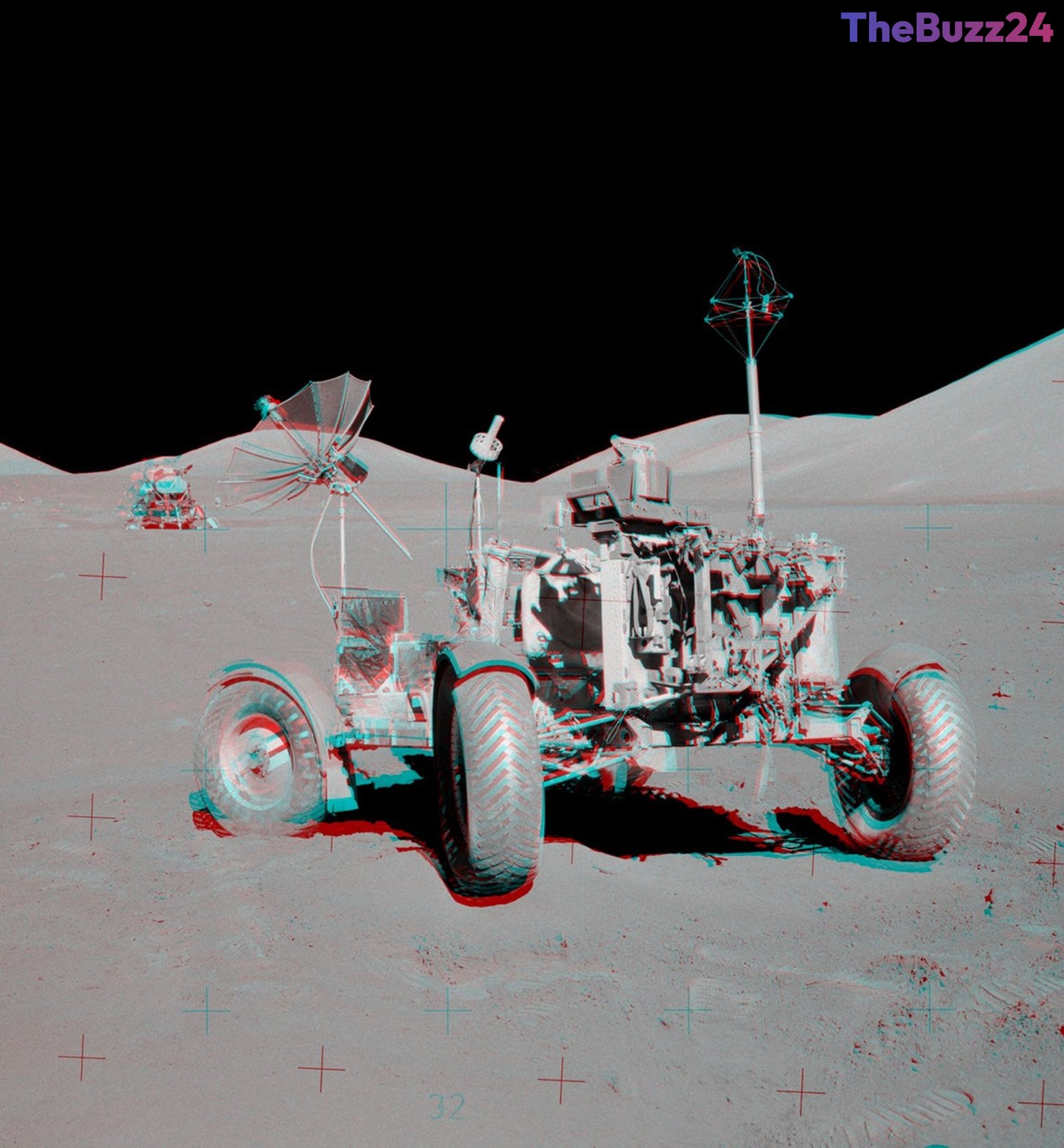
Space enthusiasts and history buffs have been treated to a remarkable three-dimensional visualization of the Taurus-Littrow valley on the Moon, highlighting the final crewed lunar mission. Utilizing classic red and blue glasses, observers can examine a detailed stereoscopic view that brings the historic Apollo 17 landing site to life with striking depth.
In the foreground of the newly highlighted anaglyph rests the mission’s iconic Lunar Rover, positioned near the Lunar Module with distant lunar hills rising in the background. This specific location earned the moniker of the ‘VIP Site’ during the 1972 mission because it served as the vantage point from which the rover’s television camera was intended to broadcast the Lunar Module’s ascent stage liftoff to a global audience.
December marks the historic legacy left behind by Apollo 17 astronauts Eugene Cernan and Harrison Schmitt, who spent roughly 75 hours exploring the lunar surface while crewmate Ronald Evans orbited above in the command module. Returning to Earth with an unprecedented 110 kilograms of geological samples, Cernan and Schmitt secured their place in history as the final humans to walk and drive on the Moon.
Key Takeaways
- A newly presented 3D anaglyph offers a detailed stereoscopic view of the Apollo 17 landing site in the Taurus-Littrow valley.
- The designated 'VIP Site' was chosen so the Lunar Rover's camera could broadcast the mission's lunar liftoff.
- Apollo 17 astronauts Eugene Cernan and Harrison Schmitt remain the last humans to walk and drive on the lunar surface.
Editor’s Analysis & Impact
The enduring fascination with the Apollo era highlights humanity’s persistent desire to return to deep space exploration. As modern space agencies and private aerospace companies set their sights back on lunar missions, archival data and imagery from historical undertakings like Apollo 17 provide invaluable technical context and public inspiration. These retrospectives not only celebrate past engineering triumphs but also serve as benchmarks for current lunar habitation and exploration frameworks. Analyzing past missions helps today’s aerospace pioneers understand the logistical challenges of prolonged stays on planetary bodies, ultimately shaping the trajectory of the modern commercial and national space race.
Frequently Asked Questions
Q: What is an anaglyph in the context of the Apollo 17 image?
A: An anaglyph is a stereoscopic 3D image format that uses contrasting color filters—typically red and cyan—to create a three-dimensional visual effect when viewed through corresponding colored glasses.
Q: Why was the Apollo 17 parking location called the 'VIP Site'?
A: It was designated the VIP Site because the Lunar Rover's onboard television camera was positioned there to broadcast the Lunar Module's ascent stage liftoff back to viewers on Earth.
Q: Who were the last astronauts to walk on the Moon?
A: Eugene Cernan and Harrison Schmitt, the astronauts of the 1972 Apollo 17 mission, remain the last humans to walk and drive on the lunar surface.
AI Disclosure: This article is based on verified data and official reports. Our Team and AI have cross-referenced every financial detail with primary sources to ensure total accuracy.
More from this Category