2,000-Year-Old Roman Shipwreck, Laden with Ancient Cargo, Discovered Off Sicily
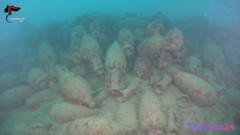
Italian divers have made a remarkable discovery off the coast of Sicily: an ancient Roman shipwreck estimated to be over 2,000 years old. The vessel, dating from the 2nd or 1st Century BC, was found brimming with hundreds of remarkably well-preserved amphorae, ceramic containers typically used to transport essential goods such as wine, olive oil, and grain across the ancient Mediterranean. Italy’s Culture Minister, Alessandro Giuli, has lauded the find as “one of the most important underwater archaeological discoveries of recent years,” underscoring its immense historical significance.
The initial discovery was made by free-diver and fisherman Giacomo De Mola, who, after receiving a tip-off from fellow fishermen, was surveying the seabed near Mazara del Vallo. De Mola recounted his astonishment when his scanner indicated a large object, which he initially mistook for a rock. Upon closer inspection, he realized it was not a geological formation but hundreds of amphorae, leading him to describe it as “the most incredible discovery of my life.” The wreckage itself measures approximately 21 meters (69 feet) long and 6 meters (20 feet) wide, resting at a depth of around 46 meters (150 feet).
Following De Mola’s report, specialist divers from the Carabinieri Art Squad, Italy’s cultural heritage protection unit, were dispatched to the site. Their mission is to safeguard the wreck and its precious cargo while experts undertake further investigation to determine the precise nature of the vessel and glean more insights into ancient Roman trade routes and maritime practices. The Mediterranean seabed is known to be a vast repository of such historical treasures, with similar ancient wrecks, including another 1st or 2nd Century BC vessel laden with amphorae, found north-west of Rome in 2023, highlighting the region’s rich underwater archaeological potential.
Key Takeaways
- A 2,000-year-old Roman shipwreck, dating from the 2nd or 1st Century BC, has been discovered off the coast of Sicily.
- The vessel was found laden with hundreds of well-preserved amphorae, indicating it was a merchant ship transporting goods like wine and olive oil.
- Hailed as a significant archaeological find, specialist Italian police divers are now securing the site for further investigation into its historical context and cargo.
Editor’s Analysis & Impact
This discovery off Sicily is more than just an archaeological find; it’s a window into the sophisticated trade networks and daily life of the Roman Empire. The well-preserved amphorae offer invaluable insights into ancient agricultural products, consumption patterns, and economic exchanges across the Mediterranean. For the archaeology and history sectors, it reinforces the critical importance of underwater exploration and cultural heritage protection. The find could spur further investment in advanced marine archaeology technologies and collaborative international efforts to map and preserve the vast number of undiscovered wrecks in the Mediterranean. Broader implications include a potential boost for cultural tourism in Sicily and a deeper understanding of maritime history, influencing academic research and public engagement with the ancient world.
Frequently Asked Questions
Q: How old is the Roman shipwreck discovered off Sicily?
A: The shipwreck is estimated to be over 2,000 years old, dating back to the 2nd or 1st Century BC.
Q: What kind of cargo was found on the ancient vessel?
A: The vessel was found with hundreds of well-preserved amphorae, which are ceramic jars typically used in ancient times to transport goods such as wine, olive oil, and grain.
Q: Who initially discovered the shipwreck?
A: The shipwreck was initially stumbled upon by a free-diver and fisherman named Giacomo De Mola, who then reported his findings to authorities, leading to investigation by specialist police divers.
AI Disclosure: This article is based on verified data and official reports. Our Team and AI have cross-referenced every financial detail with primary sources to ensure total accuracy.
More from this Category