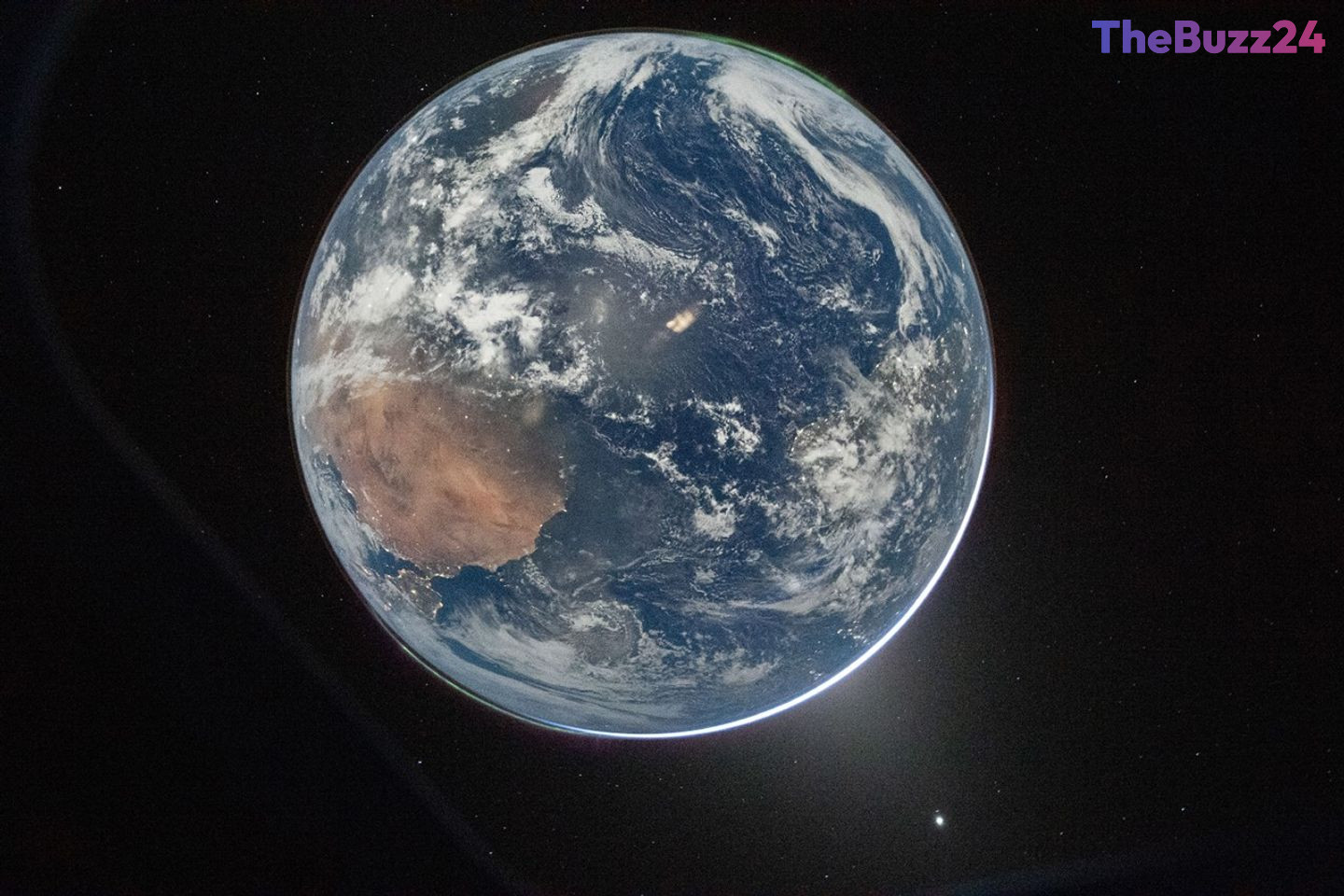
A Moonlit Masterpiece: Artemis II Captures Breathtaking Nighttime View of Earth from Deep Space
As the Artemis II spacecraft embarked on its historic journey toward the Moon, an astronaut aboard the Orion capsule captured a spectacular, unprecedented image of Earth. Taken shortly after the translunar injection burn—the maneuver that propelled the spacecraft out of Earth’s orbit—the photograph offers a rare, full-disk perspective of our planet illuminated not by direct sunlight, but by the soft glow of moonlight. From Orion’s vantage point, Earth perfectly eclipsed the Sun, leaving only a brilliant sliver of solar light peeking from the edge, while the rest of the globe lay shrouded in a cosmic twilight.
Despite the low-light conditions, advanced digital camera technology allowed the crew to capture intricate details of both natural phenomena and human civilization. By configuring the camera to an ultra-sensitive ISO setting of 51,200, the astronaut successfully documented vibrant green auroras shimmering near the polar regions, triggered by solar particles interacting with the upper atmosphere. Additionally, the image captured the faint, ethereal glow of zodiacal light—sunlight reflecting off interplanetary dust particles believed to originate from Mars—alongside a brilliant Venus shining in the background.
On the terrestrial surface, the glowing footprints of humanity were clearly visible. Bright clusters of artificial light mapped out major urban centers across Spain, Portugal, northern Africa, sub-Saharan Africa, and Brazil. This striking visual serves as a powerful reminder of the complex relationship between human activity and the global environment. While previous missions, such as Apollo 12 in 1969, and ongoing observations from the International Space Station have captured nighttime views of Earth, this single, human-captured image is uniquely comprehensive, blending atmospheric, astronomical, and anthropogenic features into one frame.
Scientific experts have expressed immense enthusiasm for the photograph’s dual value as both an artistic triumph and a scientific resource. The image highlights Earth’s dynamic interactions with the solar wind and showcases the potential for future low-light Earth observations from deep space. By bridging the gap between human space exploration and Earth science, the stunning snapshot provides researchers with a fresh perspective on how artificial light at night can be utilized to study human development and environmental changes from afar.
Key Takeaways
- The Artemis II crew captured a rare full-disk image of Earth illuminated by moonlight during its trajectory toward the Moon.
- Using a high ISO camera setting of 51,200, the photograph detailed polar auroras, zodiacal light, Venus, and glowing city lights across multiple continents.
- The image bridges human space exploration and Earth science, offering valuable insights into studying artificial light and atmospheric phenomena from deep space.
Editor’s Analysis & Impact
The stunning imagery returned by the Artemis II mission represents more than just a public relations triumph; it signals a technological leap in deep-space observation capabilities. By successfully capturing high-resolution, low-light data from a translunar trajectory, this mission demonstrates that future crewed and uncrewed deep-space missions can serve as highly effective platforms for Earth science. The ability to monitor global phenomena—such as auroral activity, atmospheric interactions, and urbanization patterns—from a distance offers a holistic view that low-Earth orbit satellites cannot easily replicate. For the aerospace and imaging technology industries, this milestone will likely accelerate the development of highly sensitive optical sensors designed for extreme low-light environments. Ultimately, integrating Earth observation goals into deep-space exploration frameworks will foster deeper interdisciplinary collaboration, enriching our understanding of our home planet’s place in the broader solar system.
Frequently Asked Questions
Q: How was the Artemis II crew able to capture such clear details of Earth in the dark?
A: The astronaut utilized advanced digital camera technology set to an extremely high sensitivity level of ISO 51,200. This, combined with the natural illumination provided by a full Moon, allowed the camera to capture faint light sources like city lights, auroras, and zodiacal light.
Q: What is zodiacal light, and why is it visible in the photo?
A: Zodiacal light is a faint, hazy glow caused by sunlight reflecting off interplanetary dust particles scattered throughout the solar system. In the photo, it appears near Earth's edge, with scientific data suggesting these dust particles may originate from Mars.
Q: Why is this image scientifically significant compared to satellite photos?
A: While satellites regularly monitor Earth, this single, human-captured photo provides a unique, full-disk perspective that simultaneously displays atmospheric auroras, astronomical phenomena, and human-made light patterns, illustrating Earth's dynamic interactions as a celestial body.
AI Disclosure: This article is based on verified data and official reports. Our Team and AI have cross-referenced every financial detail with primary sources to ensure total accuracy.
More from this Category