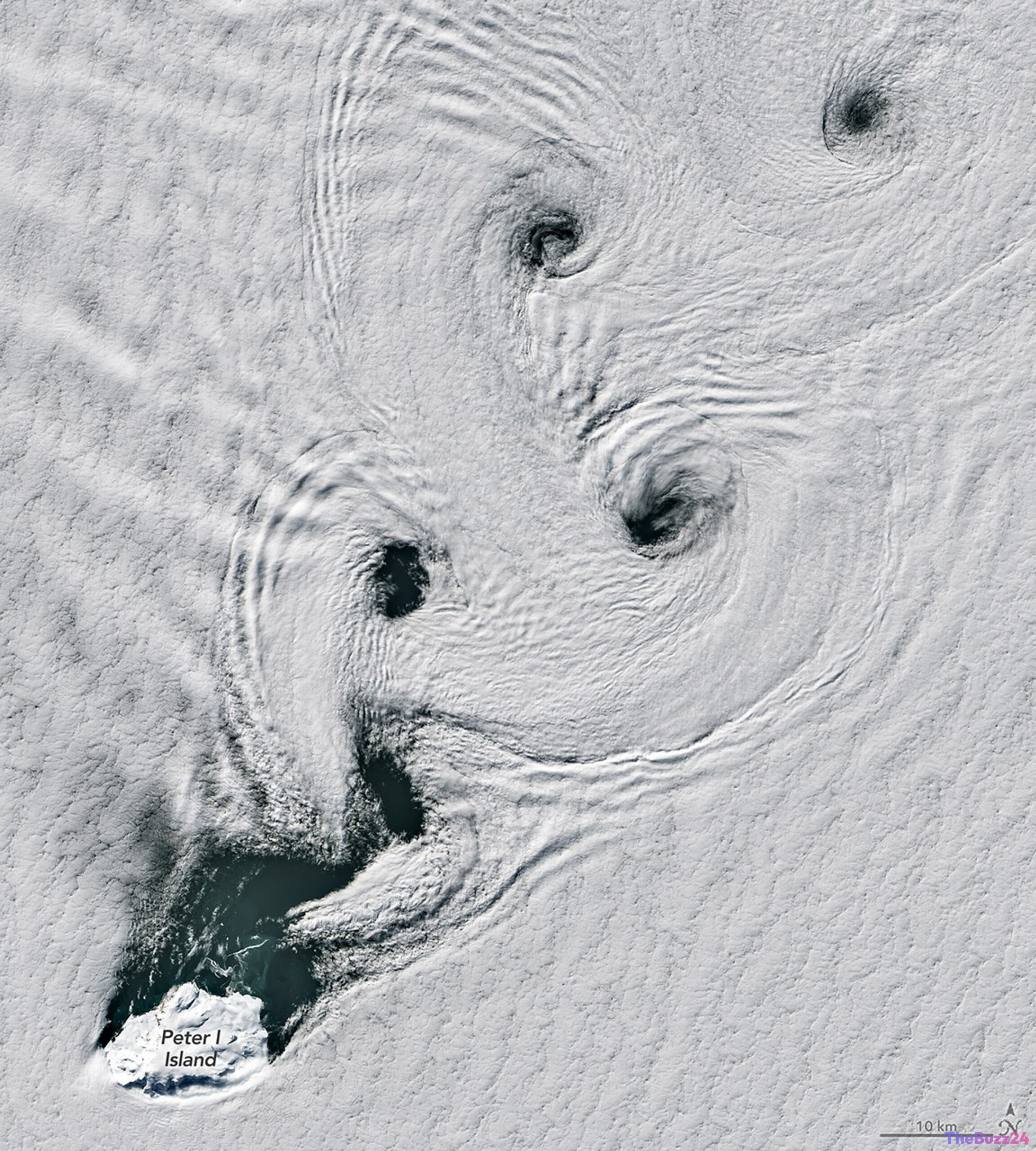
Atmospheric Art: Rare Cloud Vortices Spotted Over Remote Antarctic Peak
A breathtaking meteorological phenomenon has been observed near Peter I Island, a desolate volcanic landmass located in the Southern Ocean. Satellite imagery recently captured the formation of von Kármán vortex streets—a series of counter-rotating cloud spirals that manifest when steady, consistent winds are interrupted by a physical obstacle. In this instance, the island’s towering volcanic peak acted as the catalyst, forcing the airflow to deflect and swirl into rhythmic, repeating patterns.
Peter I Island, situated approximately 400 kilometers off the coast of West Antarctica, is an ice-shrouded shield volcano reaching an elevation of 1,640 meters. While the island is known for its rugged, frozen terrain and a distinct summit crater, it has remained geologically quiet in recent history. The specific atmospheric conditions required to produce these cloud spirals are quite precise; wind speeds must remain within a moderate range of 18 to 54 kilometers per hour. If the winds exceed this threshold, the delicate structure of the eddies collapses, making the capture of such imagery a rare event.
Despite its scientific significance, the island remains one of the most isolated places on Earth. Since its initial discovery in 1821, the combination of extreme weather and treacherous sea ice has made it exceptionally difficult for researchers to conduct on-site studies. Nevertheless, the island continues to serve as a vital, albeit remote, laboratory for scientists looking to understand geological history, biodiversity, and the long-term climate records trapped within its ancient ice sheets.
Key Takeaways
- Von Kármán vortex streets are rare, rhythmic cloud patterns formed when wind is obstructed by a physical barrier like a mountain peak.
- The phenomenon requires specific wind speeds between 18 and 54 km/h to maintain its structural integrity.
- Peter I Island is a remote, ice-covered volcano that serves as a critical site for studying historical climate data despite its extreme isolation.
Editor’s Analysis & Impact
The observation of von Kármán vortex streets over Peter I Island highlights the intersection of fluid dynamics and atmospheric science in one of the planet’s most inaccessible regions. From an industry perspective, the ability to capture such phenomena via satellite imagery underscores the growing importance of remote sensing technology in environmental monitoring. As climate change continues to alter global wind patterns and sea ice stability, these natural laboratories become increasingly vital for researchers. The broader implication is that even the most remote geographical features play a significant role in our understanding of global weather systems. Future advancements in high-resolution satellite imaging will likely provide even deeper insights into these ephemeral atmospheric events, allowing scientists to model complex airflows without the need for dangerous and costly physical expeditions.
Frequently Asked Questions
Q: What causes the cloud spirals seen near Peter I Island?
A: These spirals, known as von Kármán vortex streets, are caused by steady winds hitting a physical barrier—in this case, the island's volcanic peak—which forces the air to deflect and spin into rhythmic eddies.
Q: Why is it difficult for scientists to study Peter I Island?
A: The island is extremely isolated, located in the treacherous waters of the Southern Ocean, and is surrounded by difficult ice conditions that make regular human access nearly impossible.
AI Disclosure: This article is based on verified data and official reports. Our Team and AI have cross-referenced every financial detail with primary sources to ensure total accuracy.
More from this Category