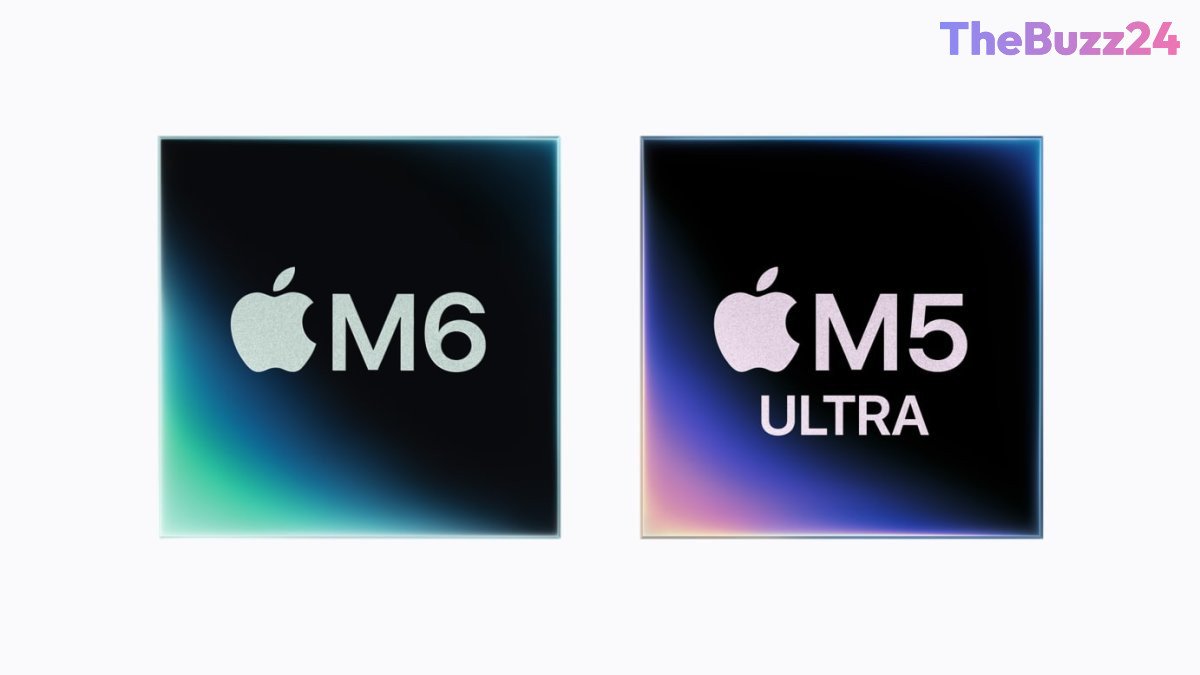
Apple Unveils Powerhouse M5 Ultra and M6 Chips, Redefining Mac Performance for AI
Apple has introduced its latest generation of processors, the M5 Ultra and M6 chips, designed to significantly enhance the performance of its new Mac Mini and Mac Studio models. These advancements underscore Apple’s commitment to pushing the boundaries of computing power, particularly in the burgeoning field of artificial intelligence.
The M5 Ultra stands out as Apple’s most formidable chip to date, engineered by fusing two M5 Max chips into a groundbreaking quad-die architecture. This design allows it to tackle exceptionally demanding AI workloads with ease. Boasting an impressive configuration of up to a 36-core CPU and an 80-core GPU, alongside a staggering 1.2 TB/s of unified memory bandwidth—a 50% increase over its predecessor, the M3 Ultra—the M5 Ultra is tailored for professionals engaged in complex 3D rendering, visual effects, and the development of cutting-edge AI models. While primarily aimed at high-end users, its capabilities are also expected to attract hobbyist AI developers.
For everyday users, Apple has developed the M6 chip, built on an advanced 2nm process. This chip integrates a new CPU complex, two additional CPU and GPU cores, and a Dual 16-core Neural Engine, all contributing to enhanced unified memory bandwidth and remarkable energy efficiency. The M6’s 12-core CPU complex delivers nearly a 30% boost in peak GPU compute for AI tasks compared to the M5, leading to faster processing of prompts for on-device large language models. This empowers developers to run and fine-tune substantial AI models directly on their Mac devices, leveraging Apple’s optimized developer tools and frameworks.
Apple’s strategy with these new chips emphasizes on-device AI processing, offering a secure and controlled environment for developers to innovate. While the company has previously relied on partners like Google’s Gemini for certain AI functionalities, such as the Siri upgrade, its strength in local processing for features like Face ID and Touch ID highlights a potential competitive edge. By enabling powerful AI workloads to run entirely on-device, Apple aims to provide a more private and secure alternative to cloud-based AI solutions, fostering a robust ecosystem for new AI tools and applications. The new Mac Mini devices, featuring these advanced chips, are now available for preorder, with shipments commencing after September 22.
Key Takeaways
- Apple introduced the M5 Ultra and M6 chips, significantly enhancing performance for Mac Mini and Mac Studio models.
- The M5 Ultra, Apple's "most powerful chip ever," is designed for intensive AI workloads, featuring a quad-die architecture and substantial memory bandwidth.
- The M6 chip targets everyday users with improved energy efficiency and a nearly 30% increase in AI GPU compute, emphasizing secure on-device AI processing.
Editor’s Analysis & Impact
Apple’s introduction of the M5 Ultra and M6 chips marks a strategic pivot towards strengthening its on-device AI capabilities, potentially reshaping the competitive landscape. By focusing on local processing, Apple aims to differentiate itself from cloud-centric AI solutions, offering enhanced privacy and security—a significant draw for both consumers and developers. This move could inspire other hardware manufacturers to invest more heavily in local AI processing, fostering innovation across the industry.
The future outlook suggests Apple is positioning itself to lead in secure, personalized AI experiences, particularly in creative and professional sectors. The emphasis on robust developer tools indicates a concerted effort to build a vibrant ecosystem around on-device AI. While Apple has faced challenges in proprietary large language models, its hardware prowess in local AI could become a formidable competitive advantage, redefining how AI integrates into personal computing and user privacy.
Frequently Asked Questions
Q: What are the main differences between the M5 Ultra and M6 chips?
A: The M5 Ultra is Apple's most powerful chip, designed for professional, compute-intensive tasks like 3D rendering and frontier AI models, featuring a quad-die design and high memory bandwidth. The M6 chip is geared towards everyday users, focusing on energy efficiency and improved on-device AI performance for common workloads.
Q: Which Mac models will feature these new chips?
A: The new M5 Ultra and M6 chips will power Apple's latest Mac Mini and Mac Studio models.
Q: How does Apple's on-device AI strategy benefit users?
A: Apple's emphasis on on-device AI processing, as seen with the M6 chip, enhances user privacy and security by keeping data and AI computations local, similar to Face ID and Touch ID, rather than relying on cloud-based solutions. This offers a more controlled environment for AI applications.
AI Disclosure: This article is based on verified data and official reports. Our Team and AI have cross-referenced every financial detail with primary sources to ensure total accuracy.
More from this Category