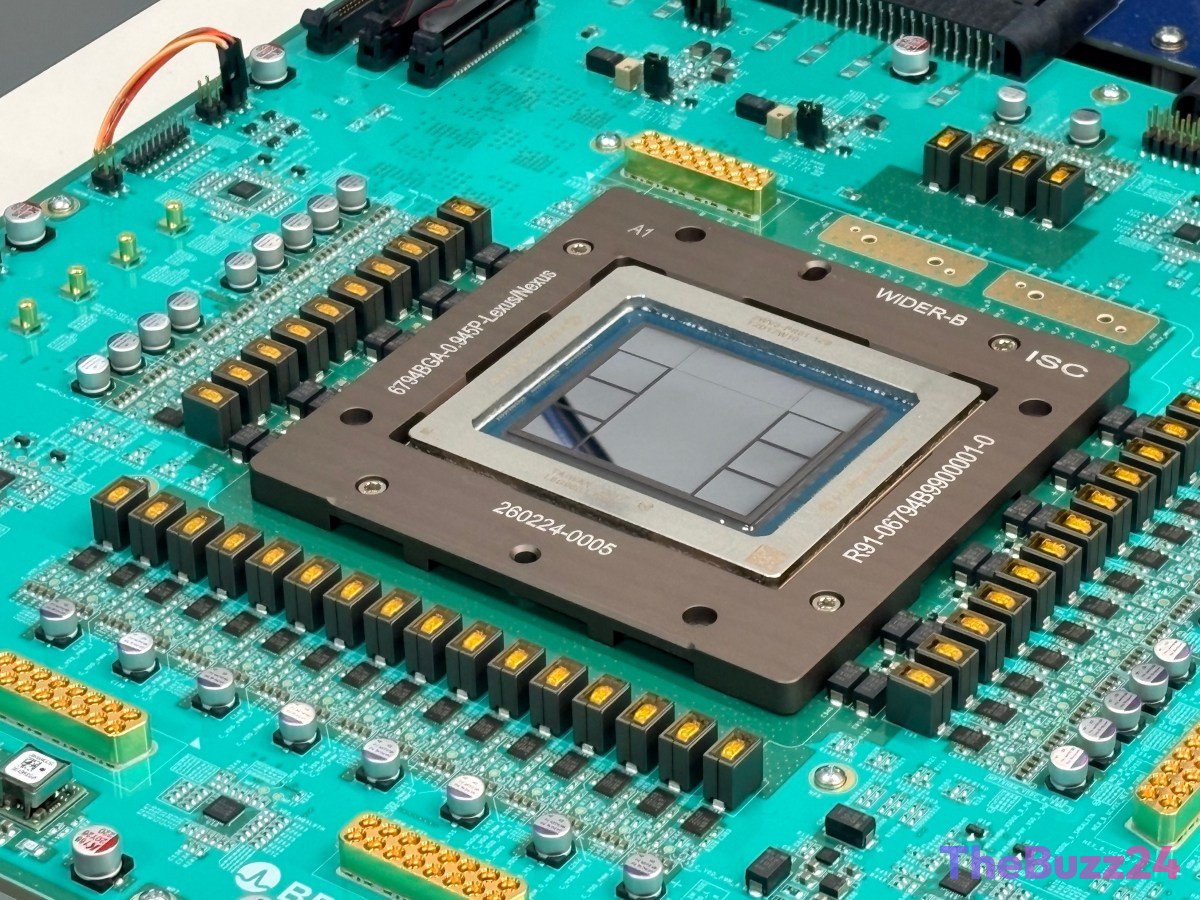
OpenAI’s Custom ‘Jalapeño’ Silicon Promises Massive Leap in AI Inference Efficiency
OpenAI has revealed the first benchmark performance data for its custom-designed artificial intelligence chip, code-named Jalapeño. Engineered specifically to accelerate AI inference at scale, the new processor demonstrated superior performance in early testing, delivering higher token generation rates per user and greater energy efficiency per kilowatt compared to current industry-standard hardware.
Richard Ho, OpenAI’s head of hardware, emphasized that Jalapeño represents a major leap forward in processing power and efficiency. The chip is designed to handle massive AI workloads with minimal power consumption while simultaneously reducing latency for end-users. However, widespread adoption is still several years away. OpenAI projects a limited initial rollout of Jalapeño by late 2026, with larger-scale deployment slated for 2027, by which time competitors like Nvidia will likely have introduced newer architectures beyond their current Blackwell systems.
Developed in close partnership with semiconductor giant Broadcom, Jalapeño represents OpenAI’s shift toward a vertically integrated hardware strategy. Notably, OpenAI utilized its own advanced AI models to assist in the chip’s design process. The company envisions Jalapeño as a multi-generational platform where software models, custom silicon, and memory architectures are co-developed to maximize system synergy.
By adopting a full-stack design approach, OpenAI targeted specific bottlenecks that typically slow down AI inference. Jalapeño is engineered to minimize data movement and communication delays, particularly during the critical prefill phase. By keeping the model state and key-value (KV) cache localized, the chip optimizes the coordination of compute, memory, and networking resources, ensuring faster and more reliable response times.
Key Takeaways
- OpenAI's custom Jalapeño chip outperformed current state-of-the-art processors, including Nvidia's Blackwell, in early inference and energy efficiency benchmarks.
- Developed in collaboration with Broadcom, the chip utilized OpenAI's own AI models during its design phase to create a highly integrated hardware-software ecosystem.
- Initial low-volume deployment of Jalapeño is scheduled for late 2026, with broader scaling expected to roll out in 2027.
Editor’s Analysis & Impact
OpenAI’s foray into custom silicon with Jalapeño highlights a broader industry trend: major AI developers are seeking independence from Nvidia’s near-monopoly on hardware. By co-designing chips with Broadcom and leveraging its own models for development, OpenAI is pursuing a vertical integration strategy reminiscent of Apple’s. This full-stack approach allows OpenAI to optimize hardware specifically for its proprietary models, potentially lowering the massive operational costs associated with running large-scale AI services like ChatGPT. However, the 2026–2027 timeline presents a challenge. By the time Jalapeño is deployed at scale, Nvidia and other competitors will have advanced their architectures by multiple generations. OpenAI’s success will depend on whether its custom software-hardware synergy can outpace the raw hardware advancements of traditional chipmakers.
Frequently Asked Questions
Q: What is OpenAI's Jalapeño chip?
A: Jalapeño is a custom-designed AI inference chip developed by OpenAI in collaboration with Broadcom, engineered to process AI model responses faster and with greater energy efficiency.
Q: How does Jalapeño compare to Nvidia's hardware?
A: In early benchmark tests, Jalapeño demonstrated higher throughput per kilowatt and more tokens per user than Nvidia's current state-of-the-art Blackwell architecture.
Q: When will the Jalapeño chip be deployed?
A: OpenAI plans a very limited initial deployment of the chip in late 2026, with more significant, large-scale deployment expected in 2027.
AI Disclosure: This article is based on verified data and official reports. Our Team and AI have cross-referenced every financial detail with primary sources to ensure total accuracy.
More from this Category