Cosmic Engine Revealed: Scientists Unmask the Power Source of Superluminous Supernovae
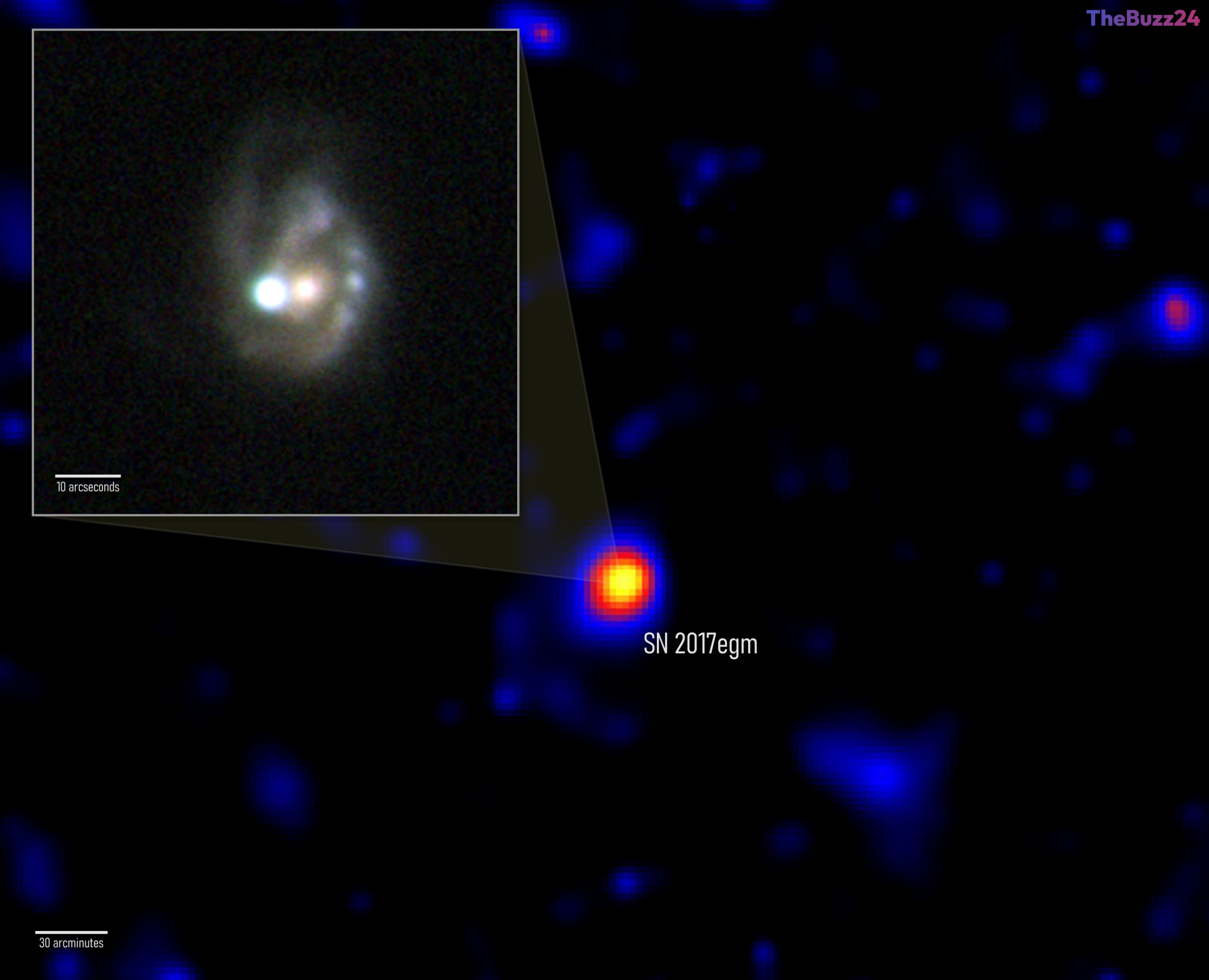
A team of international researchers has successfully identified the mechanism driving some of the universe’s most brilliant stellar explosions. By examining data captured by the Fermi Gamma-ray Space Telescope, scientists have confirmed that a rare, superluminous supernova known as SN 2017egm is powered by the birth of a magnetar—a highly dense neutron star characterized by an exceptionally powerful magnetic field.
Standard core-collapse supernovae occur when massive stars run out of fuel and implode, typically resulting in the formation of a neutron star or a black hole. However, superluminous supernovae are significantly more intense, emitting ten times the visible light of a typical stellar death. For nearly two decades, the scientific community has sought evidence of gamma-ray emissions to explain this extreme brightness. The observation of SN 2017egm, situated 440 million light-years away in the galaxy NGC 3191, has finally provided the definitive data needed to confirm the magnetar model.
The research indicates that the magnetar functions as a central engine, spinning hundreds of times per second. This rapid rotation creates a powerful outflow of electrons and positrons, forming a ‘magnetar wind nebula.’ Within this high-energy environment, gamma rays are generated and then reprocessed into the visible light that gives these explosions their signature brilliance. This mechanism not only explains the initial intensity of the event but also why these supernovae remain visible for much longer than their standard counterparts.
While the magnetar model provides a robust explanation for the initial phases of SN 2017egm, researchers acknowledge that the later stages of the explosion’s decline may involve more complex physical interactions. As technology advances, upcoming ground-based facilities and existing space observatories are expected to provide deeper insights into these cosmic phenomena, potentially unlocking further secrets regarding the most energetic events in the cosmos.
Key Takeaways
- Researchers identified a magnetar as the primary engine behind the extreme brightness of superluminous supernova SN 2017egm.
- The magnetar's rapid rotation creates a 'magnetar wind nebula' that converts high-energy gamma rays into visible light.
- This discovery solves a two-decade-old mystery regarding the mechanism that allows these rare stellar explosions to remain visible for extended periods.
Editor’s Analysis & Impact
The confirmation of the magnetar model for superluminous supernovae represents a significant milestone in high-energy astrophysics. By bridging the gap between theoretical models and observational data, this finding provides a clearer understanding of the life cycles of the most massive stars in the universe. From an industry perspective, this discovery underscores the critical importance of multi-messenger astronomy and the continued investment in space-based observatories like the Fermi Gamma-ray Space Telescope. As we refine our ability to detect and analyze these distant, high-energy events, we gain not only knowledge of stellar evolution but also a better understanding of the fundamental physics governing the universe. Future research will likely focus on the late-stage decay of these explosions, which could reveal even more exotic states of matter.
Frequently Asked Questions
Q: What is a magnetar?
A: A magnetar is a type of neutron star that possesses an extremely powerful magnetic field, which can drive high-energy processes like those observed in superluminous supernovae.
Q: Why are superluminous supernovae different from regular ones?
A: Superluminous supernovae are significantly brighter, emitting up to ten times more visible light than standard stellar explosions, and they often remain visible for a much longer duration.
AI Disclosure: This article is based on verified data and official reports. Our Team and AI have cross-referenced every financial detail with primary sources to ensure total accuracy.
More from this Category