Balancing Progress and Preservation: The Architectural Legacy of Greenbelt, Maryland
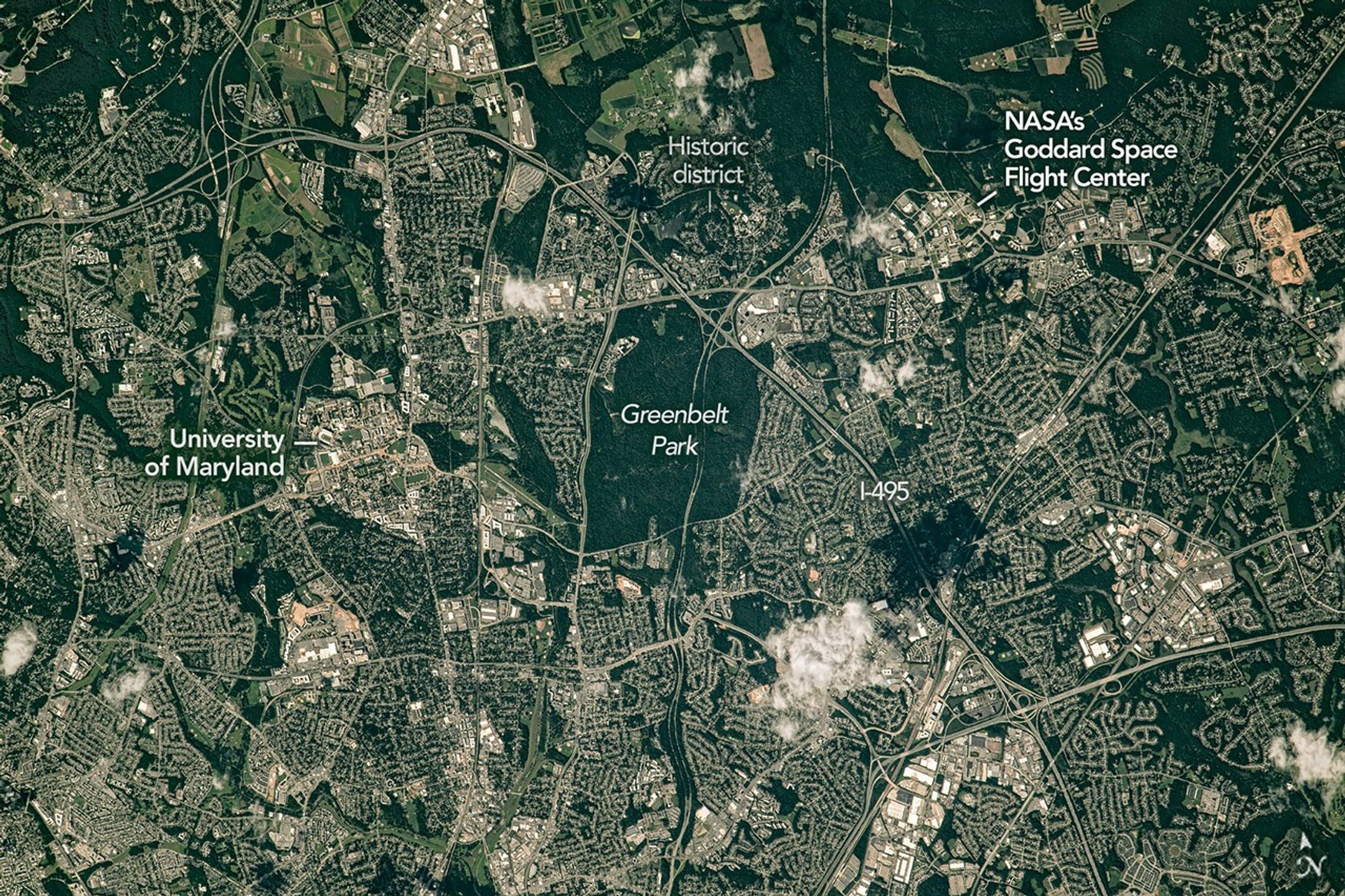
The suburban landscape surrounding the Washington, D.C. metropolitan area serves as a sophisticated example of how dense residential living can coexist with expansive natural preservation. A standout instance of this equilibrium is found in Greenbelt, Maryland, where the northeast corridor of the Capital Beltway (I-495) integrates seamlessly with significant green spaces. This region stands as a testament to mid-20th-century urban planning that successfully merged essential transportation infrastructure with protected environmental zones.
Central to this region’s identity is Greenbelt Park, a massive five-square-kilometer expanse featuring forests, campgrounds, and hiking trails. Originally intended for residential development, the land was preserved by the National Park Service in 1950, ensuring the community would maintain a permanent link to the natural world. This design is deeply rooted in 1930s New Deal-era philosophies, which emphasized cooperative housing models connected by pedestrian-friendly paths and accessible public parks.
Beyond its residential appeal, the Greenbelt corridor functions as a vital hub for global scientific and academic advancement. The area hosts NASA’s Goddard Space Flight Center, the agency’s inaugural spaceflight complex, which is nestled within protective forested buffers. This scientific density is further strengthened by the presence of the University of Maryland in College Park and various agricultural research sites located in nearby Beltsville.
This unique combination of high-level research institutions, academic excellence, and preserved natural corridors creates a distinct regional identity. Through the use of tree-lined thoroughfares like the Baltimore-Washington Parkway, the area demonstrates a long-standing commitment to maintaining environmental connectivity even as the suburbs of the nation’s capital continue to evolve and expand.
Key Takeaways
- Greenbelt, Maryland, serves as a premier example of integrating residential development with large-scale natural preservation.
- The region's layout is heavily influenced by 1930s New Deal urban planning and cooperative housing models.
- The area acts as a critical scientific corridor, housing NASA's Goddard Space Flight Center and the University of Maryland.
Editor’s Analysis & Impact
The Greenbelt model provides a vital blueprint for sustainable suburban development in an era increasingly defined by rapid urban sprawl. By prioritizing the maintenance of ‘green belts’ alongside major transportation arteries like the Capital Beltway, the region has successfully mitigated the environmental degradation typically associated with metropolitan expansion. The strategic integration of high-value intellectual assets—specifically NASA’s Goddard Space Flight Center and the University of Maryland—within these protected ecological zones demonstrates that economic and scientific progress can coexist with environmental stewardship. As modern urban planners face mounting pressure to address climate change and biodiversity loss, the Greenbelt approach of maintaining environmental connectivity through forested buffers and pedestrian-centric design offers a scalable, resilient strategy for creating high-functioning suburban ecosystems that serve both humanity and the natural world.
Frequently Asked Questions
Q: How does Greenbelt maintain its natural character despite being near a major metro area?
A: Greenbelt maintains its natural character through the preservation of Greenbelt Park and the strategic use of forested buffers that protect residential and scientific areas from urban encroachment.
Q: What major scientific institutions are located in the Greenbelt region?
A: The region is a major scientific hub, hosting NASA's Goddard Space Flight Center, the University of Maryland in College Park, and several agricultural research facilities in Beltsville.
AI Disclosure: This article is based on verified data and official reports. Our Team and AI have cross-referenced every financial detail with primary sources to ensure total accuracy.
More from this Category