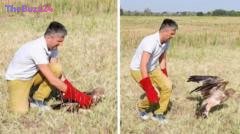
Rare Imperial Eagle Returned to the Wild Following International Rescue Operation
A rare eastern imperial eagle named Feliks has successfully returned to the wild in Serbia following a complex international rescue effort that saved him from animal traffickers. The young raptor was released on Thursday after undergoing months of intensive care and rehabilitation across multiple countries.
Feliks had initially left his nest last year fitted with a satellite tracking device intended for conservation monitoring. While migrating toward the Middle East, his signal disappeared in October. It was soon discovered that he had been captured in Syria by poachers who demanded a monetary ransom for his release. Conservation authorities categorically rejected the demand to prevent funding illegal smuggling networks, opting instead for protracted diplomatic and community negotiations.
Following negotiations, the eagle was safely moved across the Syrian border into Lebanon. He was placed under the care of a wildlife sanctuary in Beirut, where he spent over six months regaining his strength. In June, Serbian peacekeepers returning from a mission escorted the bird aboard a military aircraft back to Serbia. Upon arrival, Feliks was transferred to the shelter at Palic Zoo for daily health checks and final conditioning.
The successful release marks a significant milestone for the conservation of the eastern imperial eagle, a critically endangered species characterized by a six-foot wingspan. Intensive preservation efforts initiated in 2017 have helped rebuild the local population in Serbia from just one breeding pair to 29 pairs this year. Specialists will continue to monitor Feliks closely as he adapts to life in the wild.
Key Takeaways
- A critically endangered eastern imperial eagle named Feliks was released back into the wild in Serbia after being saved from animal traffickers.
- Conservationists refused ransom demands to avoid incentivizing poachers, successfully negotiating the bird's transfer through Lebanon instead.
- Targeted conservation programs have expanded Serbia's eastern imperial eagle population from a single pair in 2017 to 29 pairs today.
Editor’s Analysis & Impact
The successful recovery and release of Feliks underscore both the vulnerabilities facing migratory birds in unstable regions and the crucial role of global conservation cooperation. By firmly refusing to pay ransom demands, wildlife organizations established a vital precedent against the commercialization of poached animals, preventing the financial encouragement of illegal trafficking operations. Furthermore, the multi-stage rescue—involving cross-border coordination, sanctuary support, and military transport—demonstrates how multi-agency partnerships can resolve high-stakes wildlife crises. The broader rebound of Serbia’s eastern imperial eagle population from one pair to 29 in less than a decade proves that structured habitat management and species monitoring can yield remarkable ecological recoveries, even for critically endangered apex predators.
Frequently Asked Questions
Q: Why did conservationists refuse to pay a ransom for the eagle?
A: Paying ransom demands directly supports and incentivizes illegal smuggling chains. Refusing payment prevents traffickers from profiting while protecting future wildlife populations from similar capture.
Q: How did the eagle return to Serbia from the Middle East?
A: After being transported from Syria to a wildlife center in Beirut, Lebanon, Feliks was flown back to Serbia aboard a military aircraft accompanied by returning peacekeepers.
Q: What is the current status of the eastern imperial eagle in Serbia?
A: The species is critically endangered, but active conservation measures since 2017 have helped the Serbian population grow from just one pair to 29 pairs.
AI Disclosure: This article is based on verified data and official reports. Our Team and AI have cross-referenced every financial detail with primary sources to ensure total accuracy.
More from this Category