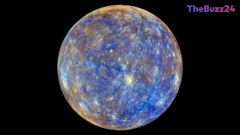
BepiColombo Spacecraft Nears Mercury After Epic Eight-Year Journey Across Six Billion Miles
Following an arduous eight-year trek spanning nearly six billion miles through the inner solar system, the joint European and Japanese space mission BepiColombo is preparing to insert itself into orbit around Mercury. The probe faces one of the most punishing environments in space, where temperatures swing wildly between a scorching 430 degrees Celsius during the day and a frigid minus 180 degrees Celsius at night, all while exposed to intense solar radiation. Entering orbit requires a high-stakes, 37-minute braking maneuver; any failure during this precise burn could cause the spacecraft to shoot past the planet entirely into deep space.
Launched in 2018 from French Guiana, the mission represents a collaborative venture between the European Space Agency and the Japan Aerospace Exploration Agency. To overcome the Sun’s immense gravitational pull, BepiColombo executed a complex, multi-year flight path involving nine planetary flybys—one around Earth, two around Venus, and six around Mercury itself. Although initially planned as a seven-year voyage, an unexpected issue with the spacecraft’s ion propulsion system extended the transit by a year. Once safely in orbit, the mission will separate into two distinct probes: an European orbiter tasked with high-resolution surface mapping and a Japanese probe dedicated to studying Mercury’s magnetic field and surrounding environment.
Scientists anticipate that data gathered by BepiColombo will resolve long-standing puzzles surrounding the innermost planet, which has only been visited by two previous robotic missions. Among the key mysteries are deep polar craters that manage to preserve water ice despite proximity to the Sun, as well as thousands of geologically young, steep-sided hollows scattered across the surface. Researchers also hope to explain Mercury’s unusually large iron core relative to its thin crust, testing hypotheses that the planet suffered catastrophic ancient collisions that stripped away its outer layers or that it formed in a particularly metal-dense region of the early solar system.
Key Takeaways
- BepiColombo is arriving at Mercury after an eight-year journey covering nearly six billion miles.
- The joint ESA-JAXA spacecraft must execute a critical 37-minute burn to capture into Mercury's orbit.
- The mission will deploy two separate probes to investigate Mercury's surface ice, mysterious hollows, and unusually large metallic core.
Editor’s Analysis & Impact
The arrival of BepiColombo at Mercury marks a major technological triumph and opens a vital chapter in planetary science. Navigating the severe thermal conditions and gravitational dynamics near the Sun represents the apex of modern aerospace engineering. Scientifically, Mercury serves as a crucial piece in the puzzle of solar system formation; understanding its massive core and thin mantle could fundamentally alter planetary collision models and early accretion theories. Furthermore, the successfully executed long-duration mission highlights the power of international collaboration in space exploration. If BepiColombo successfully separates its twin probes and operates in this extreme climate, it will set a new operational benchmark for future inner-system missions to high-radiation zones.
Frequently Asked Questions
Q: Why did BepiColombo take eight years to reach Mercury?
A: Travelling toward the center of the solar system requires slowing down against the Sun's powerful gravitational pull. BepiColombo used continuous electric propulsion and nine complex gravity-assist flybys around Earth, Venus, and Mercury, alongside a one-year delay caused by a propulsion technical issue, to safely match Mercury's orbit.
Q: What happens after the spacecraft enters Mercury's orbit?
A: A few weeks after entering orbit, BepiColombo will split into two separate probes: a European orbiter focused on close-up surface analysis and a Japanese orbiter designed to study Mercury's magnetosphere and surrounding space from a higher altitude.
Q: How can water ice exist on a planet so close to the Sun?
A: Water ice persists inside deep, permanently shadowed craters at Mercury's poles. Because the planet has virtually no atmospheric heat redistribution and very low tilt, these deep crater floors never see sunlight and remain permanently at freezing temperatures below minus 180 degrees Celsius.
AI Disclosure: This article is based on verified data and official reports. Our Team and AI have cross-referenced every financial detail with primary sources to ensure total accuracy.
More from this Category