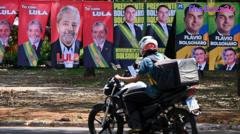
Brazil Heads to High-Stakes Presidential Run-Off as Flávio Bolsonaro Leads First Round
Brazil is preparing for a highly polarized presidential run-off election on October 25 after right-wing candidate Flávio Bolsonaro secured a surprising lead over incumbent left-wing President Luiz Inácio Lula da Silva in the first round of voting. While Bolsonaro captured 47.03% of the vote compared to Lula’s 45.16%, neither candidate secured the absolute majority required to win outright. The outcome has set the stage for a tense three-week campaign in Latin America’s largest economy, with the political future of the nation hanging in the balance.
Flávio Bolsonaro, the eldest son of former President Jair Bolsonaro—who is currently serving a 27-year prison sentence for his role in a failed 2022 coup attempt—exceeded pre-election polling expectations. His strong performance was bolstered by down-ballot successes for his Liberal Party (PL), which secured the largest representation in Congress and won numerous gubernatorial races. Flávio Bolsonaro has campaigned on a platform of fiscal conservatism, promising public debt ceilings, spending cuts, and an amnesty for his father and those involved in the January 8, 2023, government building riots.
In contrast, President Lula, seeking a fourth non-consecutive term, has framed the election as a critical choice between democratic stability and “barbarism.” Lula’s campaign has heavily emphasized his legacy of social welfare initiatives, such as the Bolsa Família program, which has historically lifted millions out of poverty. However, his administration faces headwinds from a slowing economy, high personal debt levels, and a complex security landscape. While Lula has focused on targeting the financial networks of organized crime, Bolsonaro has proposed aggressive security measures, including designating domestic gangs as terrorist organizations and constructing El Salvador-style maximum-security prisons.
The election also carries significant geopolitical weight, particularly regarding Brazil’s relationship with the United States. Lula has previously raised concerns over potential foreign interference, while a Bolsonaro victory could align Brazil closely with Washington’s “Shield of Americas” anti-narcotics coalition. Additionally, both campaigns have had to navigate the fallout of a massive financial fraud scandal involving jailed banker Daniel Vorcaro, which has cast a shadow over figures across the political spectrum. As the October 25 run-off approaches, both candidates are scrambling to win over moderate voters in what promises to be a historic showdown.
Key Takeaways
- Flávio Bolsonaro led the first round of Brazil's presidential election with 47.03% of the vote, forcing a run-off against incumbent President Lula da Silva, who secured 45.16%.
- The right-wing Liberal Party (PL) achieved significant victories in congressional and gubernatorial races, positioning them for substantial legislative influence.
- Key campaign battlegrounds leading into the October 25 run-off include economic policy, rising street crime, corruption scandals, and Brazil's future geopolitical alignment with the United States.
Editor’s Analysis & Impact
The stronger-than-expected performance of Flávio Bolsonaro and the Liberal Party (PL) signals a robust right-wing resurgence in Brazil, mirroring broader political shifts across Latin America. For investors and markets, a potential Bolsonaro victory promises market-friendly policies, including public spending cuts and support for the critical minerals sector, which could boost fiscal confidence. However, it also risks heightened political volatility given his pledge to grant amnesty to those involved in the 2023 riots. Conversely, a Lula victory would preserve social safety nets but face a highly hostile, conservative-dominated Congress, likely leading to legislative gridlock. Regardless of the winner, Brazil’s economic trajectory will be defined by how the next administration balances fiscal discipline with pressing social demands and security challenges.
Frequently Asked Questions
Q: Why is there a second round of voting in Brazil's presidential election?
A: Under Brazilian election law, a presidential candidate must win an absolute majority (over 50%) of the vote in the first round to win outright. Since Flávio Bolsonaro secured 47.03% and Lula da Silva received 45.16%, a run-off election is required between the top two candidates.
Q: What are the main differences in the economic platforms of the two candidates?
A: President Lula da Silva focuses on social welfare programs like Bolsa Família to alleviate poverty, alongside state-supported infrastructure and environmental protections. Flávio Bolsonaro advocates for fiscal austerity, government spending cuts, a public debt ceiling, and boosting the critical minerals sector.
Q: How could this election impact Brazil's relationship with the United States?
A: A victory for Flávio Bolsonaro would likely align Brazil closer to the U.S., potentially joining regional security initiatives like the 'Shield of Americas' coalition. Under Lula, relations have been more complex, with the incumbent president emphasizing national sovereignty and occasionally accusing the U.S. of electoral interference.
AI Disclosure: This article is based on verified data and official reports. Our Team and AI have cross-referenced every financial detail with primary sources to ensure total accuracy.
More from this Category