Brazil’s Shifting Sands: The Paradoxical Oasis of Lençóis Maranhenses National Park
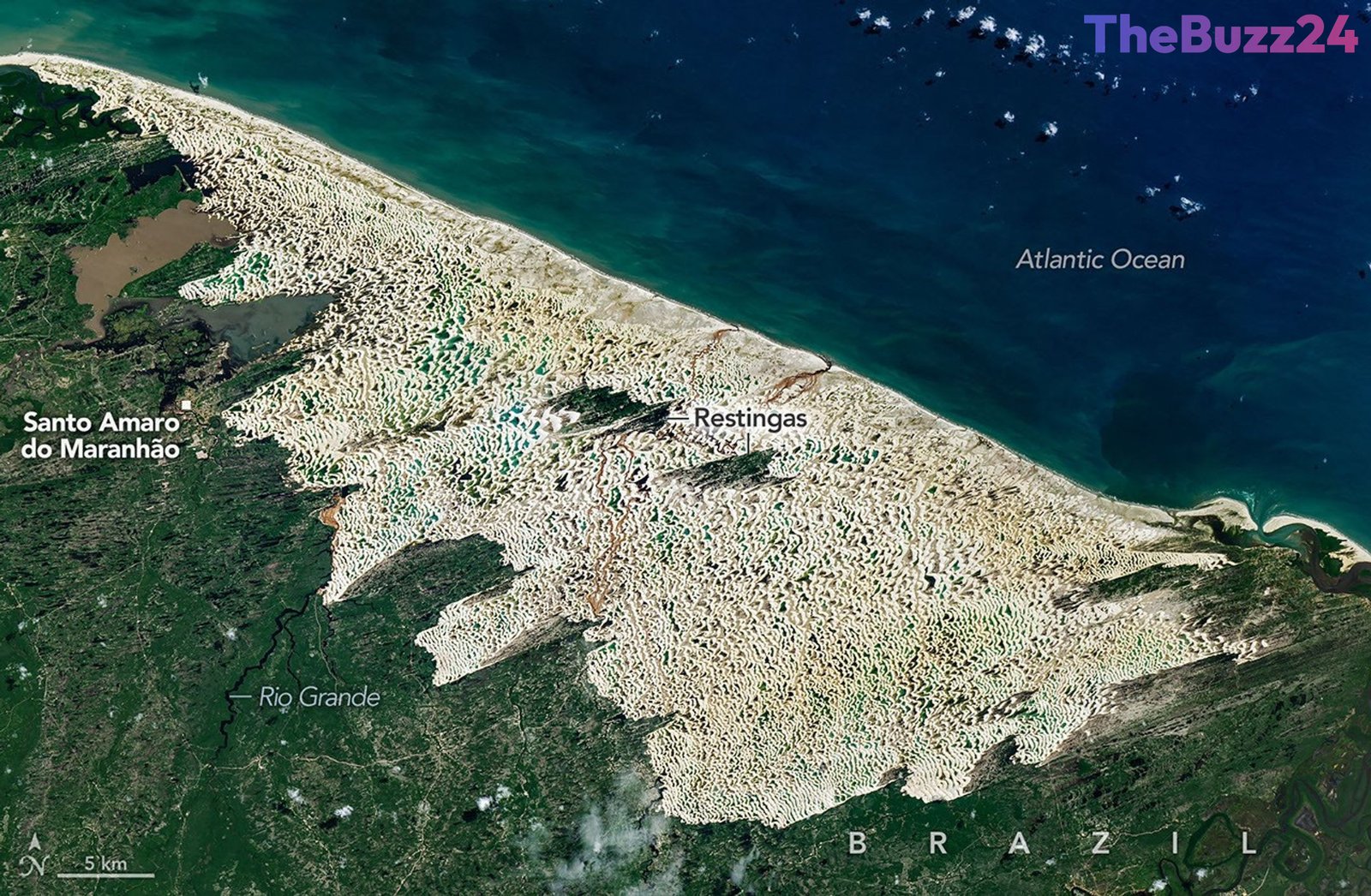
Lençóis Maranhenses National Park in northeastern Brazil presents one of Earth’s most surreal and paradoxical landscapes. While appearing as a vast desert of sparkling white quartz dunes, the region receives approximately 125 centimeters (50 inches) of rain annually—more than cities like Seattle or London. This abundant rainfall transforms the troughs between the towering dunes, some reaching 30 meters (100 feet), into a breathtaking mosaic of blue and green freshwater lagoons. The park’s name, derived from the Portuguese word ‘lençóis’ meaning ‘bedsheets,’ aptly describes the sweeping curves of this immense coastal dune field when viewed from above, resembling a rumpled, white linen expanse.
The formation of these ephemeral lagoons is a testament to unique geological conditions. Beneath the shifting sands lies a partially impermeable layer of bedrock and clay, which prevents the rainwater from draining away during the wet season. Water levels typically peak around June, creating hundreds of interconnected pools. However, as the rains subside between August and November, the water table drops, and by December, most of these vibrant lagoons recede, leaving behind dry basins until the next rainy cycle. Winds predominantly from the northeast continuously sculpt the dunes, pushing them westward at rates of roughly 4 to 25 meters per year, a dynamic process that prevents widespread vegetation establishment across the dune field.
Spanning about 900 square kilometers (350 square miles)—roughly the size of New York City—the dune field is the park’s centerpiece. The lagoons exhibit a spectrum of colors; shallower pools often appear light blue, turquoise, or aquamarine as sunlight reflects off the sand, while deeper lagoons take on darker blue hues due to water absorbing more light wavelengths. Suspended sediment, microscopic algae, and dissolved organic matter further contribute to an array of green and brown tones. The dune field is uniquely situated at the confluence of three Brazilian biomes: the Amazon rainforest to the west, the tropical wooded savannas of the Cerrado to the south, and the dry shrublands of the Caatinga to the east, with mangroves and restinga forests thriving closest to the coast.
This extraordinary landscape is a result of a rare convergence of geological and climatic factors. Rivers like the Mearim and Parnaíba continuously deposit massive quantities of quartz sand onto this unusually flat stretch of the Maranhão coastline. Over hundreds of thousands of years, fluctuating sea levels and persistent easterly trade winds have accumulated and shaped these dunes. Satellite imagery, such as that from Landsat, has tracked the westward expansion of the dune field by about 0.5 kilometers in some areas between 1986 and 2026, showcasing the relentless movement of sand.
In 2024, UNESCO recognized Lençóis Maranhenses National Park as a World Heritage site, acknowledging its remarkable geology and rich biodiversity. The park is a sanctuary for over 850 documented species, including fish, birds, reptiles, and mammals. Among its inhabitants are four endangered species: the neotropical otter, West Indian manatee, scarlet ibis, and oncilla. The lagoons are also home to the fascinating trahira (Hoplias malabaricus), a predatory fish known for its canine-like teeth, which burrows into damp mud and enters a dormant state during the dry season, re-emerging with the rains to hunt.
Key Takeaways
- Lençóis Maranhenses National Park in Brazil is a unique landscape of white sand dunes and freshwater lagoons, despite its desert-like appearance, due to high annual rainfall.
- The lagoons form seasonally, peaking in the wet season and drying up in the dry season, supported by an impermeable bedrock layer beneath the shifting quartz dunes.
- Recognized as a UNESCO World Heritage site in 2024, the park boasts significant biodiversity, including several endangered species and unique aquatic life adapted to its extreme conditions.
Editor’s Analysis & Impact
The designation of Lençóis Maranhenses National Park as a UNESCO World Heritage site significantly elevates its global profile, promising a boost to ecotourism in the region. This recognition will likely attract more visitors, creating economic opportunities for local communities through hospitality, guiding services, and artisanal crafts. However, it also underscores the critical need for sustainable tourism management to protect the park’s delicate ecosystem from increased human impact. From a broader perspective, the park serves as a powerful natural laboratory for studying the complex interplay of geology, climate, and biodiversity. Its unique hydrological cycle and dynamic dune system offer insights into environmental resilience and adaptation, particularly relevant in an era of climate change. Future outlook involves balancing conservation efforts with responsible development, ensuring the long-term preservation of this extraordinary natural wonder for both scientific study and public enjoyment.
Frequently Asked Questions
Q: What makes Lençóis Maranhenses National Park unique?
A: It's a paradoxical landscape in northeastern Brazil featuring vast white sand dunes interspersed with thousands of freshwater lagoons. Despite its desert-like appearance, it receives significant annual rainfall, which fills the depressions between the dunes.
Q: How do the lagoons form and why do they disappear?
A: The lagoons form during the rainy season when water collects in the troughs between dunes, prevented from draining by an impermeable layer of bedrock and clay beneath the sand. They typically dry up during the dry season as the water table falls, only to reappear with the next rains.
Q: What is the significance of the park's UNESCO World Heritage status?
A: Declared a World Heritage site in 2024, this status recognizes the park's remarkable geology and rich biodiversity, including several endangered species. It helps promote its conservation, sustainable management, and global recognition as a natural treasure.
AI Disclosure: This article is based on verified data and official reports. Our Team and AI have cross-referenced every financial detail with primary sources to ensure total accuracy.
More from this Category