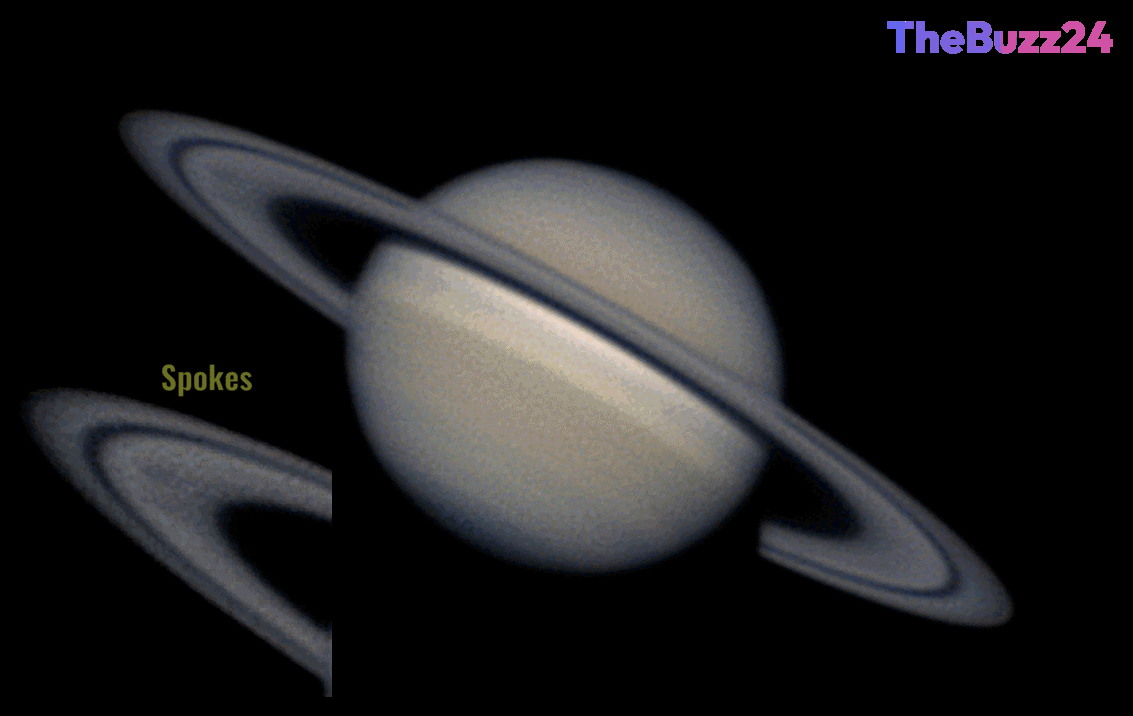
Unraveling the Ghostly Spokes of Saturn’s B Ring
Saturn, the solar system’s ringed jewel, continues to captivate astronomers with its enigmatic features. Among its many mysteries are the transient “spokes” that periodically appear and disappear within its prominent B ring. Recent observations, including a nearly two-hour timelapse capturing a significant portion of Saturn’s 10-hour day, have provided further insights into these elusive phenomena, revealing subtle, ghoulish shadows that emerge and fade as the B ring rotates.
Decades of meticulous observation from missions like Voyager 2, Cassini, and the Hubble Space Telescope have confirmed that the appearance of these spokes is not constant but varies significantly with Saturn’s seasons. Similar to Earth, Saturn’s spin axis is tilted relative to its orbital plane around the Sun. During the planet’s equinoxes, when the rings are less tilted away from the Sun, they receive a more evenly distributed influx of sunlight and solar wind, which appears to correlate with changes in spoke activity.
While their precise origin remains a subject of ongoing scientific inquiry, the prevailing hypothesis suggests that Saturn’s spokes are likely formed by electromagnetic interactions. It is believed that the solar wind, interacting with Saturn’s powerful magnetic field, creates an electrical charge that levitates dust and ice particles above the ring plane. These levitating particles then cast shadows or reflect light, creating the ghostly spoke-like patterns observed from Earth and by spacecraft. The continued study of these features offers a unique window into the complex dynamics governing planetary rings and their interactions with the space environment.
Key Takeaways
- Mysterious, transient "spokes" are observed within Saturn's B ring, appearing as subtle, ghoulish shadows.
- The visibility and appearance of these spokes are strongly linked to Saturn's seasons, influenced by the planet's axial tilt and interaction with solar wind.
- Scientists hypothesize that the spokes are formed by electromagnetic interactions between the solar wind and Saturn's magnetic field, causing dust and ice particles to levitate above the ring plane.
Editor’s Analysis & Impact
The ongoing study of Saturn’s spokes represents a fascinating frontier in planetary science, offering crucial insights into the complex interplay between a planet’s magnetic field, its rings, and the solar wind. While not directly impacting commercial markets, advancements in understanding these phenomena contribute significantly to our broader knowledge of solar system dynamics and exoplanetary systems. Future missions and improved observational technologies will likely refine our models, potentially revealing new physics at play. This research inspires public interest in space exploration and encourages STEM education, fostering the next generation of scientists and engineers who will continue to unravel the universe’s mysteries.
Frequently Asked Questions
Q: What are Saturn's spokes?
A: Saturn's spokes are mysterious, transient features that appear as dark or bright radial patterns within the planet's B ring. They are not solid structures but rather temporary formations that emerge and fade over hours.
Q: Why do Saturn's spokes appear and disappear?
A: The appearance and disappearance of Saturn's spokes are strongly linked to the planet's seasons. They are more prominent around Saturn's equinoxes, when the rings are less tilted relative to the Sun, suggesting an influence from solar wind and sunlight distribution.
Q: What causes Saturn's spokes, according to current theories?
A: The leading theory suggests that Saturn's spokes are caused by electromagnetic interactions. The solar wind interacts with Saturn's magnetic field, creating an electrical charge that levitates fine dust and ice particles above the ring plane, which then cast shadows or reflect light to form the visible spoke patterns.
AI Disclosure: This article is based on verified data and official reports. Our Team and AI have cross-referenced every financial detail with primary sources to ensure total accuracy.
More from this Category