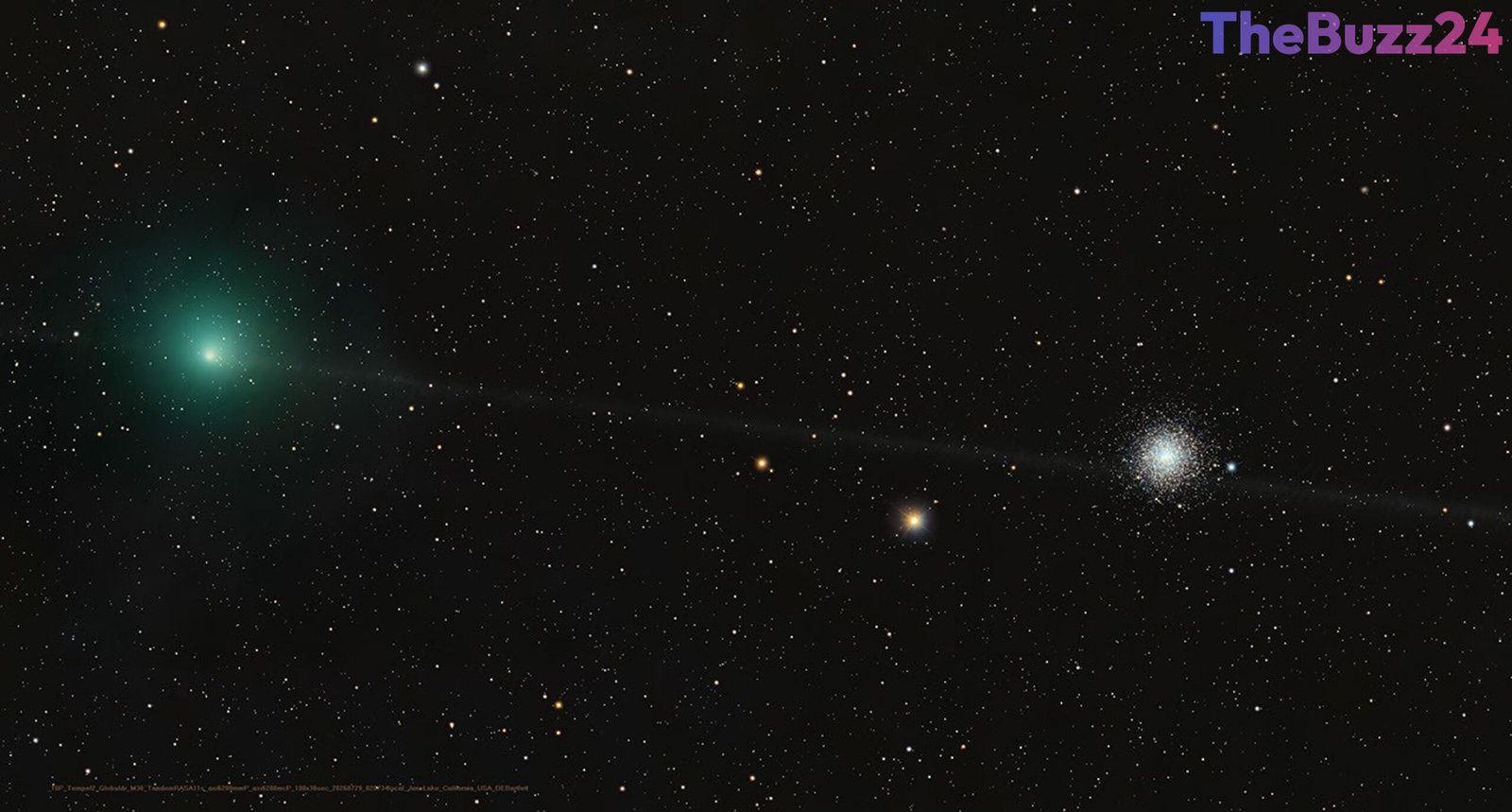
Celestial Alignment: Comet Tempel 2 Passes Near Globular Cluster M30
A striking astronomical event was captured on July 29, 2026, featuring a rare visual alignment between the periodic comet 10P/Tempel 2 and the globular star cluster Messier 30 (M30). The telescopic image highlights the distinct visual contrast between the comet’s diffuse, greenish coma and the dense, ancient collection of stars that makes up M30.
While the two objects appear to overlap from our perspective on Earth, the reality of their positioning is vastly different. The comet, currently on its periodic journey through our solar system, was situated just 3.5 light-minutes away from the observer. In stark contrast, the globular cluster M30 resides approximately 28,000 light-years away, making the visual intersection a matter of cosmic coincidence rather than physical proximity.
The pairing serves as a modern reminder of the challenges faced by 18th-century astronomer Charles Messier. Messier famously compiled his catalog of nebulae and star clusters specifically to distinguish these stationary, fuzzy objects from the moving comets he was actively hunting. Even with modern technology, the two objects can appear remarkably similar in a telescope’s field of view, underscoring why Messier’s historical classification remains a foundational tool for amateur and professional astronomers alike.
Key Takeaways
- Periodic comet 10P/Tempel 2 was photographed in a rare visual alignment with the globular cluster Messier 30.
- Despite appearing to overlap in the sky, the comet is only 3.5 light-minutes away, while M30 is 28,000 light-years distant.
- The observation highlights the historical significance of the Messier Catalogue, which was created to help astronomers differentiate between stationary deep-sky objects and moving comets.
Editor’s Analysis & Impact
This celestial event provides a compelling intersection of historical astronomy and modern imaging capabilities. The ‘Messier Moment’ serves as an educational bridge, reminding the public of the foundational work done by early astronomers to map the night sky. From a scientific perspective, such alignments are highly valued for their ability to engage the public in observational astronomy. As imaging technology continues to advance, the ability to capture high-resolution data of transient objects like 10P/Tempel 2 against static deep-sky backgrounds allows for better tracking of orbital dust trails and cometary behavior. The broader implication is the continued democratization of space observation, where high-quality amateur photography contributes to the collective understanding and appreciation of our universe’s vast, yet interconnected, nature.
Frequently Asked Questions
Q: Why did Charles Messier create his famous catalog?
A: Charles Messier created his catalog to list 'fuzzy' objects in the sky that were not comets, allowing him and other astronomers to avoid confusing these stationary star clusters and nebulae with the moving comets they were searching for.
Q: Are the comet and the star cluster actually close to each other in space?
A: No. The alignment is purely a visual effect from our perspective on Earth. The comet is only 3.5 light-minutes away, while the globular cluster M30 is located 28,000 light-years away.
AI Disclosure: This article is based on verified data and official reports. Our Team and AI have cross-referenced every financial detail with primary sources to ensure total accuracy.
More from this Category