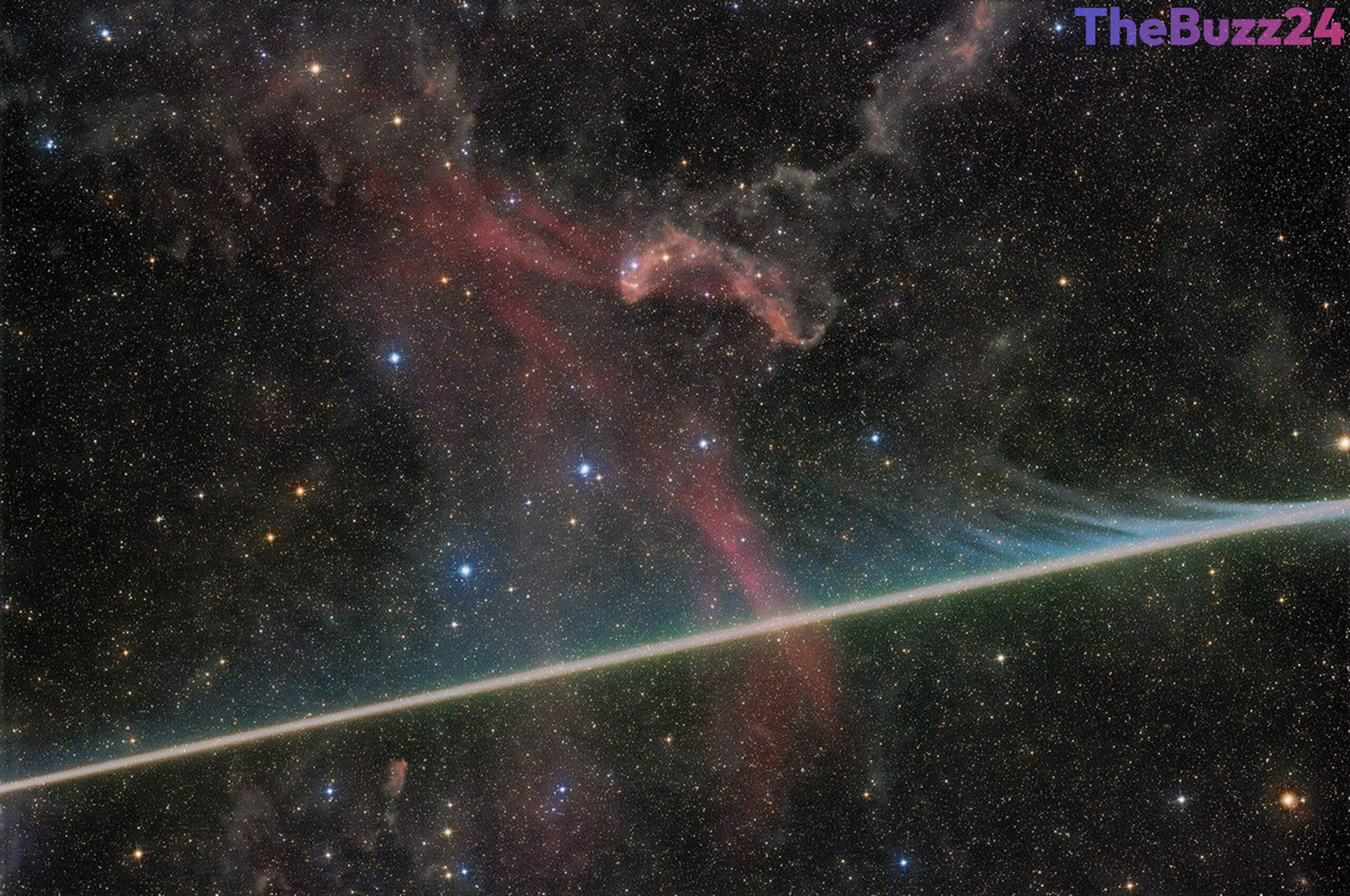
Celestial Photobomb: Meteor Streak Captured Against the Great Lacerta Nebula
A striking astronomical image captured last month from the Death Valley Observatories in Nevada has provided a rare look at a meteor streak intersecting the faint, red glow of the Great Lacerta Nebula. The image, taken during a long-exposure session, highlights the dramatic moment a small meteoroid—likely no larger than a pebble—entered Earth’s atmosphere and vaporized. The resulting streak of light is a product of the object heating and exciting the surrounding air, leaving behind a trail of gas and dust that offers scientists valuable data regarding its chemical composition.
This celestial event occurs as the night sky enters a period of heightened meteor activity. Currently, three distinct meteor showers are active, though their visibility is somewhat hampered by the illumination of a bright gibbous Moon. Astronomers note that conditions are expected to improve significantly in the coming days as the lunar cycle progresses.
Observers are particularly anticipating the peak of the Perseids meteor shower, which is expected to reach its maximum intensity in approximately ten days. This year’s event is highly anticipated, as the peak coincides with a new Moon, providing optimal dark-sky conditions for viewing. In some regions, this timing will also align with a solar eclipse, marking a rare and significant moment for stargazers and researchers alike.
Key Takeaways
- A long-exposure photograph from Death Valley captured a meteor streak passing in front of the Great Lacerta Nebula.
- The meteor's glow is caused by the vaporization of a small object as it interacts with Earth's atmosphere, leaving a trail that reveals its composition.
- The upcoming Perseids meteor shower is expected to peak in about 10 days under ideal dark-sky conditions due to a new Moon.
Editor’s Analysis & Impact
The capture of transient phenomena like meteor streaks against deep-space objects such as the Lacerta Nebula underscores the increasing sophistication of amateur and semi-professional astrophotography. By utilizing long-exposure techniques, observers are able to document the intersection of atmospheric events and distant galactic structures, providing both aesthetic value and scientific interest. The upcoming Perseids peak represents a significant opportunity for public engagement with astronomy. As light pollution continues to be a challenge for urban observers, the coincidence of a new Moon provides a rare window for high-quality data collection and public education. This event highlights the importance of maintaining dark-sky preserves, such as those in Death Valley, which remain critical for both professional research and the broader astronomical community’s ability to monitor near-Earth objects and atmospheric phenomena.
Frequently Asked Questions
Q: What causes the glow seen in a meteor streak?
A: The glow is created when a meteoroid enters Earth's atmosphere at high speed, heating and exciting the surrounding air molecules, while the object itself vaporizes.
Q: Why is the upcoming Perseids meteor shower expected to be particularly good for viewing?
A: The peak of the Perseids this year coincides with a new Moon, which means there will be minimal moonlight to interfere with the visibility of the meteors, allowing for much darker skies.
AI Disclosure: This article is based on verified data and official reports. Our Team and AI have cross-referenced every financial detail with primary sources to ensure total accuracy.
More from this Category