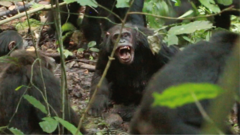
Blood Feud in the Forest: The Violent Fracture of Uganda’s Largest Chimpanzee Community
The once-stable social order of the Ngogo chimpanzee community in Uganda’s Kibale National Park has descended into a period of intense, lethal conflict. For decades, this massive population of nearly 200 chimpanzees functioned as a single, cohesive unit. However, recent observations reveal a devastating shift, as the community has fractured into two warring factions: the Western and Central groups. This division has transformed former allies into mortal enemies engaged in a brutal struggle for dominance.
Since the formal split in 2018, the violence has taken a heavy toll on the population. Researchers have documented at least 24 targeted killings, a figure that includes seven adult males and a heartbreaking 17 infants. This surge in aggression marks a radical departure from the group’s historical behavior, which was characterized by cooperative social activities such as grooming and collective patrolling.
Experts believe several converging factors have fueled this instability. The loss of influential individuals who previously served as social mediators, a shift in alpha male leadership, and the lingering effects of a 2017 respiratory epidemic appear to have dismantled the community’s social infrastructure. The epidemic, in particular, may have weakened the group’s ability to maintain the bonds that once prevented large-scale conflict.
This ongoing phenomenon provides scientists with a rare opportunity to study the evolutionary roots of group-based warfare. By observing how a highly social species transitions from cooperation to lethal territoriality, researchers hope to better understand the biological and social drivers of conflict. The situation in Kibale serves as a stark reminder of how quickly social cohesion can evaporate when the underlying structures of a community are compromised.
Key Takeaways
- The Ngogo chimpanzee community has split into two warring factions: the Western and Central groups.
- At least 24 chimpanzees, including 17 infants and 7 adult males, have been killed in territorial disputes since 2018.
- The conflict is attributed to leadership changes, the loss of social mediators, and a previous respiratory epidemic.
Editor’s Analysis & Impact
The breakdown of the Ngogo community offers a profound look into the fragility of social structures. While many view primate behavior through the lens of simple instinct, this case suggests that complex social ‘infrastructure’—the relationships and mediators that maintain peace—is just as vital as physical resources. The loss of key individuals who acted as social bridges likely created a vacuum that new, more aggressive leadership filled. This study is critical for understanding how environmental stressors, such as the 2017 epidemic, can act as catalysts for long-term social decay. For the scientific community, this provides a rare, real-time window into the evolutionary mechanics of group-based warfare, illustrating how quickly cooperation can devolve into lethal territoriality when the social fabric is torn.
Frequently Asked Questions
Q: What triggered the split in the Ngogo chimpanzee community?
A: The split was likely caused by a combination of shifts in alpha male leadership, the loss of key individuals who acted as social mediators, and the impact of a 2017 respiratory epidemic.
Q: How many chimpanzees have died due to this conflict?
A: Since the official split in 2018, at least 24 chimpanzees have been killed, including seven adult males and 17 infants.
AI Disclosure: This article is based on verified data and official reports. Our Team and AI have cross-referenced every financial detail with primary sources to ensure total accuracy.
More from this Category