AI Breakthrough: New Model Predicts Solar Storms Hours Before Emergence
As humanity sets its sights on deeper space exploration, the ability to accurately predict space weather – conditions primarily driven by the Sun – has become paramount. A team of astrophysicists and data scientists from NASA’s COFFIES (Consequence Of Fields and Flows in the Interior and Exterior of the Sun) has achieved a significant breakthrough, developing a novel machine-learning model capable of predicting the emergence of active regions on the Sun up to 12 hours before they become visible.
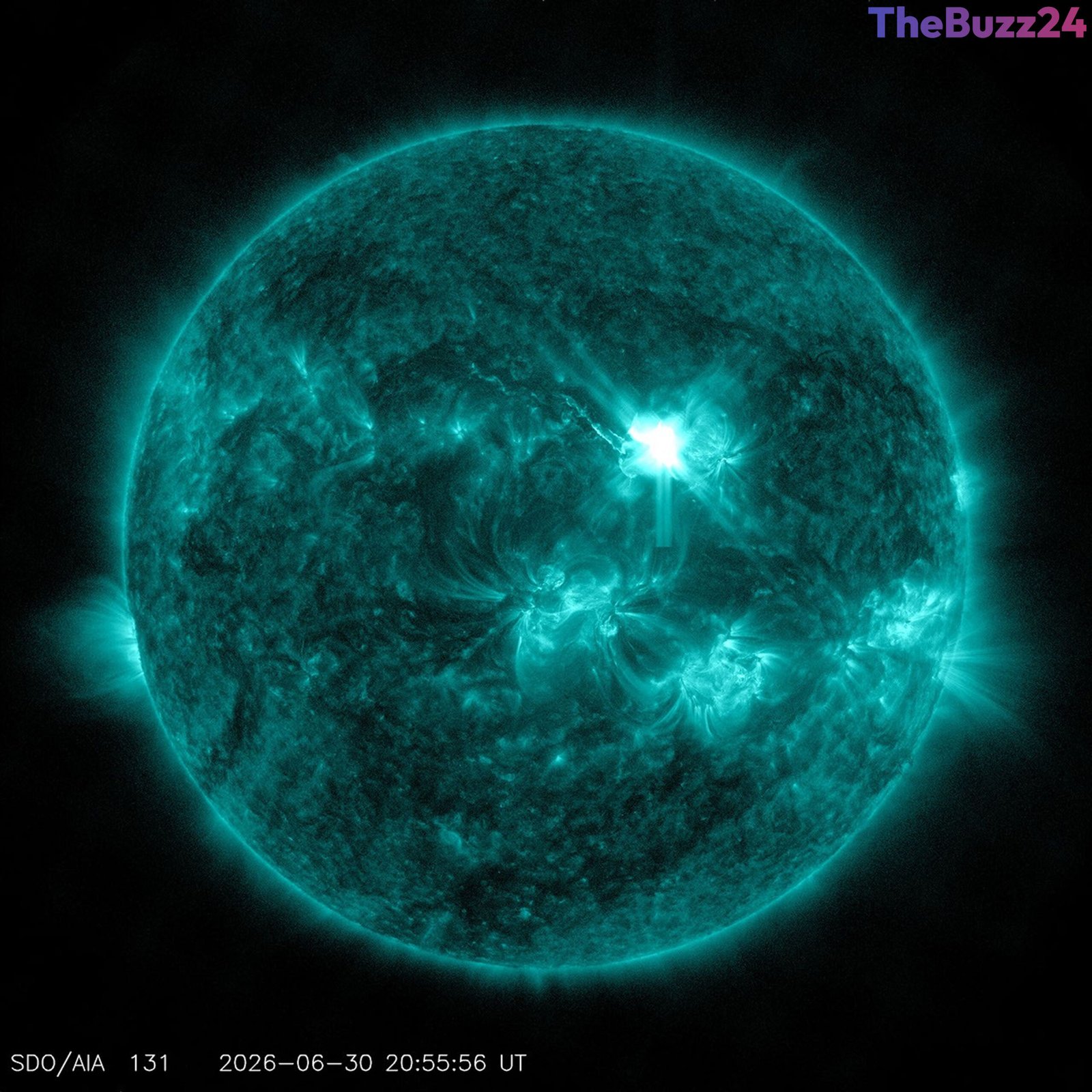
The Sun is a dynamic star, constantly churning with intense concentrations of localized magnetic fields that can suddenly break through its surface, forming sunspots. These sunspots are visible indicators of active regions, which are the primary drivers of severe space weather events such as solar flares and coronal mass ejections (CMEs). Such eruptions unleash high-energy radiation and charged particles across space, creating storms that pose threats to astronauts, can disable satellites, and disrupt critical radio communications on Earth. The COFFIES team, a collaborative effort involving researchers from New Jersey Institute of Technology (NJIT), Princeton University, and NASA’s Ames Research Center, leveraged advanced artificial intelligence architectures and data from the agency’s Solar Dynamics Observatory. Their approach analyzes subtle fluctuations in acoustic waves and magnetic fields caused by sunspot regions as they form beneath the solar surface and begin their ascent.
Unlike traditional methods that monitor active regions once they are already visible, this new AI model employs a specialized “sliding-window transformer architecture” to detect tiny reductions in the Sun’s acoustic activity and magnetic field – signals previously difficult for scientists to capture. By focusing on recent data within a moving window across a long timeline of solar activity, the model identifies patterns that predict emerging active regions hours before they surface. This capability offers the potential to revolutionize space weather forecasting, moving from reactive observation to proactive prediction of approximate sunspot locations.
While the model is currently undergoing validation and is not yet ready for real-time operational forecasting, its implications are profound. Enhanced predictive capabilities are crucial for safeguarding astronauts on upcoming missions like Artemis to the Moon and future crewed expeditions to Mars. It also promises to protect vital technology in orbit and on Earth from the volatile environment of our solar system. Collaborations between NASA’s Moon to Mars Space Weather Analysis Office and NOAA’s Space Weather Prediction Center aim to integrate such research into comprehensive operational tools, ensuring greater safety and resilience for both human endeavors in space and critical infrastructure on our planet.
Key Takeaways
- NASA's COFFIES team has developed an AI model that can predict the emergence of solar active regions up to 12 hours in advance.
- The model utilizes a novel 'sliding-window transformer architecture' to detect subtle changes in the Sun's acoustic waves and magnetic fields beneath its surface.
- This breakthrough significantly enhances space weather forecasting, crucial for protecting astronauts, satellites, and Earth's communication systems from solar storms.
Editor’s Analysis & Impact
This AI-driven advancement in space weather prediction marks a pivotal moment for the space industry and global infrastructure. By enabling forecasts of solar active regions hours before they become visible, the model offers an unprecedented window for proactive mitigation strategies. Satellite operators can prepare for potential disruptions, telecommunication companies can brace for outages, and space agencies can better ensure astronaut safety on missions like Artemis and beyond. The broader implication is a shift from reactive responses to predictive resilience against solar events. This development underscores the increasing integration of AI into complex scientific domains, promising not only enhanced safety and operational efficiency but also opening new avenues for understanding our star and its profound influence on the solar system.
Frequently Asked Questions
Q: What are solar active regions and why are they important?
A: Solar active regions are areas on the Sun's surface characterized by intense, localized magnetic fields. These regions are the source of powerful solar flares and coronal mass ejections (CMEs), which release high-energy radiation and charged particles. These events can disrupt satellites, communication systems, and pose risks to astronauts.
Q: How does this new AI model improve current space weather forecasting?
A: Current space weather forecasting primarily relies on observing active regions once they are already visible on the Sun. The new AI model can predict their emergence up to 12 hours in advance by detecting subtle precursors beneath the solar surface, allowing for more proactive warnings and protective measures before a storm fully develops.
Q: What are the potential benefits of more accurate space weather predictions?
A: Improved predictions can significantly enhance the safety of astronauts on deep-space missions, protect critical satellites from damage, prevent disruptions to GPS and radio communications on Earth, and help mitigate potential impacts on power grids. This leads to greater resilience for both space-based and terrestrial technologies.
AI Disclosure: This article is based on verified data and official reports. Our Team and AI have cross-referenced every financial detail with primary sources to ensure total accuracy.
More from this Category