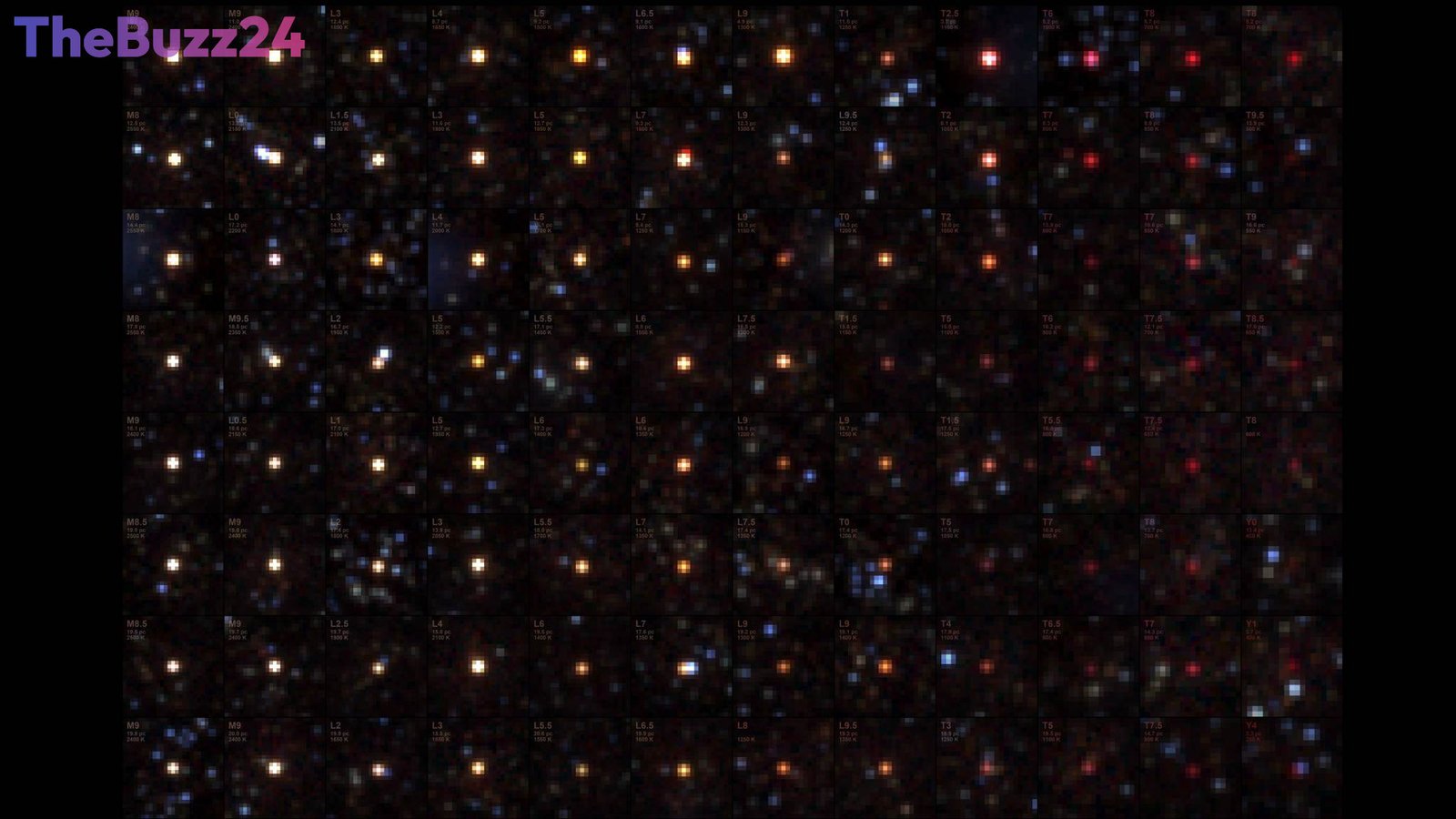
NASA’s SPHEREx Telescope Uncovers Hidden Worlds: Brown Dwarfs Reveal Chemically Rich Atmospheres
NASA’s innovative SPHEREx telescope, designed to map the universe in unprecedented detail, is making surprising discoveries closer to home by revealing the secrets of brown dwarfs. These celestial objects, often described as a cosmic middle ground between stars and planets, are proving to be far more complex than previously understood. Recent analysis of SPHEREx data, published in The Astrophysical Journal, indicates that these dim, free-floating worlds possess atmospheres rich in water, carbon dioxide, carbon monoxide, and methane.
Brown dwarfs form like stars from collapsing gas clouds but lack the mass to ignite sustained nuclear fusion. Consequently, they emit only faint light and heat, largely from their internal warmth. Unlike planets, they drift independently through space, unattached to a host star. While only a few dozen have been studied extensively, SPHEREx is now enabling scientists to examine thousands of these objects, providing a much broader understanding of their composition, atmospheric dynamics, and evolutionary paths. This marks a significant advancement from reliance on theoretical models.
The SPHEREx telescope, launched in March 2025, operates in the infrared spectrum, allowing it to observe wavelengths of light that are absorbed by Earth’s atmosphere. This capability is crucial for studying the faint emissions from brown dwarfs. By measuring the brightness of 37 nearby brown dwarfs across 102 different colors, from deep red to infrared, SPHEREx generates detailed spectra. These spectral fingerprints reveal the chemical makeup of their atmospheres, showing distinct patterns that vary with temperature and age. Scientists are particularly intrigued by the differences observed, noting that even brown dwarfs at similar temperatures exhibit unique spectral signatures, suggesting a high degree of individual complexity.
While the primary mission of SPHEREx is to create a comprehensive map of the sky and study the early universe, its ability to detect these atmospheric molecules on brown dwarfs is a significant secondary achievement. The telescope’s broad spectral coverage is ideal for identifying molecules like methane, carbon dioxide, and carbon monoxide, which leave distinct absorption patterns in the light emitted by these objects. As SPHEREx continues its mission, scientists anticipate uncovering even more about the diversity of brown dwarfs and the physical processes that govern these enigmatic celestial bodies, potentially offering new insights into planetary formation and atmospheric science.
Key Takeaways
- NASA's SPHEREx telescope has detected thousands of brown dwarfs, revealing chemically rich atmospheres containing water, carbon dioxide, carbon monoxide, and methane.
- Brown dwarfs are celestial objects that bridge the gap between stars and planets, forming independently without a host star and lacking sustained nuclear fusion.
- SPHEREx's infrared capabilities are crucial for observing these objects, providing detailed spectral data that challenges existing models and highlights the unique nature of each brown dwarf.
Editor’s Analysis & Impact
The findings from NASA’s SPHEREx telescope regarding brown dwarfs represent a significant leap in our understanding of these ‘failed stars.’ The detection of complex molecules in their atmospheres, previously only theorized or observed in limited cases, underscores the value of SPHEREx’s broad spectral coverage. This discovery not only enriches our knowledge of stellar and planetary evolution but also highlights the potential for unexpected scientific breakthroughs from missions designed for broader cosmological surveys. The variability observed between individual brown dwarfs suggests that atmospheric models will need further refinement, potentially leading to new insights into the conditions under which planets and other celestial bodies form and evolve. The data’s public availability promises further research and discovery by the global scientific community.
Frequently Asked Questions
Q: What is a brown dwarf?
A: A brown dwarf is a celestial object that is more massive than a planet but less massive than a star. It forms from a collapsing cloud of gas and dust, similar to a star, but it does not have enough mass to sustain nuclear fusion of hydrogen in its core. Brown dwarfs are often referred to as 'failed stars' and emit a faint glow from residual heat.
Q: How does the SPHEREx telescope study brown dwarfs?
A: The SPHEREx (Spectro-Photometer for the History of the Universe, Epoch of Reionization, and Ices Explorer) telescope is an infrared space telescope. It observes light in wavelengths that are absorbed by Earth's atmosphere, making it ideal for studying faint objects like brown dwarfs. By analyzing the spectrum of light emitted by these objects across 102 different colors, SPHEREx can identify the chemical composition of their atmospheres.
Q: Why are brown dwarfs considered 'goth' or 'dark wanderers'?
A: They are called 'goth' or 'dark wanderers' because they are free-floating, not orbiting a star, and emit very little light. They are heated internally and are not illuminated by a parent star, causing them to drift alone in the darkness of space.
AI Disclosure: This article is based on verified data and official reports. Our Team and AI have cross-referenced every financial detail with primary sources to ensure total accuracy.
More from this Category