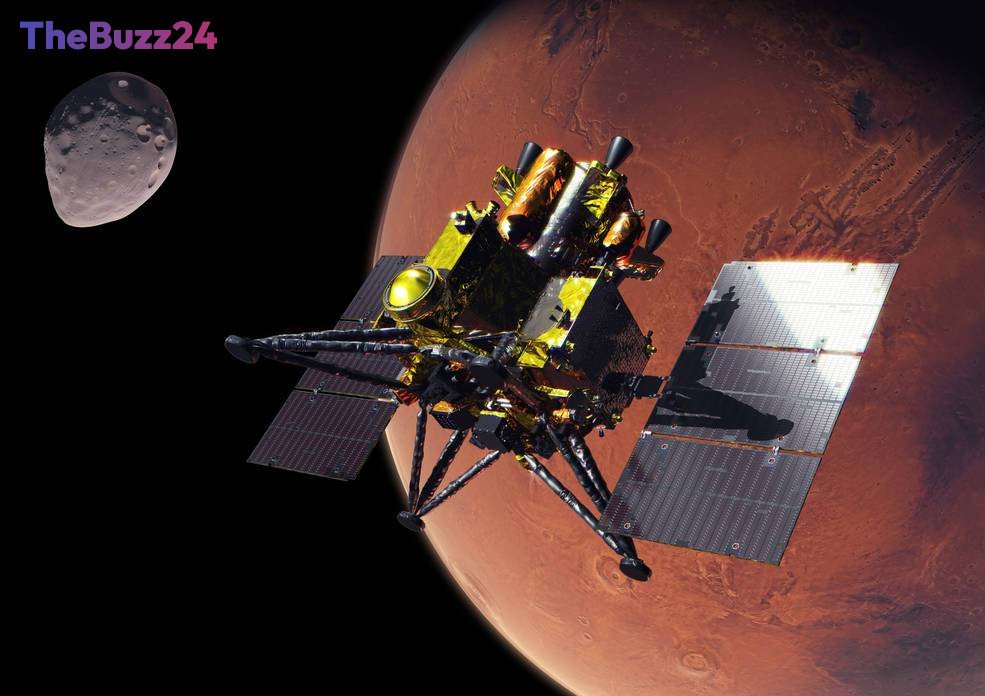
NASA Details Crucial Role in Upcoming Japanese Mission to Mars’ Moons
NASA is set to brief the media on its significant contributions to Japan’s ambitious Martian Moons eXploration (MMX) mission. The teleconference, scheduled for Thursday, October 15th at 4 p.m. EDT, will provide an in-depth look at the U.S. space agency’s involvement in the groundbreaking endeavor.
The MMX mission, spearheaded by the Japan Aerospace Exploration Agency (JAXA), is slated for launch from the Tanegashima Space Center on October 19th. This mission aims to conduct a comprehensive survey of Mars’ two natural satellites, Phobos and Deimos, beginning with their arrival in Martian orbit in August 2027. A key objective includes collecting a surface sample from Phobos, targeted for no earlier than December 2028, with the sample expected to return to Earth in 2031.
NASA’s involvement is multifaceted, encompassing the development of the MEGANE (Mars-moon Exploration with Gamma-rays and Neutrons) spectrometer, a critical instrument for analyzing the moons’ composition. Additionally, the agency is providing the sophisticated surface sampler mechanism for the MMX spacecraft and essential communications and navigation support through its Deep Space Network. Funding for U.S. scientists participating in the MMX science team is also a key NASA contribution, underscoring the international collaboration at the heart of this mission.
The MEGANE instrument is a product of the Johns Hopkins Applied Physics Laboratory, while the pneumatic sampler mechanism was engineered by Honeybee Robotics, a subsidiary of Blue Origin. These technological advancements, funded through NASA’s Discovery Program, highlight the program’s commitment to supporting high-value planetary science investigations and fostering international partnerships in space exploration.
Key Takeaways
- NASA will detail its contributions to Japan's MMX mission, which aims to explore Mars' moons, Phobos and Deimos.
- The mission includes a sample return from Phobos, with NASA providing key instruments like the MEGANE spectrometer and the surface sampler.
- NASA's Deep Space Network will support mission communications and navigation, highlighting international collaboration in planetary science.
Editor’s Analysis & Impact
This collaboration between NASA and JAXA on the MMX mission signifies a deepening trend of international cooperation in space exploration, particularly in the pursuit of understanding Mars and its unique moons. The inclusion of a sample return from Phobos is a significant scientific undertaking, promising novel insights into the formation and evolution of Martian satellites. NASA’s provision of advanced instrumentation and operational support not only bolsters the MMX mission’s success but also strengthens its own planetary science objectives. The involvement of private entities like Blue Origin’s Honeybee Robotics further illustrates the evolving landscape of space mission development, blending governmental expertise with commercial innovation. This mission could pave the way for future joint ventures in exploring the Red Planet and beyond.
Frequently Asked Questions
Q: What is the primary goal of the MMX mission?
A: The primary goal of the Martian Moons eXploration (MMX) mission is to survey Mars' two moons, Phobos and Deimos, collect a surface sample from Phobos, and return it to Earth for analysis.
Q: What specific contributions is NASA making to the MMX mission?
A: NASA is contributing the MEGANE gamma-ray and neutron spectrometer, the spacecraft's surface sampler mechanism, communications and navigation support via the Deep Space Network, and funding for U.S. scientists on the MMX science team.
Q: When is the MMX mission expected to launch and return its sample?
A: The MMX mission is scheduled to launch on October 19th. The spacecraft is expected to arrive at Mars in August 2027, collect a sample from Phobos no earlier than December 2028, and deliver it to Earth in 2031.
AI Disclosure: This article is based on verified data and official reports. Our Team and AI have cross-referenced every financial detail with primary sources to ensure total accuracy.
More from this Category