Cosmic Cavity: Hubble Captures Spectacular ‘Superbubble’ in Neighboring Galaxy
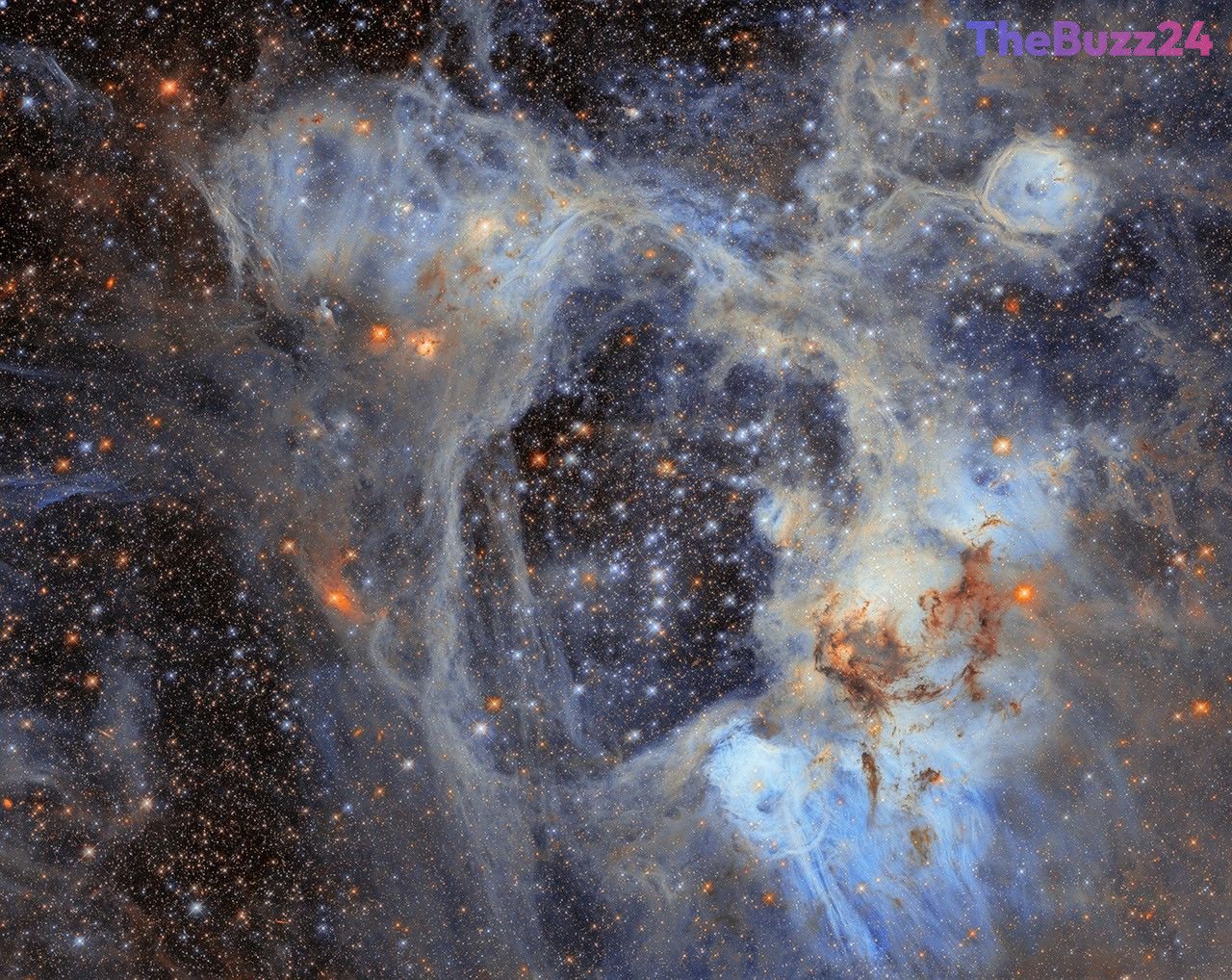
A breathtaking new cosmic portrait has emerged from the depths of the Large Magellanic Cloud, a satellite galaxy orbiting the Milky Way. Located approximately 160,000 light-years away in the southern constellation Dorado, the highly active star-forming region known as LHA 120-N44, or simply N44, has been captured in stunning detail. The image highlights a complex landscape of glowing gas, dark dust lanes, and a massive central void that dominates the stellar nursery.
This prominent void, classified as a “superbubble,” spans an immense area of roughly 210 by 140 light-years. Scientists trace the origin of this giant cosmic cavity to the cluster of brilliant stars residing at its center. The powerful stellar winds and violent supernova explosions from these massive stars have swept away the surrounding gas and dust, carving out the empty space. As this material was pushed outward, it compressed into a dense outer shell, triggering a secondary wave of star birth along the perimeter.
Researchers are leveraging these detailed observations to study the intricate timeline of star formation, specifically tracking how long it takes for cold gas clouds to collapse and ignite nuclear fusion. A comprehensive census of the region has cataloged nearly half a million stars, including approximately 30,000 pre-main-sequence stars—stellar infants that have not yet begun fusing hydrogen in their cores. The high-resolution capabilities of modern space telescopes allow astronomers to isolate these faint, young stars even within highly crowded clusters.
Beyond the central superbubble, the surrounding gas glows intensely under the influence of ultraviolet radiation from nearby massive stars. The region also features smaller structures, such as N44F, a localized bubble sculpted by the fierce winds of a single, exceptionally hot star. Because the Large Magellanic Cloud has a low abundance of elements heavier than helium, studying regions like N44 provides invaluable insights into how stars formed in the early, metal-poor universe.
Key Takeaways
- The N44 nebula features a massive 'superbubble' measuring 210 by 140 light-years, carved out by stellar winds and supernovae from a central star cluster.
- A massive stellar census of the region cataloged nearly 500,000 stars, including 30,000 pre-main-sequence baby stars that have not yet ignited nuclear fusion.
- Studying N44 helps astronomers understand star formation in low-metallicity environments, offering a proxy for conditions in the early universe.
Editor’s Analysis & Impact
The detailed imaging of the N44 superbubble underscores the enduring scientific value of long-serving space observatories, even in an era dominated by newer infrared telescopes. By capturing high-resolution optical and ultraviolet data, astronomers can map the delicate structures of stellar nurseries in neighboring galaxies with unprecedented precision. This research is critical for refining stellar evolution models. Because the Large Magellanic Cloud possesses a chemical makeup similar to ancient, primitive galaxies—lacking heavy elements—it serves as a local laboratory for cosmic history. Understanding how gas collapses into stars in these environments allows astrophysicists to reconstruct the conditions of the early universe, bridging the gap between local stellar dynamics and deep-space cosmology.
Frequently Asked Questions
Q: What is a superbubble in space?
A: A superbubble is a massive cavity in space, spanning hundreds of light-years, created when stellar winds from hot, young stars and shockwaves from supernovae push away the surrounding interstellar gas and dust.
Q: Where is the N44 nebula located?
A: N44 is located in the Large Magellanic Cloud, a satellite galaxy of the Milky Way, situated about 160,000 light-years from Earth in the constellation Dorado.
Q: Why are pre-main-sequence stars important to study?
A: Pre-main-sequence stars are stellar infants that have not yet ignited nuclear fusion in their cores. Studying them helps astronomers understand the earliest stages of star birth and the timeline of how gas clouds collapse into stars.
AI Disclosure: This article is based on verified data and official reports. Our Team and AI have cross-referenced every financial detail with primary sources to ensure total accuracy.
More from this Category