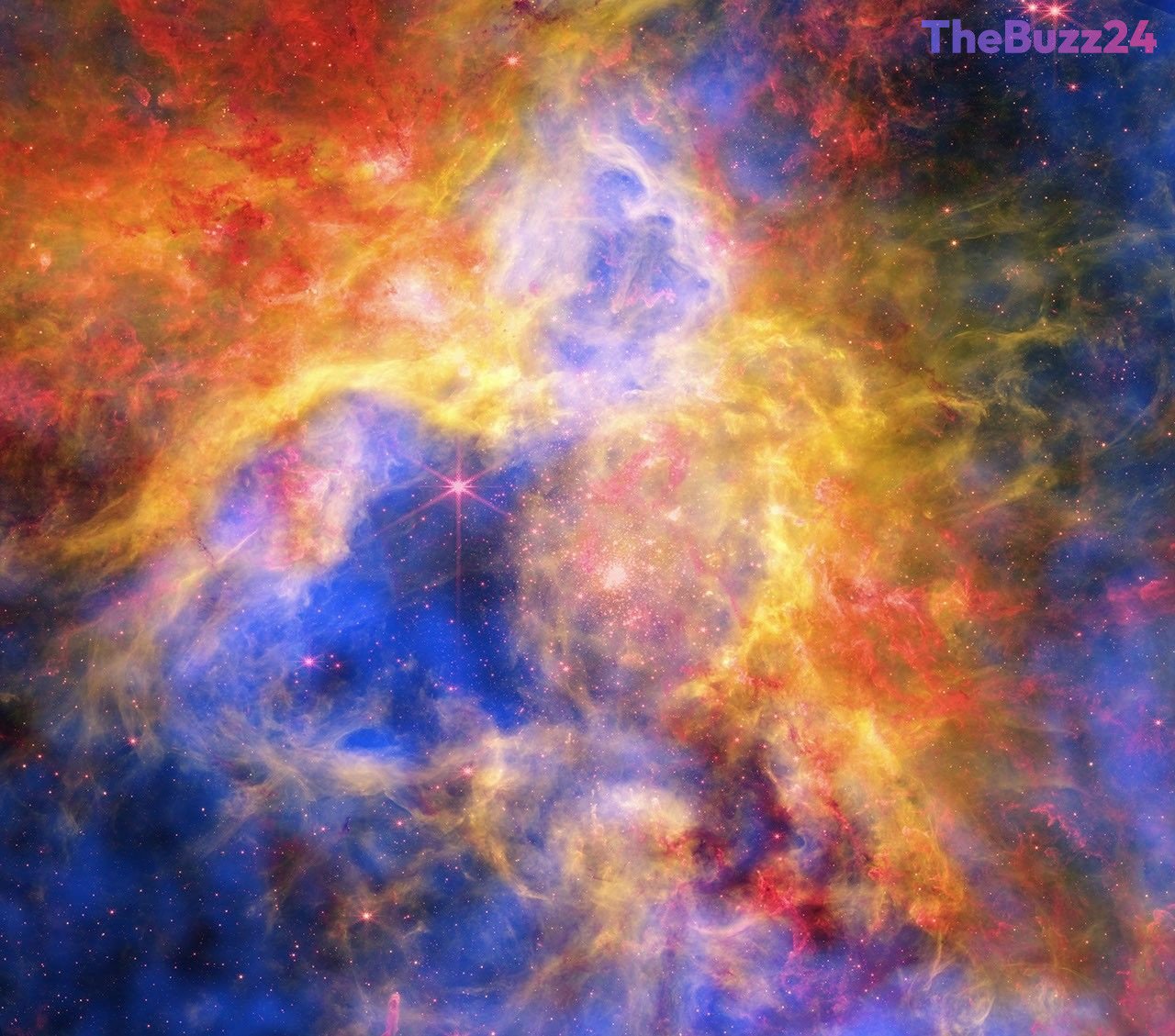
Cosmic Collaboration: Multi-Telescope Image Solves the Mystery of the Tarantula Nebula’s Missing Energy
A stunning new composite image of the Tarantula Nebula, located 160,000 light-years away in the Large Magellanic Cloud, has revealed unprecedented details about one of the cosmos’s most active star-forming regions. By combining data from multiple space observatories, researchers have created a vibrant, multi-layered view of the nebula, also known as 30 Doradus. This collaborative cosmic portrait layers X-ray, optical, and infrared data to map out a complex tapestry of gas, dust, and newborn stars.
Each observatory contributed a unique perspective to the final image. The Chandra X-ray Observatory captured superheated gas (rendered in blue) that has been blown away by powerful stellar winds and heated to millions of degrees by supersonic shock waves. The James Webb Space Telescope provided infrared data (rendered in red), revealing thousands of young stars and pockets of cold dust that will serve as the building blocks for future stellar systems. Meanwhile, the Hubble Space Telescope’s optical data (rendered in green) exposed warmer hydrogen gas and highlighted individual stars shining through the dense nebula.
Beyond its visual beauty, the multi-wavelength data has helped solve a long-standing astrophysical mystery. For years, scientists wondered why the Tarantula Nebula contained far less high-energy, X-ray-emitting gas than theoretical models predicted. Powerful winds from young, massive stars should have generated massive amounts of superheated gas. A new study published in the Astrophysical Journal, led by Jennifer Rodriguez of The Ohio State University, has finally identified where this missing energy went.
By analyzing the combined data alongside observations from the retired Spitzer Space Telescope, the research team concluded that the nebula is losing energy through three distinct pathways. First, up to half of the hot gas is escaping the nebula entirely by leaking through gaps in its structural shells. Second, turbulent mixing between hot and cold gas layers is actively cooling the system down. Finally, the nebula is losing heat through thermal conduction, where hot gas transfers its energy directly to cooler, denser surrounding structures upon contact. This multi-channel energy loss explains both the missing X-rays and the intricate, honeycomb-like structure of the nebula.
Key Takeaways
- A new composite image of the Tarantula Nebula combines X-ray, infrared, and optical data from Chandra, Webb, and Hubble.
- Astronomers solved a long-standing mystery regarding why the nebula has far less superheated, X-ray-emitting gas than expected.
- The study identified three energy-loss mechanisms: gas leakage, turbulent mixing, and thermal conduction with cooler surrounding dust shells.
Editor’s Analysis & Impact
The successful synthesis of data from Chandra, Hubble, and Webb highlights the growing importance of multi-wavelength astronomy in modern astrophysics. By combining different spectrums, scientists can overcome the limitations of individual instruments to solve complex cosmic puzzles. This study not only resolves a specific mystery about the Tarantula Nebula’s energy budget but also refines our broader understanding of stellar feedback—the process by which young, massive stars influence their host galaxies. As next-generation observatories come online, the ability to cross-reference historical data from retired missions like Spitzer with cutting-edge observations from Webb will remain a cornerstone of deep-space discovery, driving more accurate simulations of star and galaxy formation.
Frequently Asked Questions
Q: What is the Tarantula Nebula?
A: Also known as 30 Doradus, the Tarantula Nebula is a massive star-forming region located approximately 160,000 light-years from Earth in the Large Magellanic Cloud, a satellite galaxy of the Milky Way.
Q: Why did scientists think the nebula was missing energy?
A: Theoretical models predicted that powerful winds from young, massive stars should heat the surrounding gas to temperatures high enough to emit massive amounts of X-rays. However, observations showed far less X-ray-emitting gas than expected, prompting a search for where that energy went.
Q: How is the Tarantula Nebula losing its heat?
A: The nebula loses energy through three main channels: hot gas escaping through gaps in its dust shells, turbulent mixing of hot and cold gas, and thermal conduction where heat transfers directly to cooler, denser surrounding structures.
AI Disclosure: This article is based on verified data and official reports. Our Team and AI have cross-referenced every financial detail with primary sources to ensure total accuracy.
More from this Category