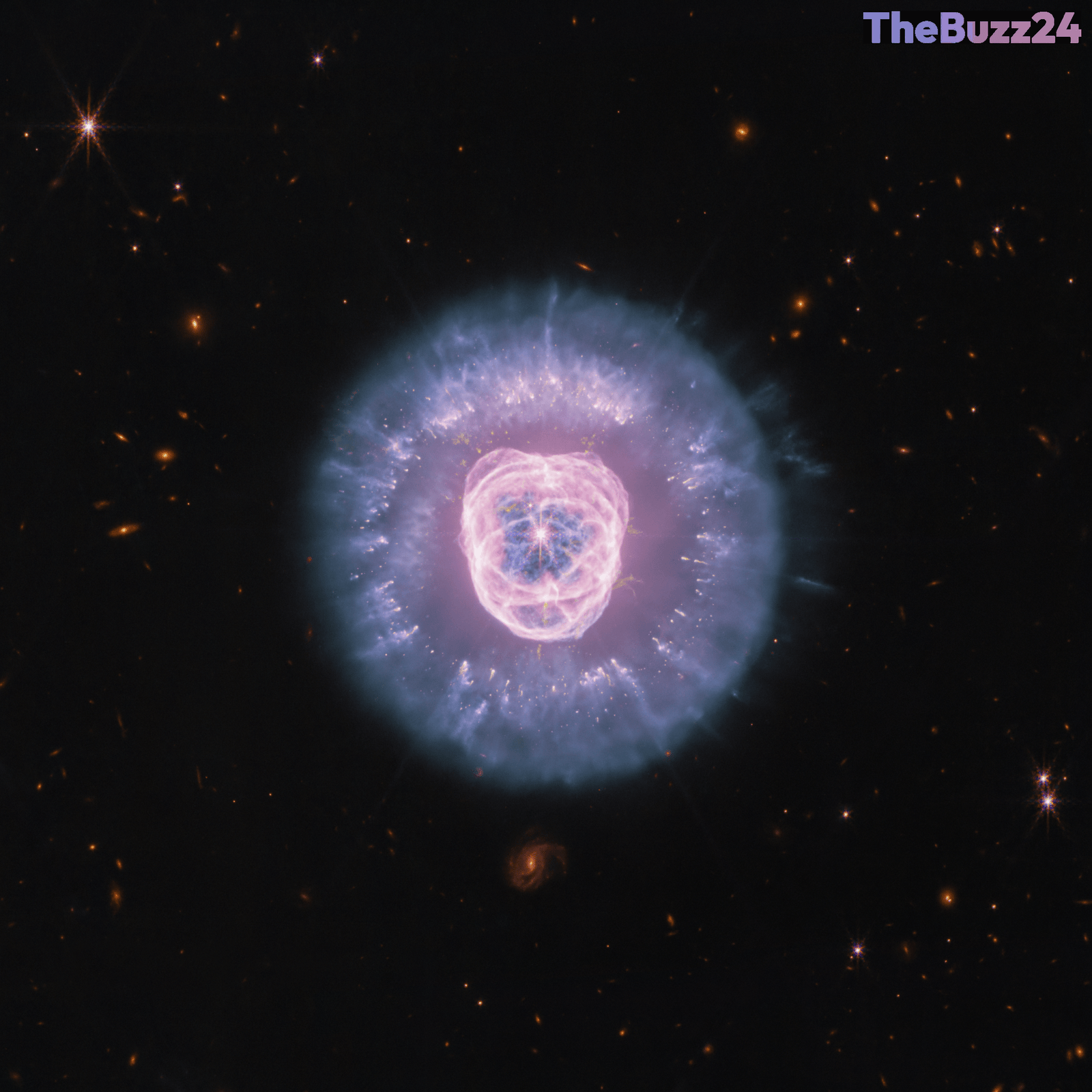
Cosmic Mane Revealed: James Webb Telescope Captures Lion Nebula in Exquisite Detail
The cosmos continues to reveal its wonders through the lens of the James Webb Space Telescope, which has recently captured breathtaking new images of the planetary nebula NGC 2392, famously known as the Lion Nebula. These detailed observations offer an unprecedented look at the celestial structure, showcasing the intricate processes at play in the universe.
Located thousands of light-years away, the Lion Nebula presents a striking visual, characterized by a distinctive bubble of ionized gas and dust that resembles a lion’s face, complete with a flowing “mane.” This unique morphology is a direct result of the dying central star, which has shed its outer layers into space, creating the expanding shell of material that glows brightly.
Utilizing its advanced Near-Infrared Camera (NIRCam) and Mid-Infrared Instrument (MIRI), the Webb Telescope has provided scientists with high-resolution data, allowing for an exceptionally clear and detailed view of the nebula’s complex filaments and glowing gases. The clarity of these images is crucial for understanding the dynamics of stellar evolution and the formation of such elaborate cosmic structures.
The observations underscore the Webb Telescope’s unparalleled capabilities in infrared astronomy, enabling astronomers to peer through obscuring dust and gas to reveal phenomena that were previously difficult to discern. These insights contribute significantly to our knowledge of how stars end their lives and enrich the interstellar medium with new elements.
Key Takeaways
- The James Webb Space Telescope has captured new, high-resolution images of the planetary nebula NGC 2392, known as the Lion Nebula.
- The images, taken with NIRCam and MIRI instruments, reveal the nebula's distinctive lion face-shaped structure and glowing "mane" of ionized gas and dust.
- These observations provide crucial insights into stellar evolution and the formation of complex cosmic structures from the remains of a central star.
Editor’s Analysis & Impact
The latest imagery from the James Webb Space Telescope, particularly of the Lion Nebula, underscores the profound scientific value of advanced astronomical observatories. While not directly impacting commercial markets, these discoveries significantly advance our understanding of stellar life cycles and the chemical enrichment of the universe. The exquisite detail captured by Webb’s instruments promises a future rich with groundbreaking insights into cosmic phenomena, from planetary formation to the evolution of galaxies. Such observations not only fuel scientific research but also inspire public interest in space exploration and encourage investment in STEM fields, fostering a new generation of scientists and engineers. The ongoing success of the Webb Telescope solidifies its role as a cornerstone for future astrophysical endeavors, continually pushing the boundaries of human knowledge.
Frequently Asked Questions
Q: What is the Lion Nebula?
A: The Lion Nebula, officially designated NGC 2392, is a planetary nebula characterized by a distinctive bubble of ionized gas and dust that resembles a lion's face and mane. It is formed from the expelled outer layers of a dying central star.
Q: Which instruments on the James Webb Space Telescope were used to image the Lion Nebula?
A: The James Webb Space Telescope utilized its Near-Infrared Camera (NIRCam) and Mid-Infrared Instrument (MIRI) to capture the high-resolution images of the Lion Nebula.
Q: Why are these new images of the Lion Nebula significant?
A: These images are significant because they provide unprecedented clarity and detail of the nebula's complex structure, offering valuable data for scientists to better understand the processes of stellar evolution and how dying stars contribute to the interstellar medium.
AI Disclosure: This article is based on verified data and official reports. Our Team and AI have cross-referenced every financial detail with primary sources to ensure total accuracy.
More from this Category