Hubble Reveals Rare Cosmic Transition in Galaxy NGC 1266
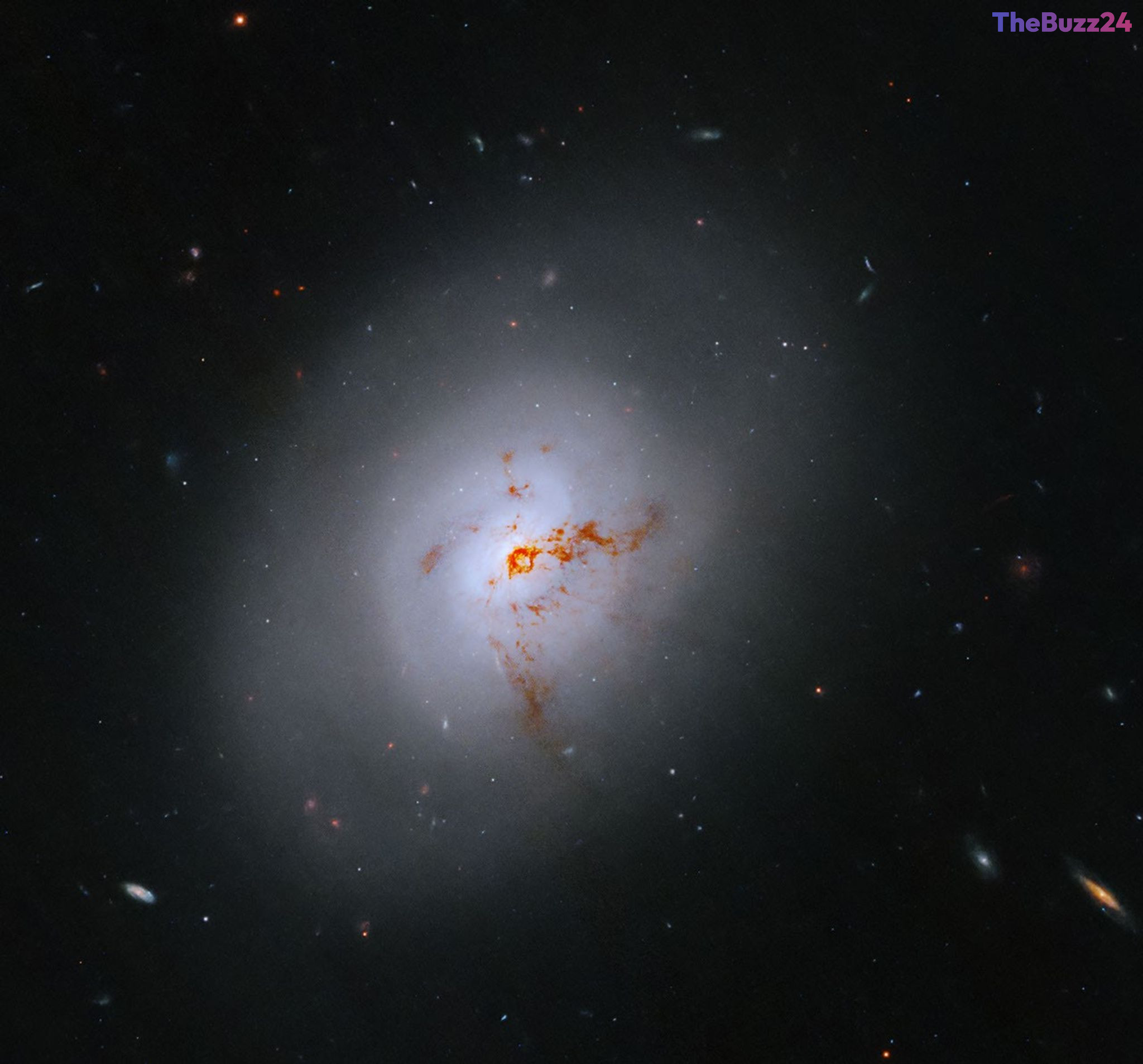
The Hubble Space Telescope has captured a striking view of NGC 1266, a lenticular galaxy located 100 million light-years away in the Eridanus constellation. This celestial object is currently serving as a vital case study for astronomers, as it exhibits a bright central core and a flattened disk structure, notably lacking the spiral arms characteristic of more active, star-forming galaxies. Dense, reddish-brown dust filaments shroud its center, providing a stark contrast against the backdrop of distant, multicolored galaxies.
NGC 1266 is classified as a rare ‘post-starburst’ galaxy, representing only about one percent of the local galactic population. It acts as an evolutionary bridge, marking the transition from vibrant, star-forming spiral galaxies to the dormant, aging elliptical galaxies. These systems are defined by a recent history of intense star formation that has significantly tapered off, leaving behind a population of young stars as the galaxy settles into a more quiescent state.
Scientific evidence suggests that NGC 1266 was shaped by a minor galactic merger roughly 500 million years ago. This event likely funneled vast quantities of gas toward the galaxy’s supermassive black hole, triggering an active galactic nucleus. The resulting energy, expressed through powerful winds and jets, has effectively depleted the galaxy’s gas reserves. This turbulent environment now prevents the formation of new stars, restricting stellar birth to the immediate core while the central black hole continues to suppress activity throughout the rest of the system.
By analyzing NGC 1266, researchers are gaining critical insights into how supermassive black holes dictate the life cycles of their host galaxies. The ongoing suppression of star formation within this system highlights the complex feedback loops that govern galactic evolution, providing a clearer picture of how galaxies transition from active, star-rich environments to the stable, aging structures observed across the universe.
Key Takeaways
- NGC 1266 is a rare 'post-starburst' galaxy that serves as an evolutionary link between spiral and elliptical galaxies.
- A galactic merger 500 million years ago likely triggered the activity of the central black hole, which now suppresses new star formation.
- The galaxy's supermassive black hole generates powerful outflows and shockwaves that prevent gas from collapsing into new stars.
Editor’s Analysis & Impact
The study of NGC 1266 is significant because it provides a ‘snapshot’ of a critical phase in galactic evolution that is rarely observed. By documenting the mechanisms through which a supermassive black hole can effectively ‘quench’ star formation, astronomers are refining models of how galaxies age and stabilize over billions of years. This research has broader implications for understanding the life cycles of galaxies in the local universe and the role of active galactic nuclei in regulating cosmic growth. As observational technology improves, the ability to map these turbulent environments will likely lead to a more comprehensive theory of how feedback processes dictate the morphology and longevity of galaxies, ultimately helping us understand the future trajectory of our own Milky Way.
Frequently Asked Questions
Q: What is a post-starburst galaxy?
A: A post-starburst galaxy is a system that has recently undergone a period of intense star formation but has since transitioned into a quieter state with very little ongoing star birth.
Q: Why is NGC 1266 considered a transitional galaxy?
A: It is considered transitional because it possesses the physical structure of a spiral galaxy but exhibits the low star-formation rates and quiescent nature typically associated with older elliptical galaxies.
AI Disclosure: This article is based on verified data and official reports. Our Team and AI have cross-referenced every financial detail with primary sources to ensure total accuracy.
More from this Category