Cosmic Fireworks: Astronauts Capture Breathtaking Night Views of Earth from Space
When gazing down at our planet from the vantage point of the International Space Station, orbital travelers are often met with a mesmerizing canvas of light and shadow that rivals the brilliance of the distant stars. Veteran spaceflyers have long documented the dazzling visual spectacle of terrestrial nighttime environments, where sprawling urban grids transform into shimmering constellations and industrial maritime operations paint the dark ocean waters with glowing sapphire hues.
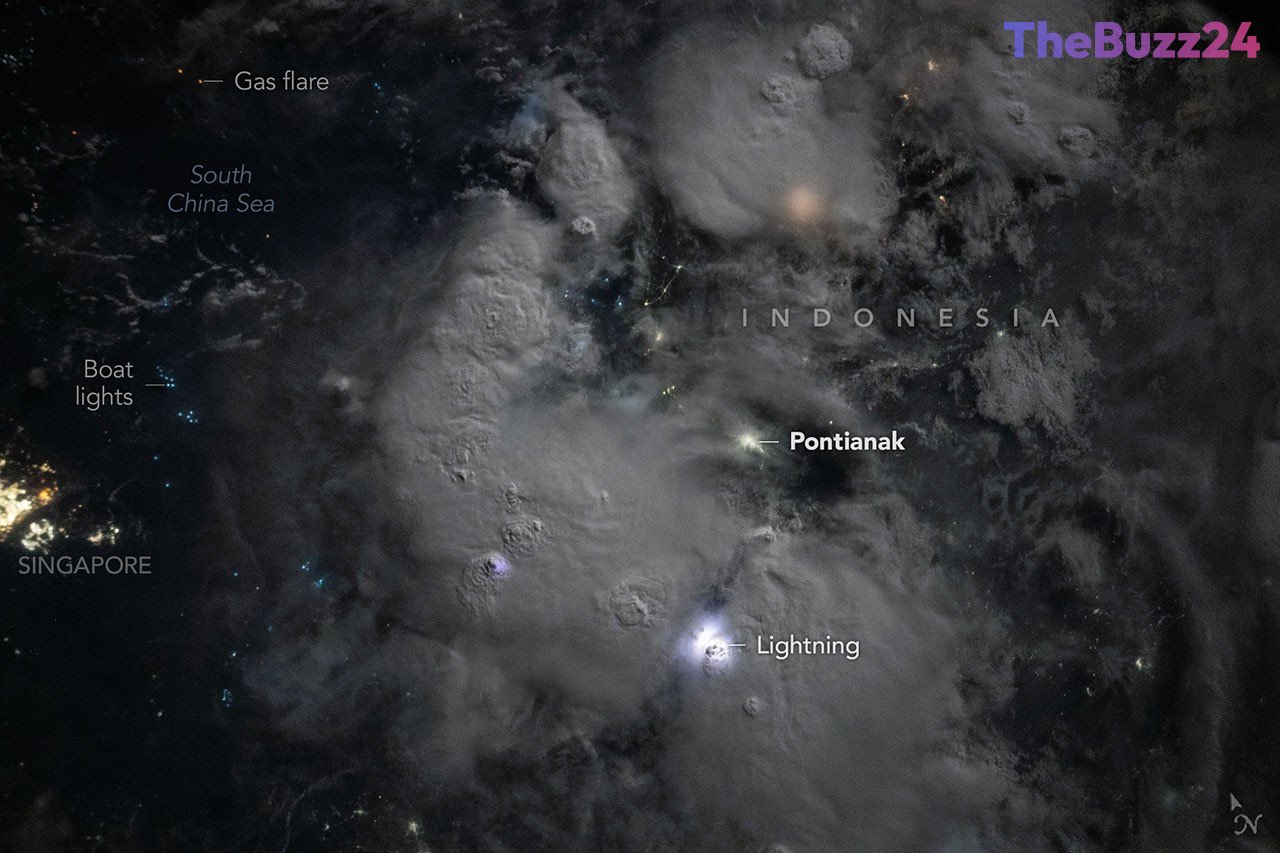
Among the most astonishing phenomena witnessed from high above the atmosphere is the sheer majesty of global electrical storms. While terrestrial observers look upward through thick layers of moisture to catch glimpses of electrical discharges, orbital crews enjoy a panoramic perspective from above. Powerful tempest systems diffuse massive electrical bolts into sprawling, luminous spheres that leap across vast stretches of clouds, creating an illusion akin to an endless cosmic fireworks display unfolding across continents.
Recently, an orbital crew member documented a striking convergence of these nocturnal phenomena while passing directly over the South China Sea near Borneo. The resulting high-resolution photography captured the vibrant urban glow of Singapore alongside the intricate geometric patterns of nearby maritime traffic. Fleets of commercial fishing vessels utilizing high-intensity illumination to draw in deep-water catches appeared as glittering clusters, reminiscent of distant star formations against the darkened seas.
Atmospheric scientists continue to rely heavily on these unique vantage points to study weather patterns and ecological footprints on a global scale. With thousands of individual tempests actively brewing across the planet at any given second, capturing high-speed optical phenomena from orbit provides vital insights into atmospheric dynamics, storm severity, and the pervasive human footprint lighting up the nighttime world.
Key Takeaways
- Astronauts aboard the International Space Station captured a rare, detailed nighttime photograph of Earth highlighting urban lights, fishing fleets, and intense thunderstorms.
- Storm systems viewed from orbit appear as expansive clusters where lightning is diffused into glowing balls of light, resembling fireworks across the clouds.
- The imagery provides scientists with crucial visual data regarding intense storm updrafts, marine fishing activities, and urban layouts in Southeast Asia.
Editor’s Analysis & Impact
The intersection of high-resolution digital photography and orbital spaceflight continues to yield extraordinary resources for both scientific research and public engagement. As imaging technology aboard spacecraft advances, the ability to document transient atmospheric events—such as lightning overshooting tops and marine bioluminescence or light-fishing—enhances our understanding of global weather patterns and human impacts on marine ecosystems. These visual archives not only inspire public interest in space exploration and earth sciences but also provide climatologists and meteorologists with invaluable observational data that complements satellite sensor readings.
Frequently Asked Questions
Q: Why does lightning look different from space compared to Earth?
A: On Earth, people view lightning from underneath the cloud canopy, which blocks and scatters the light. From orbit, astronauts look down from above, where clouds diffuse the electrical discharges into large, bursting spheres of light that illuminate entire storm systems.
Q: What causes the blue clusters of lights frequently seen in the oceans from space?
A: These blue light clusters are typically commercial fishing boats using high-powered lamps to attract squid, sardines, and other schooling fish to the water's surface.
Q: How common are thunderstorms on Earth at any given time?
A: Scientists estimate there are roughly 2,000 active thunderstorms occurring simultaneously across the globe at any given moment, generating nearly 60 flashes of lightning every second.
AI Disclosure: This article is based on verified data and official reports. Our Team and AI have cross-referenced every financial detail with primary sources to ensure total accuracy.
More from this Category