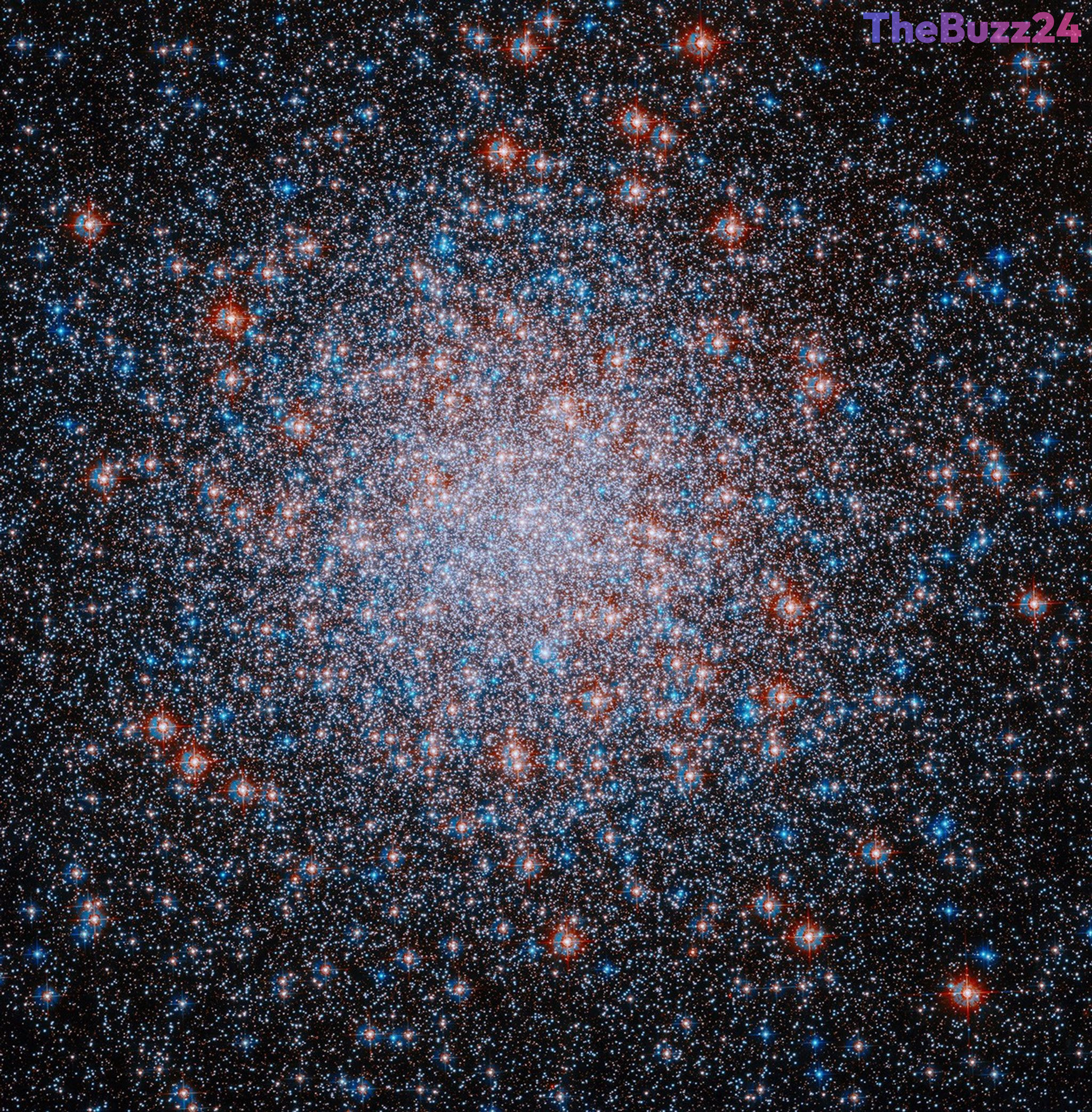
Cosmic Fireworks: Hubble Captures Stunning Half-Million Star Cluster Messier 3
A spectacular new image captured by the Hubble Space Telescope has revealed the dazzling, multi-colored brilliance of Messier 3 (M3), a massive globular cluster home to more than half a million stars. Released in commemoration of the United States’ semiquincentennial, the breathtaking cosmic portrait showcases a dense sphere of stars glowing in vibrant shades of red, white, and blue. Located in the outer regions of the Milky Way, M3 represents one of the most populous and gravitationally bound stellar systems in our galaxy, offering astronomers a pristine window into the early universe.
What makes Messier 3 particularly fascinating to researchers is its unique composition and unusual distance from the galactic center. The cluster boasts more than 240 RR Lyrae variable stars—the highest concentration found in any known globular cluster within the Milky Way. Because these ancient stars pulsate with a predictable intrinsic brightness, they serve as crucial “cosmic yardsticks” that allow scientists to calculate precise distances across the universe. Additionally, M3 contains roughly 70 “blue stragglers.” These stellar anomalies appear deceptively young and hot because they have gravitationally siphoned material from neighboring companion stars, effectively rejuvenating their appearance.
Astronomers believe the complex nature of M3, which features two distinct generations of stars, points to a dramatic evolutionary history. Evidence suggests the cluster may have formed from the merger of two separate globular clusters that originally belonged to a dwarf galaxy. This dwarf galaxy was eventually absorbed by the Milky Way billions of years ago. The newly released image, processed to highlight hotter stars in blue and cooler stars in red, is part of a broader Hubble Treasury program. This ambitious survey aims to analyze approximately half of the Milky Way’s globular clusters, helping scientists piece together a comprehensive timeline of how our home galaxy formed and evolved.
Key Takeaways
- Messier 3 (M3) is a massive globular cluster containing over 500,000 stars, newly imaged in vibrant red, white, and blue.
- The cluster holds the record for the most RR Lyrae variable stars in the Milky Way, which act as critical tools for measuring cosmic distances.
- M3's unique dual stellar populations suggest it originated from a merger of two clusters inside a dwarf galaxy that was later swallowed by the Milky Way.
Editor’s Analysis & Impact
The detailed imaging of Messier 3 underscores the enduring scientific value of the Hubble Space Telescope, even as newer observatories like the James Webb Space Telescope capture headlines. By focusing on globular clusters, astronomers are not just taking beautiful pictures; they are conducting essential galactic archaeology. Understanding the merger history of M3 provides vital clues about how the Milky Way grew through cannibalizing smaller dwarf galaxies. Looking ahead, the synergy between Hubble’s ultraviolet and visible light capabilities, Webb’s infrared precision, and the upcoming Nancy Grace Roman Space Telescope’s wide-field views will unlock unprecedented details about stellar evolution. This multi-generational fleet of space telescopes ensures that our understanding of cosmic distance scales and galactic formation will expand exponentially over the next decade.
Frequently Asked Questions
Q: What is a globular cluster?
A: A globular cluster is a densely packed, spherical collection of tens of thousands to millions of ancient stars that are gravitationally bound to one another and typically orbit the outer regions of a galaxy.
Q: Why are RR Lyrae variable stars important to astronomers?
A: RR Lyrae stars are ancient stars whose brightness fluctuates in a predictable pattern. Because their intrinsic brightness is known, astronomers can use them as 'standard candles' to measure precise distances across space.
Q: What are 'blue stragglers' in a star cluster?
A: Blue stragglers are stars within older clusters that appear much bluer and hotter—and therefore younger—than their neighbors. They achieve this youthful appearance by gravitationally pulling matter from nearby companion stars.
AI Disclosure: This article is based on verified data and official reports. Our Team and AI have cross-referenced every financial detail with primary sources to ensure total accuracy.
More from this Category