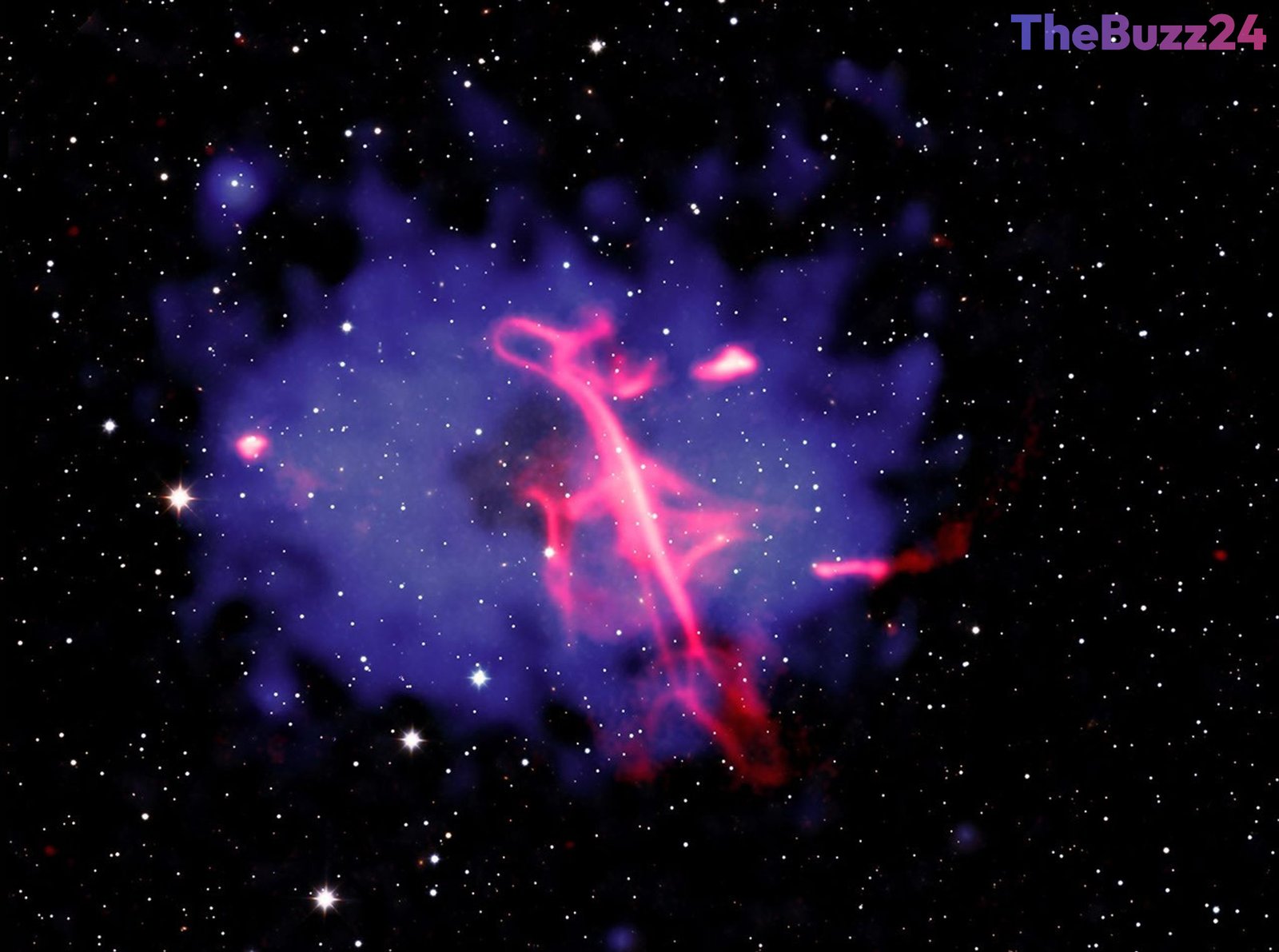
Cosmic Harmony: Gigantic ‘Treble Clef’ Deep-Space Structure Reignited by Galaxy Collisions
Spanning an astonishing two million light-years across intergalactic space, an enigmatic cosmic formation known as the ‘Treble Clef’ is offering researchers rare insights into the violent dynamics of galaxy clusters. Formally cataloged as VLSS J0318.9+5755, the structure derives its poetic moniker from its striking resemblance to the musical notation symbol. Despite its immense proportions, the structure long remained obscured from view because its optical light is masked behind the dense stars, dust, and gas of the Milky Way’s galactic plane.
First scrutinized by astronomers in 2004, the precise origins and physical mechanisms driving the Treble Clef puzzled experts for years. Now, advanced multi-wavelength observations utilizing the Chandra X-ray Observatory alongside the eROSITA space telescope have unveiled a compelling narrative. Evidence suggests that the sprawling cloud of energetic charged particles was originally launched into the cosmos by an active supermassive black hole positioned at the center of an ancient galaxy.
Over cosmic timescales, the initial burst of radio emission from these expelled particles dwindled and faded into the background. However, researchers hypothesize that the dormant particles were revived when two neighboring clusters of galaxies collided, sending colossal shockwaves rippling across millions of light-years. This cosmic impact compressed and re-accelerated the plasma, reigniting its glow across both radio wavelengths and newly mapped X-ray bands.
Composite imaging mapping the region depicts low-frequency radio emissions in vivid red hues, juxtaposed against the superheated gas radiating high-energy X-rays highlighted in blue. As astronomers continue to analyze extreme cosmic specimens like the Treble Clef, these systems serve as natural laboratories, illustrating how massive gravitational mergers sculpt large-scale cosmic architecture and drive the ongoing evolution of our universe.
Key Takeaways
- The 'Treble Clef' structure (VLSS J0318.9+5755) spans over two million light-years and was previously masked by the Milky Way's plane.
- Scientists believe an ancient supermassive black hole originally ejected the charged particle cloud, which subsequently faded over millions of years.
- A massive shockwave generated by colliding galaxy clusters reignited the dormant cloud, making it detectable in both radio and X-ray frequencies.
Editor’s Analysis & Impact
The revival mechanism identified within the Treble Clef underscores the immense power of cluster mergers in driving intergalactic astrophysics. For decades, structures located behind the Milky Way’s ‘Zone of Avoidance’ presented persistent observational hurdles for optical astronomy. The successful synthesis of radio data with X-ray observations from orbital platforms like Chandra and eROSITA demonstrates how multi-wavelength astronomy can peer through obscuring dust lanes. Looking ahead, next-generation observatories will likely identify more ‘fossil’ radio plasma structures brought back to life by cluster collisions. These findings not only validate complex shock-acceleration models but also provide essential empirical data on how magnetic fields and thermal energy are distributed across the cosmic web.
Frequently Asked Questions
Q: Why is the structure called the 'Treble Clef'?
A: The structure earned the nickname because its curving filamentary morphology across radio observations closely resembles the classic musical treble clef symbol.
Q: Why was the Treble Clef difficult to study previously?
A: Its optical emissions are largely obscured by the intervening dust, gas, and stars situated within our own Milky Way galaxy, requiring high-energy X-ray and radio telescopes to pierce through the obstruction.
Q: What caused the structure to light up again after fading?
A: Astronomers hypothesize that powerful shockwaves produced by the collision of two massive galaxy clusters re-energized and accelerated the dormant charged particles, causing them to emit radio and X-ray radiation once more.
AI Disclosure: This article is based on verified data and official reports. Our Team and AI have cross-referenced every financial detail with primary sources to ensure total accuracy.
More from this Category