Cosmic Specters: Exploring the Eerie Beauty of the Cepheus Flare
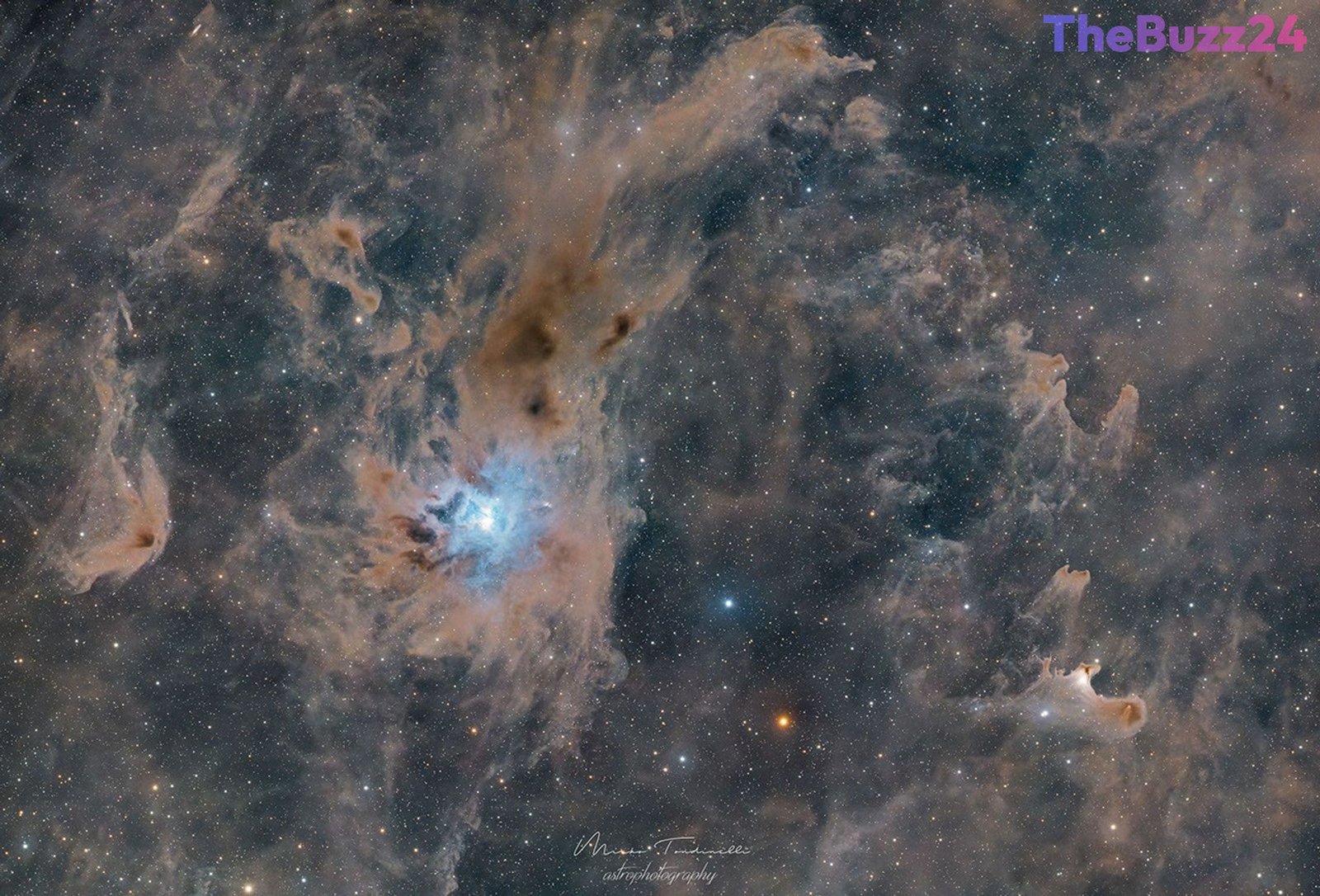
Deep within the royal constellation of Cepheus, a haunting collection of cosmic dust clouds drifts through the interstellar medium, creating a scene that appears both ghostly and ethereal. Located approximately 1,200 light-years from Earth, these formations sit at the edge of the Cepheus Flare molecular cloud complex, far above the galactic plane of the Milky Way.
Among the most prominent features in this region is vdB 141, commonly referred to as the Ghost Nebula. Spanning over two light-years, this nebula is notable for its dense cores, which exhibit the telltale reddish signatures of early-stage star formation. The nebula’s eerie appearance is enhanced by the way it reflects light, creating a stark contrast against the surrounding darkness of space.
Nearby, the Iris Nebula, cataloged as NGC 7023, provides a striking visual counterpoint. It is illuminated by the intense, bluish light of hot, young stars, casting a vibrant glow that stands out against the dusty backdrop. Together, these interstellar fields stretch across a wide telescopic frame, covering an area equivalent to nearly six full moons in the night sky, offering a glimpse into the complex and fertile environments where new stars are born.
Key Takeaways
- The Ghost Nebula (vdB 141) is a dense region of cosmic dust located 1,200 light-years away in the Cepheus constellation.
- The region is a site of active star formation, evidenced by collapsing dense cores within the nebula.
- The nearby Iris Nebula (NGC 7023) is illuminated by young, hot stars, providing a distinct blue contrast to the darker, dustier regions of the Cepheus Flare.
Editor’s Analysis & Impact
The imagery of the Cepheus Flare serves as a vital reminder of the dynamic nature of our galaxy. By studying these molecular cloud complexes, astronomers gain critical insights into the lifecycle of stars—from the initial collapse of dense dust cores to the ignition of young, hot stellar bodies. The interplay between reflected starlight and dark nebulae provides a natural laboratory for understanding interstellar medium composition. As telescope technology continues to advance, the ability to resolve these ‘ghostly’ structures with greater clarity allows researchers to map the star-forming history of the Milky Way more accurately. These observations are essential for refining models of galactic evolution and understanding the environmental conditions necessary for the birth of planetary systems.
Frequently Asked Questions
Q: What is the Ghost Nebula?
A: The Ghost Nebula, or vdB 141, is a reflection nebula located in the constellation Cepheus. It is composed of cosmic dust and is known for its eerie, haunting appearance and active star formation.
Q: How far away is the Cepheus Flare complex?
A: The Cepheus Flare molecular cloud complex is located approximately 1,200 light-years away from Earth.
AI Disclosure: This article is based on verified data and official reports. Our Team and AI have cross-referenced every financial detail with primary sources to ensure total accuracy.
More from this Category