Crypto Exchanges Accelerate Push Into Tokenized Equities as Regulatory Frameworks Evolve
The cryptocurrency industry is rapidly dismantling the boundaries between traditional financial assets and digital tokens. Major trading venues are aggressively transforming into comprehensive multi-asset ecosystems by launching tokenized spot stocks, real-world asset (RWA) perpetual futures, and specialized blockchain infrastructure. This strategic expansion provides platforms with a resilient, diversified revenue stream while introducing 24/7 accessibility to traditional equity markets.
Leading market players are actively rolling out their proprietary architectures to capture this growing demand. Kraken and its parent company Payward recently secured a $100 million investment commitment from Nasdaq Ventures to scale tokenized equity infrastructure, while concurrently working to deploy regulated perpetual futures via Hyperliquid. Similarly, Binance saw its bStocks product generate over $3.7 billion in monthly trading volume within weeks of launch, while Coinbase rolled out its B20 token standard on the Base network to offer direct claims on underlying shares. Other industry competitors, including Robinhood, OKX, and Backpack, are deploying dedicated blockchain rails to support tokenized securities.
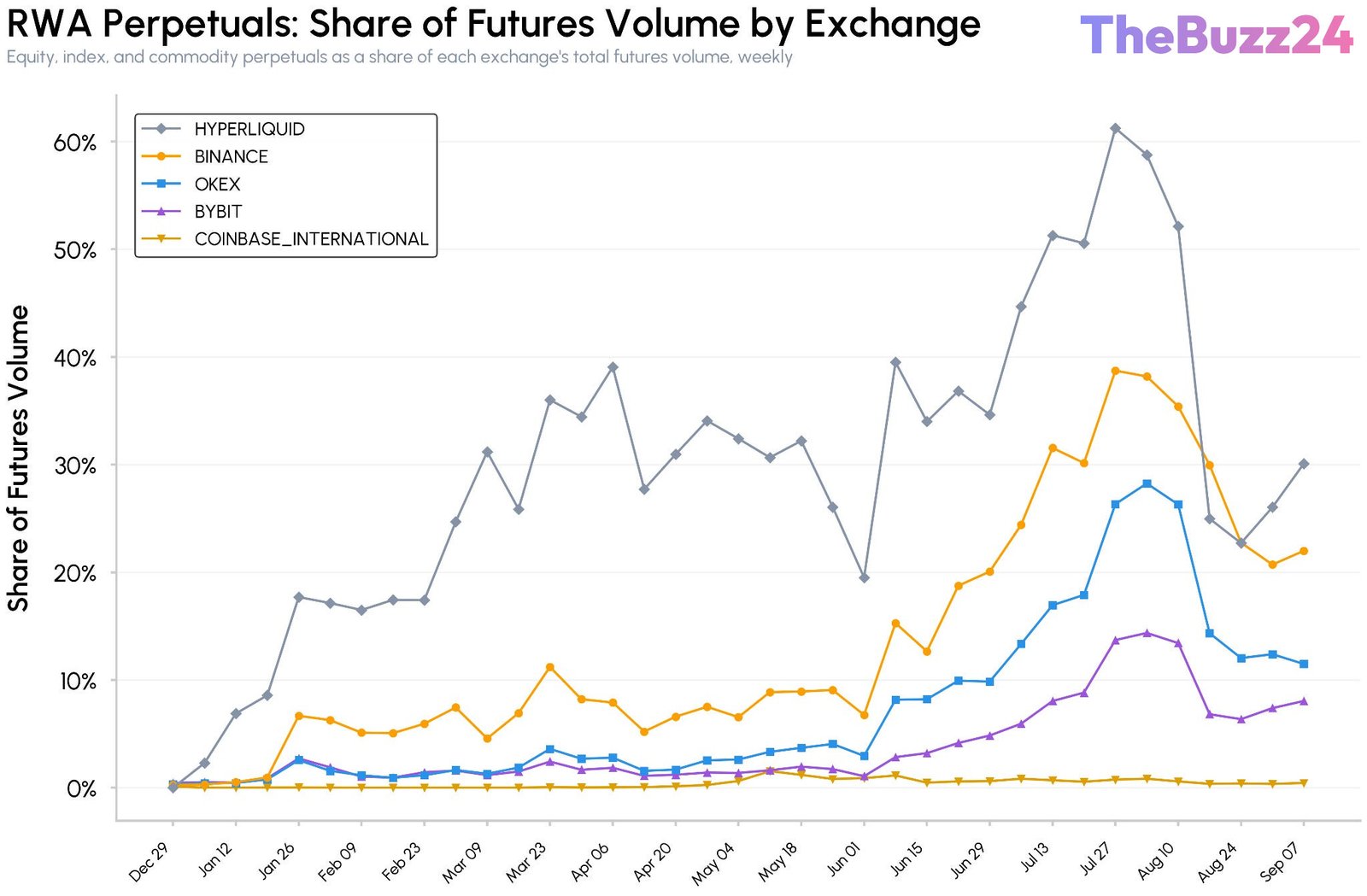
The surge in adoption is not limited to spot equity representations; the derivatives arena is seeing comparable momentum. Stock- and commodity-linked perpetual contracts now represent a sizable share of total futures volume across venues like Hyperliquid and centralized derivatives platforms. These instruments allow global market participants to gain synthetic or certificate-backed price exposure to public equities at any hour, redirecting secondary liquidity into automated market makers and decentralized protocols.
Regulators have begun responding to the rapid institutionalization of onchain equities. The U.S. Securities and Exchange Commission unveiled a five-year Innovation Exemption, creating a conditional runway for qualifying Tokenized Securities Venues to trade equity tokens onchain without completing standard exchange registration. While the framework mandates rigorous investor protections—such as bona fide voting rights and official dividend distributions—it marks a landmark step toward formally integrating decentralized market rails into mainstream capital markets.
Key Takeaways
- Digital asset platforms such as Binance, Kraken, Coinbase, and Robinhood are rapidly scaling tokenized stock offerings and multi-asset trading stacks.
- Trading volumes in tokenized equities and RWA perpetual futures have surged into the billions, establishing 24/7 continuous exposure for traditional stocks.
- A newly introduced five-year SEC Innovation Exemption establishes a regulatory avenue for onchain equity trading, favoring models that retain conventional shareholder rights.
Editor’s Analysis & Impact
The integration of equity trading into blockchain infrastructure signals a profound structural shift across capital markets. Historically, digital currency exchanges have grappled with extreme cyclical downturns during crypto bear markets. By expanding into tokenized equities and RWA perpetuals, these platforms are building an all-weather financial ecosystem that captures persistent fee volume regardless of crypto-specific market sentiment. Furthermore, 24/7 onchain settlement presents a direct technological challenge to traditional clearinghouses and restrictive market hours. As platforms navigate the SEC’s Innovation Exemption, a bifurcation is emerging between synthetic, accessibility-first tokens and fully compliant, rights-preserving equity assets. In the long term, traditional bourses will likely accelerate direct integration with public or permissioned blockchains to avoid disintermediation.
Frequently Asked Questions
Q: What are tokenized stocks?
A: Tokenized stocks are digital assets minted on a blockchain that represent economic exposure to, or fractional ownership in, publicly listed company shares.
Q: How do RWA perpetual futures differ from spot tokenized stocks?
A: Spot tokenized stocks represent an entitlement or claim to the underlying share, whereas real-world asset (RWA) perpetual futures are derivative contracts that track the asset's price without an expiration date, allowing traders to use leverage.
Q: What is the purpose of the SEC Innovation Exemption?
A: The SEC Innovation Exemption provides a five-year regulatory window permitting qualified venues to facilitate onchain tokenized equity trading without full exchange registration, provided the tokens carry standard shareholder rights like voting and dividends.
AI Disclosure: This article is based on verified data and official reports. Our Team and AI have cross-referenced every financial detail with primary sources to ensure total accuracy.
More from this Category