Curiosity Rover Ascends Martian Cliff Face to Investigate Ancient Environmental Shift
NASA’s Mars rover Curiosity has successfully navigated a challenging ascent, reaching a significant geological boundary on Mount Sharp within Gale Crater. The rover is currently investigating a feature known as an “erosional supersurface,” which marks a critical transition in Mars’ ancient history where the planet’s environment shifted from deposition to erosion, and then back to deposition. This discontinuity in the rock record offers scientists a unique window into past Martian climate and geological processes.
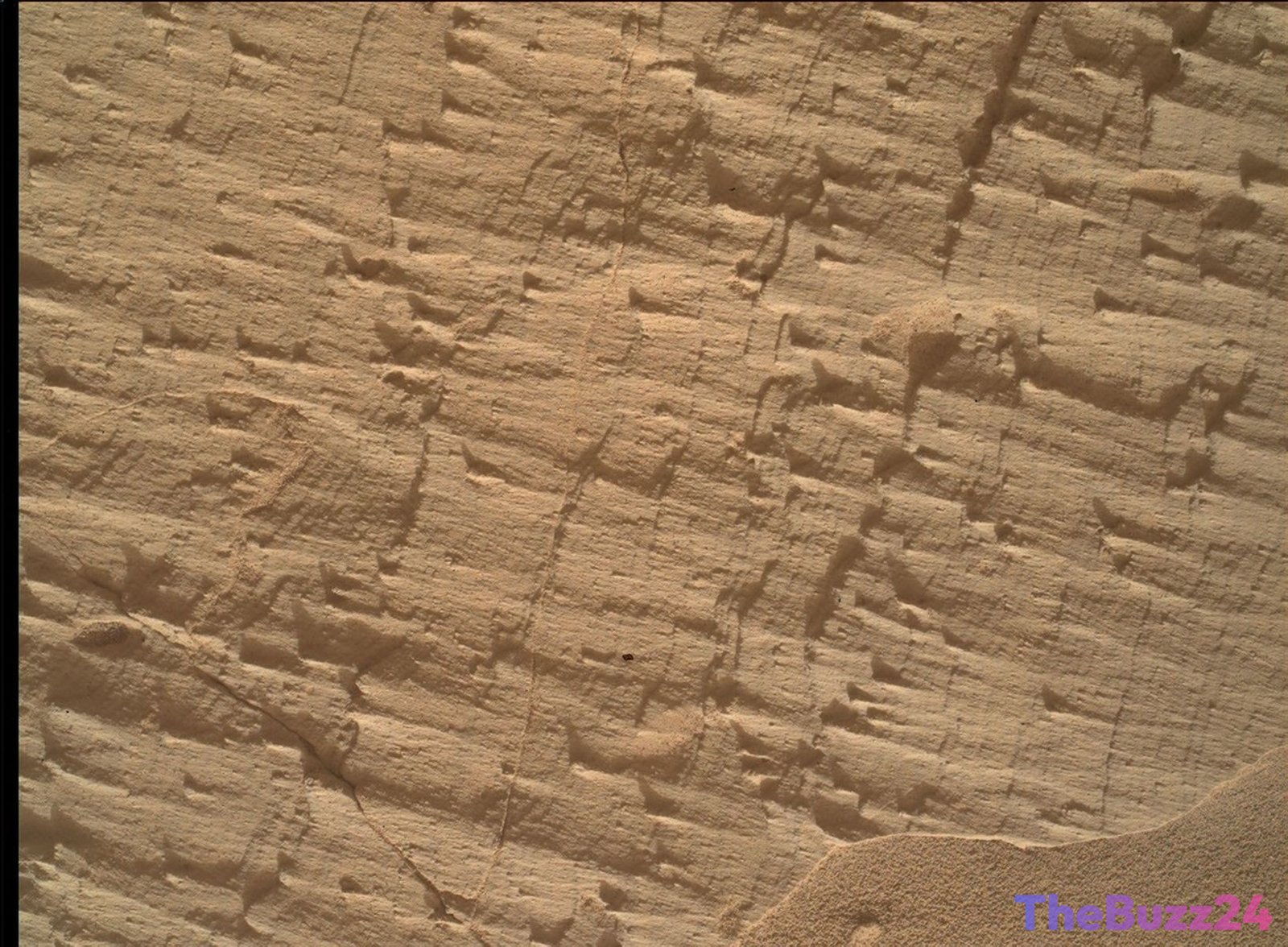
During its recent operations, spanning Sols 4968-4974, Curiosity meticulously examined the “Cerro Paine Grande” outcrop, a vertical rock face situated just below the suspected supersurface. The rover utilized its Mastcam instrument to capture extensive stereo mosaics of this exposed rock layer, providing detailed visual data. Following this, Curiosity climbed to the top of the outcrop, reaching an impressive 24-degree tilt, nearly matching the mission’s record for contact science. From this vantage point, the rover conducted a comprehensive 360-degree panorama, offering a broader geological context.
Detailed analysis of the rock layers beneath the discontinuity was performed using Curiosity’s suite of scientific instruments. The Mars Hand Lens Imager (MAHLI) and the Alpha Particle X-ray Spectrometer (APXS) were instrumental in characterizing fine-scale sedimentary textures and mineral compositions. Targeted laser analyses by ChemCam LIBS on various rock formations, including those exhibiting potential aeolian and fluvial features, are helping scientists piece together the environmental conditions that prevailed during this ancient period. Further analysis of sand samples aims to assess compositional consistency across the rover’s traverse, providing a more complete understanding of Martian geological history.
Key Takeaways
- NASA's Curiosity rover is investigating a geological "supersurface" on Mars, representing a significant shift in ancient environmental conditions.
- The rover successfully climbed a steep outcrop, capturing high-resolution images and conducting detailed rock analyses.
- Data from Mastcam, MAHLI, APXS, and ChemCam are being used to understand past Martian climate and geological processes.
Editor’s Analysis & Impact
The ongoing exploration by the Curiosity rover continues to yield invaluable data on Mars’ complex geological past. The investigation of the erosional supersurface is particularly significant, as it directly addresses key questions about the planet’s transition from potentially wetter, more dynamic periods to its current arid state. The ability of the rover to overcome challenging terrain and perform detailed in-situ analyses highlights the advancements in robotic exploration technology. The findings from this region could provide crucial context for understanding the potential for past habitability on Mars and inform future mission planning.
Frequently Asked Questions
Q: What is an "erosional supersurface"?
A: An erosional supersurface is a geological feature on Mars that indicates a period where the net environmental condition changed from deposition (building up of layers) to erosion (wearing away of layers), and then potentially back to deposition. This creates a discontinuity or break in the rock record.
Q: What instruments is Curiosity using to study these rocks?
A: Curiosity is using a suite of instruments including Mastcam for panoramic and stereo imaging, the Mars Hand Lens Imager (MAHLI) for close-up views of rock textures, the Alpha Particle X-ray Spectrometer (APXS) for elemental composition, and ChemCam (including LIBS) for laser-induced breakdown spectroscopy to analyze rock chemistry.
Q: Why is studying these rock layers important?
A: Studying these ancient rock layers is crucial for understanding Mars' past climate, geological evolution, and whether conditions suitable for life may have once existed on the planet. The discontinuity represents a significant environmental change that scientists are keen to decipher.
AI Disclosure: This article is based on verified data and official reports. Our Team and AI have cross-referenced every financial detail with primary sources to ensure total accuracy.
More from this Category