Saturn’s Celestial Family: A Glimpse at the Ringed Giant’s Diverse Moon System
Saturn continues to assert its dominance in the solar system’s moon count. As of mid-2026, the gas giant boasts a staggering 293 confirmed moons, far outpacing Jupiter, which currently holds 115. While many of these satellites are tiny, irregular fragments orbiting in tilted paths, the sheer scale of Saturn’s lunar system is unparalleled.
Among this vast collection are several major moons that define the planet’s neighborhood. Titan, the most prominent of these, stands as a massive world with a diameter of 5,150 kilometers—larger than Earth’s Moon and even slightly bigger than Mercury. First identified by Christiaan Huygens in 1655, Titan remains a primary focus for planetary science due to its complex atmosphere and size.
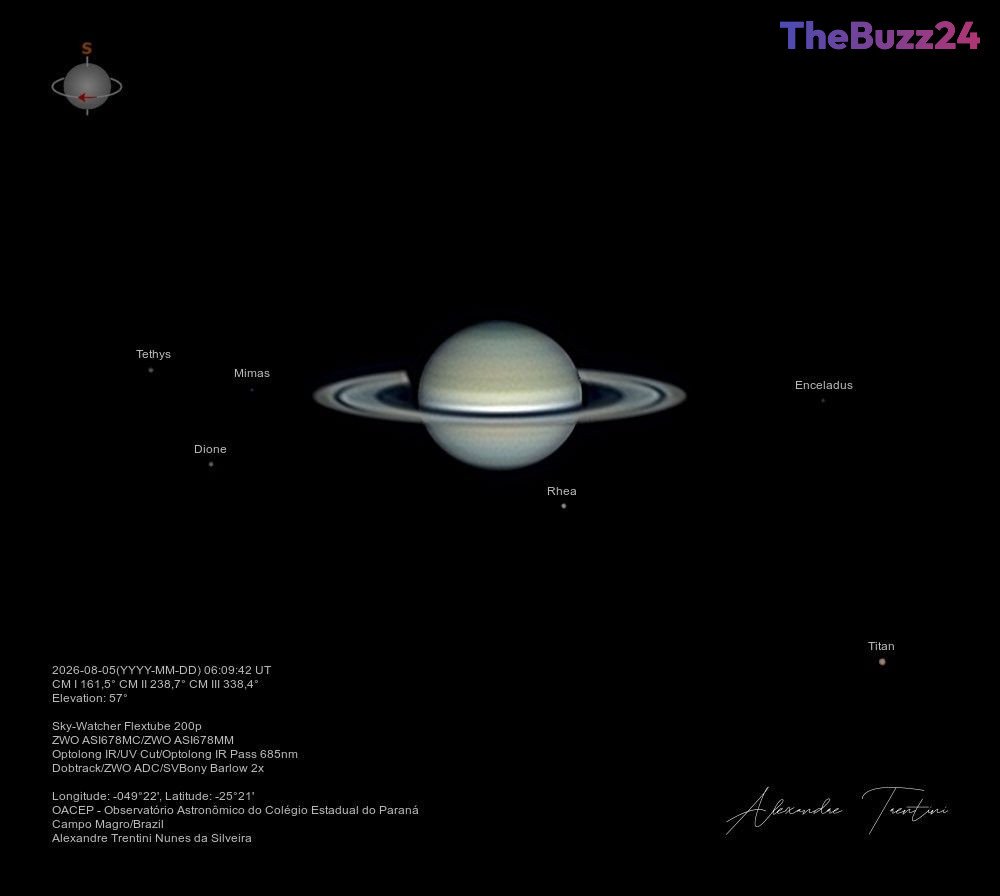
Recent telescopic observations have captured a stunning view of Saturn’s most significant satellites. Alongside Titan, the icy moons Mimas, Tethys, Enceladus, Dione, and Rhea are clearly visible in recent high-resolution imagery. These moons, many of which were characterized through the legacy of the Voyager and Cassini missions, provide critical insights into the formation and evolution of our solar system.
Key Takeaways
- Saturn currently holds the record for the most confirmed moons in the solar system with 293.
- Titan is the largest moon in the group, surpassing the size of Mercury.
- The Saturnian system includes a diverse range of icy moons, including Enceladus and Rhea.
Editor’s Analysis & Impact
The increasing number of confirmed moons around Saturn highlights the ongoing evolution of planetary science and our observational capabilities. As technology advances, the distinction between ‘major’ moons and ‘irregular satellites’ continues to blur, with many small bodies being discovered in the outer reaches of the Saturnian system. This surge in discoveries, fueled by data from past missions like Cassini and modern telescopic advancements, suggests that our understanding of gas giant systems is far from complete. For the scientific community, the focus is shifting from mere discovery to detailed characterization—understanding the geophysics, atmospheres, and potential habitability of moons like Enceladus and Titan. This trend indicates a future where the study of moons may become as significant as the study of the planets themselves.
Frequently Asked Questions
Q: Which planet has the most moons?
A: As of 2026, Saturn leads the solar system with 293 confirmed moons, significantly more than Jupiter's 115.
Q: How big is Saturn's moon Titan?
A: Titan is a massive satellite with a diameter of approximately 5,150 kilometers, making it larger than Earth's Moon and slightly larger than the planet Mercury.
Q: Who discovered Titan?
A: Titan was first discovered in 1655 by the Dutch astronomer Christiaan Huygens.
AI Disclosure: This article is based on verified data and official reports. Our Team and AI have cross-referenced every financial detail with primary sources to ensure total accuracy.
More from this Category