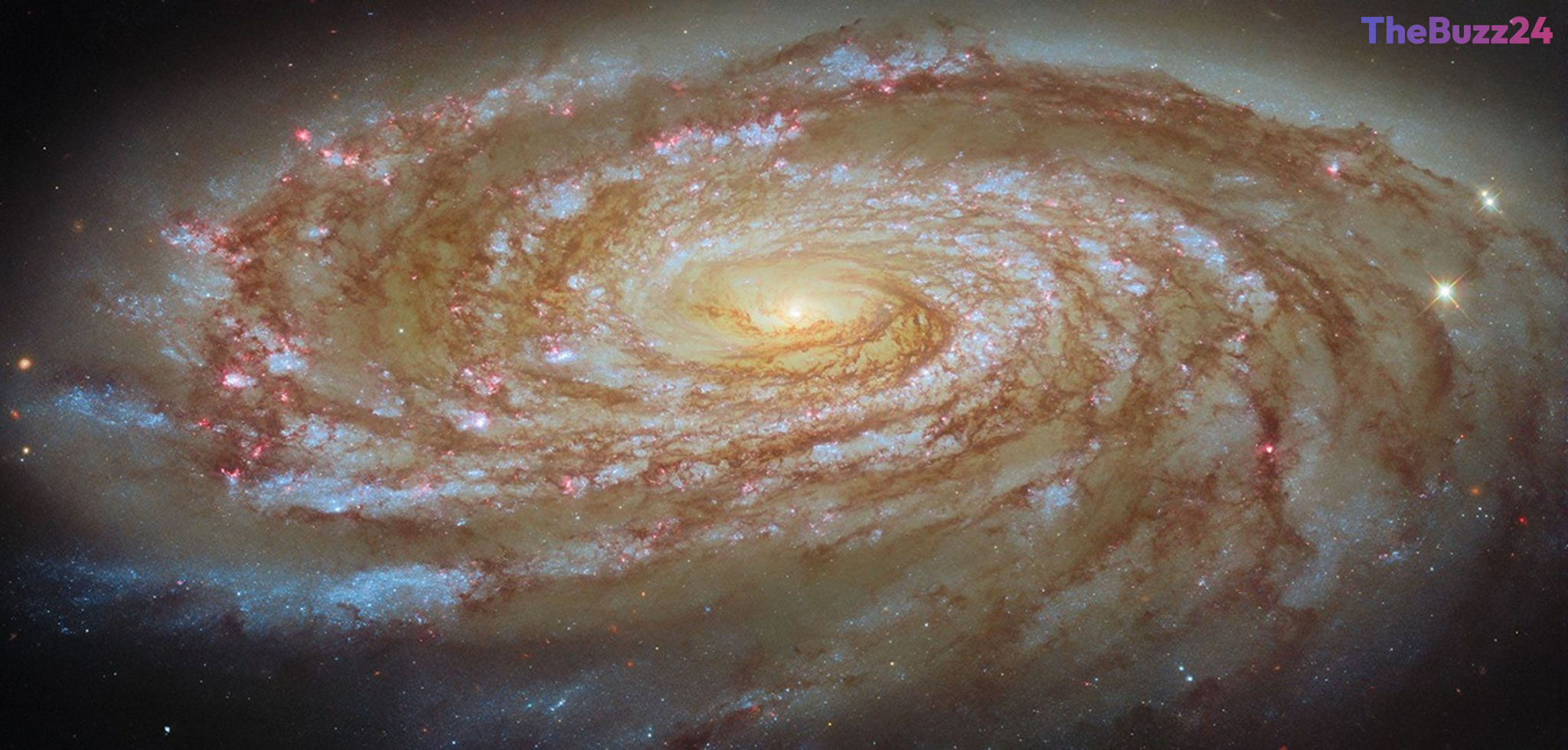
Deep Space Snapshot: Hubble Captures the Active Spiral Galaxy Messier 88
The Hubble Space Telescope has provided a stunning new look at Messier 88 (M88), a prominent spiral galaxy situated approximately 63 million light-years from Earth. Located within the Coma Berenices constellation, this celestial structure is currently undergoing a significant evolutionary journey that has spanned hundreds of millions of years as it navigates the dense environment of the Virgo Cluster.
Classified as an active galaxy, M88 is defined by the intense gravitational activity occurring at its core. Astronomers have identified a supermassive black hole at the center of the galaxy, estimated to be roughly 100 million times the mass of our Sun. This massive object is actively consuming surrounding gas and dust, a process that generates powerful outflows of material radiating outward from the galactic center.
This latest observation highlights the complex dynamics of spiral galaxies and the role of supermassive black holes in shaping their host environments. By studying the interaction between the central black hole and the surrounding interstellar medium, researchers continue to gain critical insights into the life cycles of galaxies and the mechanisms that drive their long-term structural evolution.
Key Takeaways
- Messier 88 is a spiral galaxy located 63 million light-years away in the Coma Berenices constellation.
- The galaxy features a supermassive black hole at its core with a mass approximately 100 million times that of the Sun.
- Active consumption of gas and dust by the central black hole is currently driving significant outflows of material from the galaxy's center.
Editor’s Analysis & Impact
The imaging of Messier 88 serves as a vital data point in our ongoing effort to map the dynamics of the Virgo Cluster. From an industry perspective, the continued operation of the Hubble Space Telescope remains essential for high-resolution extragalactic research, bridging the gap between historical data and the next generation of space-based observatories. The study of active galactic nuclei (AGN) like M88 is crucial for understanding how black holes influence the star-formation rates and overall morphology of their host galaxies. As we refine our understanding of these cosmic engines, we improve our ability to model the evolution of the universe on a grand scale. Future research will likely focus on the long-term impact of these gas outflows on the galaxy’s ability to produce new stars, providing a clearer picture of galactic aging.
Frequently Asked Questions
Q: What makes Messier 88 an 'active' galaxy?
A: M88 is considered an active galaxy because it contains a supermassive black hole at its center that is actively accreting matter, which in turn powers energetic outflows of gas.
Q: How far away is Messier 88 from Earth?
A: Messier 88 is located approximately 63 million light-years away from Earth in the constellation Coma Berenices.
AI Disclosure: This article is based on verified data and official reports. Our Team and AI have cross-referenced every financial detail with primary sources to ensure total accuracy.
More from this Category