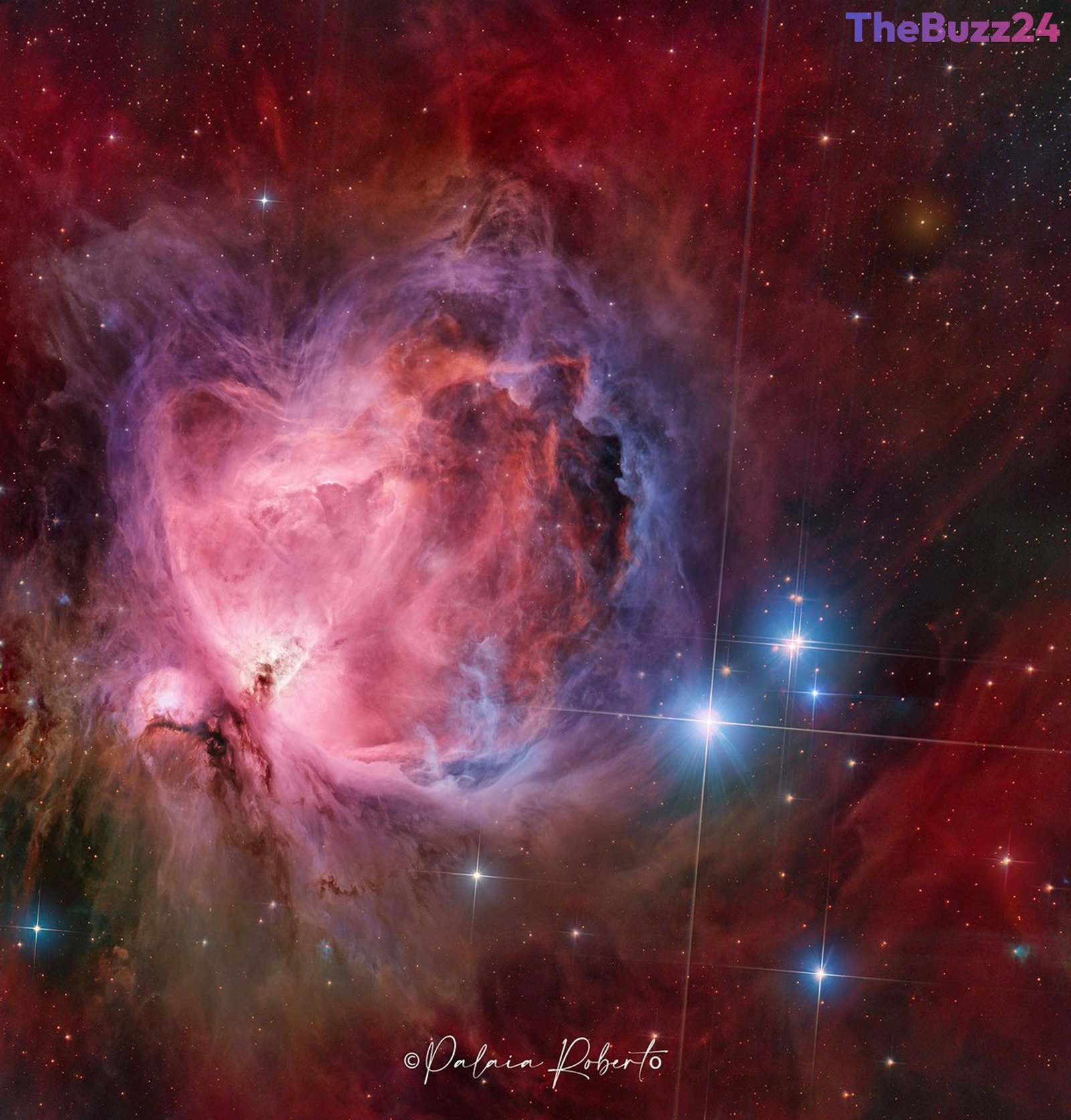
Exploring M42: Stunning New Visuals Reveal the Stellar Nursery of the Orion Nebula
Located roughly 1,500 light-years from Earth, the Great Nebula in Orion—cataloged as M42—remains one of the most intensely studied and visually striking starbirth regions in our galaxy. Situated within the same spiral arm of the Milky Way as our solar system, this immense cosmic structure offers astronomers an unprecedented vantage point into the raw mechanisms of stellar evolution. Spanning approximately 40 light-years across, M42 consists of vibrant glowing gas, intricate veils of dust, and intense energetic radiation generated by newly forged stars.
At the central core of the nebula lies a famous open star cluster known as the Trapezium. The massive, hot stars within this cluster radiate extreme energy, illuminating the surrounding hydrogen gas clouds and casting dramatic shadows across dense interstellar dust. Deep astrophotographic images captured in specific spectral wavelengths reveal intricate wisps, shockwaves, and high-velocity stellar jets that spew material into space, actively reshaping the surrounding cloud density.
In addition to its massive stellar inhabitants, the Orion Nebula houses numerous protoplanetary disks, or proplyds, which represent the earliest embryonic stages of emerging solar systems. Because of its proximity and brightness, M42 is uniquely accessible to earthbound observers. Located just below the iconic three-star belt in the constellation Orion, the nebula can be identified with the unaided eye under clear dark skies, serving as both a popular viewing target for amateur skywatchers and an indispensable natural laboratory for planetary scientists.
Key Takeaways
- The Great Nebula in Orion (M42) spans 40 light-years and is situated 1,500 light-years away in the Milky Way's local spiral arm.
- The region acts as a vibrant stellar nursery containing energetic young stars, protoplanetary disks (proplyds), and high-velocity jets.
- Located near Orion's Belt, M42 is easily visible to the naked eye and provides valuable insights into how star systems form.
Editor’s Analysis & Impact
High-resolution observations of cosmic nurseries like M42 continue to drive fundamental advancements in astrophysics and planetary science. Because the Orion Nebula is relatively close to Earth in astronomical terms, it serves as the benchmark model for studying star formation and early protoplanetary disk evolution. The detection and analysis of proplyds within M42 offer vital clues regarding how our own Solar System originated roughly 4.6 billion years ago. As next-generation ground-based observatories and space telescopes refine our imaging capabilities, detailed spectral analysis of M42 will shed further light on the distribution of complex organic molecules and heavy elements critical for planet building throughout the galaxy.
Frequently Asked Questions
Q: What is M42 or the Orion Nebula?
A: M42, commonly known as the Great Nebula in Orion, is a vast interstellar cloud of gas and dust located 1,500 light-years from Earth where new stars are actively forming.
Q: Can the Orion Nebula be seen without a telescope?
A: Yes, under dark and clear skies, the Orion Nebula can be spotted with the naked eye as a faint, fuzzy patch of light near the constellation Orion's Belt.
Q: Why is the Orion Nebula important to astronomers?
A: Because of its close proximity to Earth, M42 provides scientists with a detailed view of active star formation, stellar jets, and protoplanetary disks that could eventually mature into new planetary systems.
AI Disclosure: This article is based on verified data and official reports. Our Team and AI have cross-referenced every financial detail with primary sources to ensure total accuracy.
More from this Category