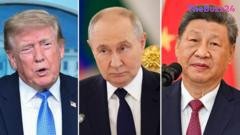
Global Powers Converge: Trump, Putin, and Xi Set for Landmark China Summit
The leaders of the United States, Russia, and China are slated to hold an unprecedented trilateral meeting next week on the sidelines of the Asia-Pacific Economic Co-operation (APEC) summit in Shenzhen, China. This landmark gathering will bring together U.S. President Donald Trump, Russian President Vladimir Putin, and Chinese President Xi Jinping for discussions on critical global issues.
A primary focus for the U.S. delegation, as articulated by a White House spokesperson, will be the urgent need for global nuclear weapons reduction. President Trump has consistently voiced concerns about nuclear proliferation, advocating for a new arms control framework that includes China, following the expiration of a key U.S.-Russia treaty in February. While Iran is also expected to be on the agenda, discussions are not anticipated to cover the conflict in Ukraine.
The trilateral talks come amidst a complex geopolitical landscape. Beijing has significantly deepened its economic ties with Moscow since Russia’s 2022 invasion of Ukraine, which led to widespread Western sanctions. Concurrently, relations between the U.S. and China remain multifaceted, marked by ongoing dialogues on trade, technological competition, and regional stability, including Taiwan. Despite the high-level engagement, senior U.S. officials have indicated that no formal agreement is expected to emerge from the discussions.
President Trump’s visit to China is part of a broader diplomatic tour that also includes an Association of South-east Asian Nations (ASEAN) summit in the Philippines. This upcoming meeting with Xi will mark their fourth interaction since President Trump’s return to office in 2025, underscoring continuous high-level engagement between the two nations. Both Chinese and Russian state channels have acknowledged plans for bilateral talks at the summit, with the Kremlin confirming readiness for trilateral discussions.
Key Takeaways
- Leaders of the U.S., Russia, and China are scheduled for a historic trilateral meeting at the APEC summit in Shenzhen, China.
- U.S. President Trump aims to discuss nuclear weapons reduction, advocating for a new arms control treaty that includes China, with Iran also on the agenda.
- No formal agreements are anticipated from the talks, which occur amid complex U.S.-China and China-Russia geopolitical dynamics.
Editor’s Analysis & Impact
This unprecedented trilateral meeting signals a critical juncture in global diplomacy, reflecting both the complexities and necessities of engagement among the world’s leading powers. While immediate breakthroughs are not expected, the very act of these leaders convening could offer a pathway for de-escalation on contentious issues like nuclear proliferation and regional conflicts. For markets, any perceived shift in geopolitical stability, particularly concerning trade relations between the U.S. and China or energy flows involving Russia and Iran, could trigger significant reactions. The discussions on AI dominance and trade also highlight the ongoing economic competition. The broader implication is a potential recalibration of international relations, moving towards a more multipolar world where direct dialogue among major players becomes increasingly vital, even in the absence of immediate consensus.
Frequently Asked Questions
Q: What is the primary purpose of this trilateral meeting?
A: The primary purpose, from the U.S. perspective, is to discuss global nuclear weapons reduction and the potential for a new arms control framework that includes China. Iran is also expected to be a topic.
Q: Where and when will the meeting take place?
A: The meeting is scheduled to occur next week on the sidelines of the Asia-Pacific Economic Co-operation (APEC) summit in Shenzhen, China.
Q: Are any major agreements expected from these talks?
A: Senior U.S. officials have indicated that no formal agreements are anticipated to emerge from these high-level discussions.
AI Disclosure: This article is based on verified data and official reports. Our Team and AI have cross-referenced every financial detail with primary sources to ensure total accuracy.
More from this Category