Global Space Alliance Soars: Artemis Accords Surpass 75 Nations, Charting Future of Exploration
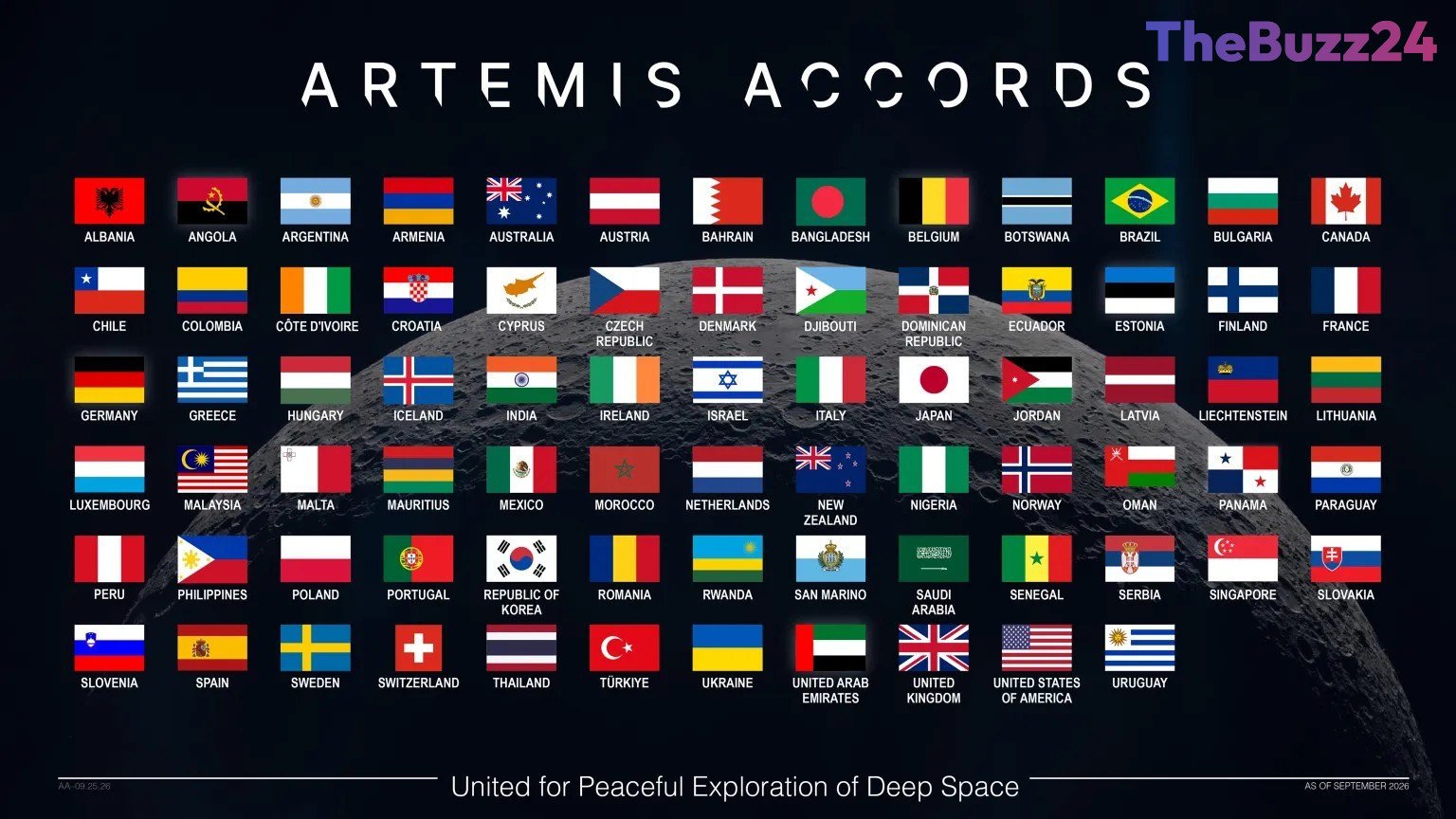
The international framework for space exploration, the Artemis Accords, has reached a significant milestone, now encompassing 76 signatory nations. This expansion underscores a growing global commitment to responsible and peaceful activities beyond Earth’s atmosphere, with Albania, Croatia, Côte d’Ivoire, and San Marino being the latest countries to join the collaborative effort.
NASA Administrator Jared Isaacman emphasized the accelerating momentum, stating, “Our momentum reflects a growing commitment to peaceful, responsible exploration and a shared understanding that the future in space will be shaped by those willing to lead.” He noted that nearly one-third of all signatories have joined since the start of President Trump’s second term, highlighting a concerted effort to strengthen a coalition of partners aligned with shared values for future exploration, including returning Americans to the lunar surface and laying groundwork for Mars. This rapid growth marks one of the most substantial expansions of international cooperation in civil space history, with nearly 40% of the world’s nations now participating. Notably, almost two-thirds of the countries that signed the foundational 1967 Outer Space Treaty have also endorsed the Artemis Accords.
What began as an informal coalition has evolved into a structured community, guided by the Signatories Group Method of Operations adopted in 2024. This framework facilitates twice-annual meetings, including a technical workshop and a Principals’ Meeting during the International Astronautical Congress (IAC), supplemented by virtual sessions throughout the year. These gatherings have been instrumental in advancing agreed-upon recommendations concerning noninterference, interoperability, scientific data sharing, and registration practices. Recent workshops have further solidified technical alignment, with signatories reviewing planned lunar landings and orbital missions, and engaging in hands-on sessions focused on open science and practical tools for sharing lunar data.
The upcoming Artemis Accords Principals’ Meeting, scheduled for October 5 at the IAC in Antalya, Türkiye, will be co-chaired by NASA Deputy Administrator Matt Anderson and Major General Roberto Melgar Sheen, director of the Peruvian Space Agency (CONIDA). The agenda includes discussions on supporting emerging space nations and disseminating recommendations for lunar debris mitigation. Furthermore, the creation of the Moon Base initiative extends an invitation to every Artemis Accords signatory to participate in the return to the Moon through scientific payloads, technology demonstrations, CubeSats, and other capabilities. Launched in 2020 by the United States and seven other nations, the Accords establish practical principles to enhance safety and coordination for exploration of the Moon, Mars, and beyond, committing signatories to explore peaceably and transparently, render aid, enable scientific data access, ensure non-interference, and preserve historically significant sites. More nations are anticipated to join this expanding global alliance in the coming years.
Key Takeaways
- The Artemis Accords now include 76 nations, significantly expanding global cooperation in space exploration and governance.
- The framework promotes peaceful, transparent, and responsible space activities through structured meetings, technical workshops, and shared principles.
- Participating nations are actively collaborating on technical alignment, data sharing, and lunar mission planning, with future opportunities for Moon Base involvement.
Editor’s Analysis & Impact
The rapid expansion of the Artemis Accords to 76 nations signals a growing international consensus on the principles governing future space exploration. This development is crucial for the burgeoning commercial space industry, as it provides a more stable and predictable regulatory environment, potentially reducing risks for private sector investment in lunar and deep-space missions. The standardization of practices and commitment to transparency fostered by the Accords could lower operational costs and enhance the success rate of complex international missions.
Looking ahead, the Accords are poised to become a foundational pillar of international space law, influencing policies on resource utilization, space debris mitigation, and planetary protection. This collaborative approach reinforces democratic values in space and sets a precedent for global governance in new frontiers, ensuring a more unified and responsible future for humanity’s endeavors beyond Earth.
Frequently Asked Questions
Q: What are the Artemis Accords?
A: The Artemis Accords are a set of non-binding principles established in 2020 by the United States and seven other nations to guide responsible and peaceful civil space exploration, particularly for activities on the Moon, Mars, and beyond. They aim to enhance safety, coordination, and transparency in international space endeavors.
Q: Which countries recently joined the Artemis Accords?
A: Albania, Croatia, Côte d’Ivoire, and San Marino are the latest nations to join the Artemis Accords, bringing the total number of signatories to 76 countries.
Q: What are the core principles that signatories commit to under the Artemis Accords?
A: Signatories commit to several core principles, including exploring space peaceably and transparently, rendering aid to those in need, enabling access to scientific data, ensuring activities do not interfere with others, and preserving historically significant sites and artifacts by developing best practices.
AI Disclosure: This article is based on verified data and official reports. Our Team and AI have cross-referenced every financial detail with primary sources to ensure total accuracy.
More from this Category