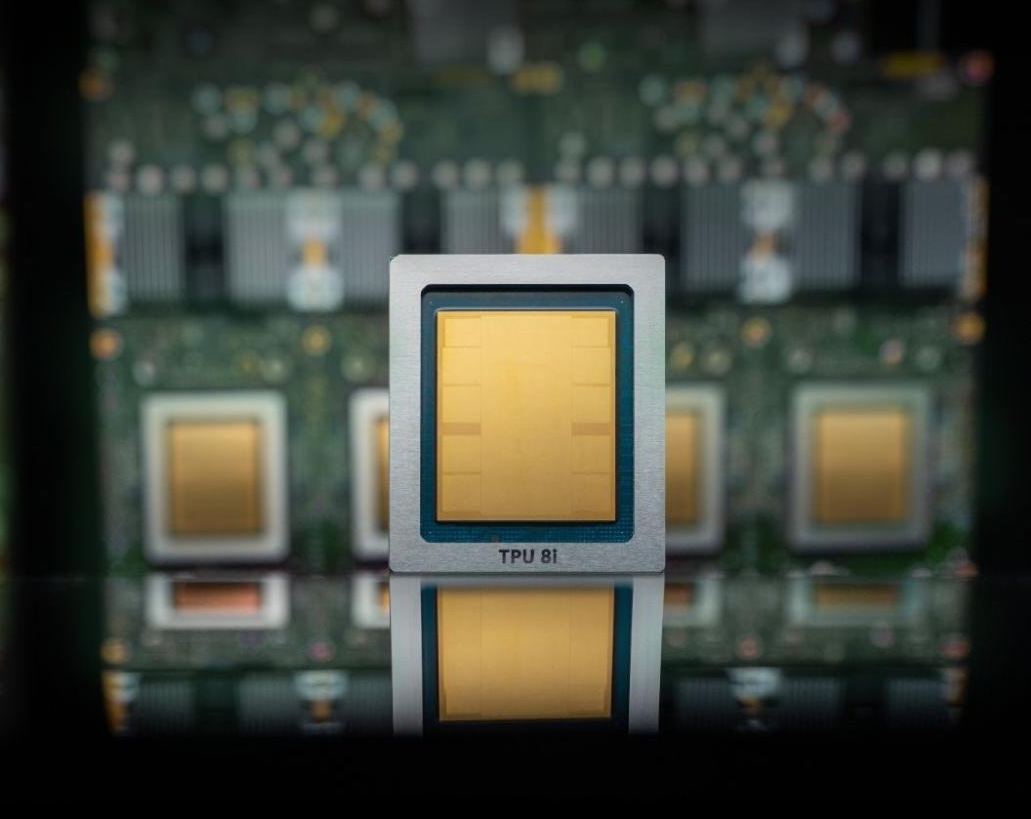
Google Cloud Debuts Eighth-Generation AI Chips to Boost Computing Efficiency
Google Cloud has officially launched its eighth generation of custom-designed Tensor Processing Units (TPUs), marking a significant milestone in the company’s effort to optimize artificial intelligence infrastructure. The new lineup includes two distinct chips: the TPU 8t, which is specifically engineered for the heavy lifting required in AI model training, and the TPU 8i, which is optimized for inference tasks—the process of deploying trained models for real-world applications.
These next-generation processors represent a substantial leap in performance compared to previous iterations. According to internal benchmarks, the new architecture offers up to three times faster training speeds and an 80% improvement in performance per dollar. A standout feature of this new hardware is its ability to scale, allowing for the connection of over one million TPUs into a single, unified cluster. This design is intended to provide customers with massive computing power while simultaneously improving energy efficiency and lowering operational overhead.
Despite the push toward proprietary silicon, Google Cloud maintains a balanced approach by continuing to integrate Nvidia hardware into its ecosystem. The company confirmed that it will offer Nvidia’s upcoming Vera Rubin chips to its users later this year. Furthermore, Google and Nvidia are collaborating on the refinement of Falcon, an open-source networking technology designed to enhance the efficiency of Nvidia-based systems within cloud environments. This dual-track strategy ensures that Google Cloud can leverage its own custom hardware while continuing to support the industry-standard performance provided by Nvidia’s GPUs.
Key Takeaways
- Google Cloud introduced the TPU 8t and TPU 8i, eighth-generation chips designed for AI training and inference respectively.
- The new architecture supports clusters of over one million chips, promising a 3x increase in training speed and 80% better cost-performance.
- Google is maintaining its partnership with Nvidia, planning to offer the new Vera Rubin chips and co-developing networking solutions for better hardware integration.
Editor’s Analysis & Impact
The introduction of the eighth-generation TPU signifies a strategic pivot by hyperscalers to reduce dependency on third-party hardware while maintaining a hybrid ecosystem. By developing custom silicon that excels in specific AI workloads, Google Cloud is effectively lowering the barrier to entry for large-scale model training, which is currently a massive cost driver for enterprises. However, the continued collaboration with Nvidia highlights that proprietary hardware is not yet a total replacement for general-purpose GPUs. The broader implication is a shift toward ‘heterogeneous computing,’ where cloud providers mix and match custom and off-the-shelf hardware to maximize efficiency. As AI models grow in complexity, the ability to scale clusters to over a million units will become a critical competitive advantage for cloud providers vying for dominance in the enterprise AI market.
Frequently Asked Questions
Q: What is the difference between the TPU 8t and the TPU 8i?
A: The TPU 8t is specifically optimized for the intensive process of training AI models, while the TPU 8i is designed for inference, which is the application of those models to perform tasks.
Q: Does the launch of these new chips mean Google is moving away from Nvidia hardware?
A: No. Google Cloud continues to integrate Nvidia's GPUs into its infrastructure and plans to offer the upcoming Vera Rubin chips to its customers, indicating a strategy of using both custom and third-party hardware.
AI Disclosure: This article is based on verified data and official reports. Our Team and AI have cross-referenced every financial detail with primary sources to ensure total accuracy.
More from this Category