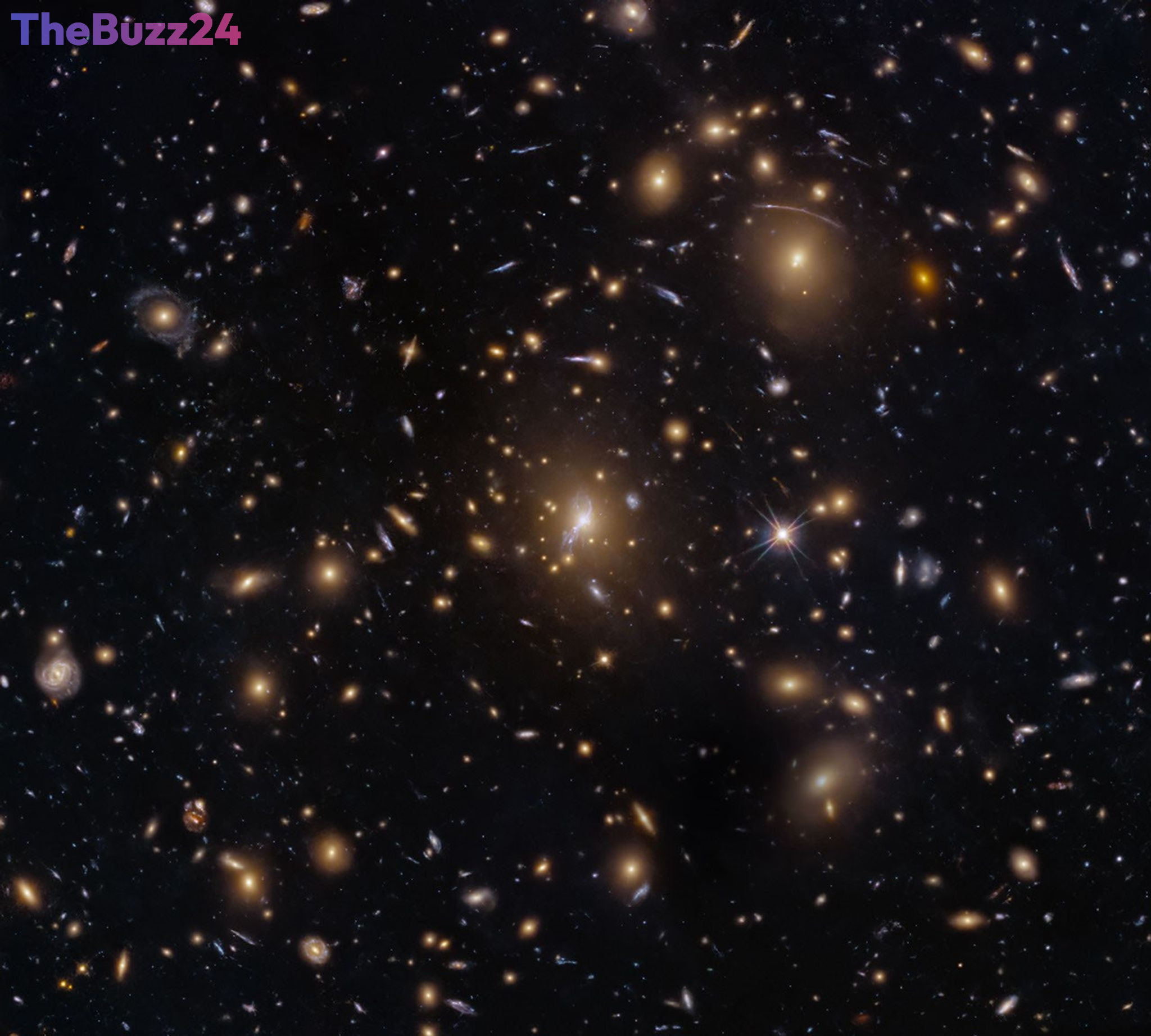
Hubble Captures Cosmic Swarm: Galaxy Cluster MACS0329-0211 Revealed
The Hubble Space Telescope has delivered a stunning new image showcasing the galaxy cluster MACS0329-0211, an astronomical formation that resembles a bustling swarm of bees returning to their hive. Released on June 12, 2026, this observation provides valuable insights into the evolution of the universe’s structure.
Galaxy clusters such as MACS0329-0211 serve as crucial cosmic signposts, offering astronomers a unique perspective on the universe’s development. They act as natural telescopes, magnifying the light from galaxies in the universe’s earliest stages, allowing us to peer back billions of years. Within this particular cluster, a diverse population of galaxies can be observed, including large, oval-shaped elliptical galaxies and slender spiral and lenticular galaxies seen from their edges. The image also captures the full, face-on view of spiral galaxies, their characteristic arms clearly visible.
A closer examination of the upper-right quadrant reveals faint arcs, which are the distorted images of even more distant galaxies. Their light has been bent and magnified by the immense gravitational pull of the MACS0329-0211 cluster. The most prominent of these arcs is situated above a large, bright elliptical galaxy. At the heart of the image, intricate, intersecting curves form a distorted figure-eight pattern, likely another distant galaxy whose light has been dramatically warped by the cluster’s powerful gravity.
This detailed observation of MACS0329-0211 was conducted as part of a broader research program focused on X-ray bright galaxy clusters. Scientists utilized Hubble’s Advanced Camera for Surveys and Wide Field Camera 3 to capture data across visible and infrared light spectrums. Hubble’s remarkable capability to observe such a wide range of light wavelengths underscores its importance in unraveling the fundamental nature of these massive cosmic structures.
Key Takeaways
- The Hubble Space Telescope has imaged the galaxy cluster MACS0329-0211, revealing a diverse collection of galaxies.
- Galaxy clusters act as natural lenses, magnifying light from the early universe and aiding in the study of cosmic evolution.
- The observation utilized Hubble's Advanced Camera for Surveys and Wide Field Camera 3 to capture visible and infrared light.
Editor’s Analysis & Impact
The imaging of MACS0329-0211 by the Hubble Space Telescope highlights the ongoing significance of space-based observatories in cosmological research. Galaxy clusters are not only visually spectacular but are fundamental to understanding dark matter distribution and the large-scale structure of the universe. The gravitational lensing effect observed in this image provides a powerful tool for studying faint, distant galaxies that would otherwise be undetectable. This data will contribute to refining models of cosmic evolution and the formation of the earliest galaxies, reinforcing the value of continued investment in advanced astronomical instruments.
Frequently Asked Questions
Q: What is MACS0329-0211?
A: MACS0329-0211 is a galaxy cluster, a massive collection of galaxies bound together by gravity. These clusters are important for studying the evolution of the universe.
Q: What is gravitational lensing?
A: Gravitational lensing is a phenomenon where the gravity of a massive object, like a galaxy cluster, bends the light from objects behind it. This can magnify and distort the appearance of distant galaxies, allowing astronomers to study them.
Q: Which instruments on Hubble were used for this observation?
A: The observation utilized Hubble's Advanced Camera for Surveys (ACS) and Wide Field Camera 3 (WFC3) to gather data in visible and infrared light.
AI Disclosure: This article is based on verified data and official reports. Our Team and AI have cross-referenced every financial detail with primary sources to ensure total accuracy.
More from this Category