Hubble Captures Dazzling Stellar Nursery Aglow in Crimson Hues
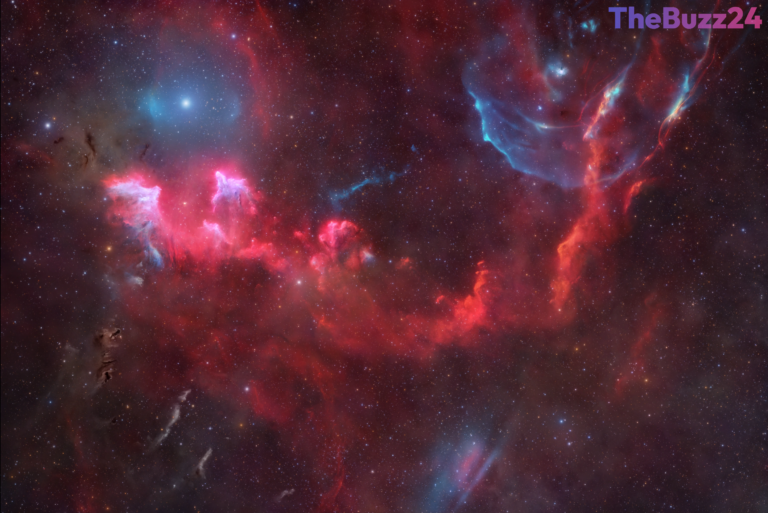
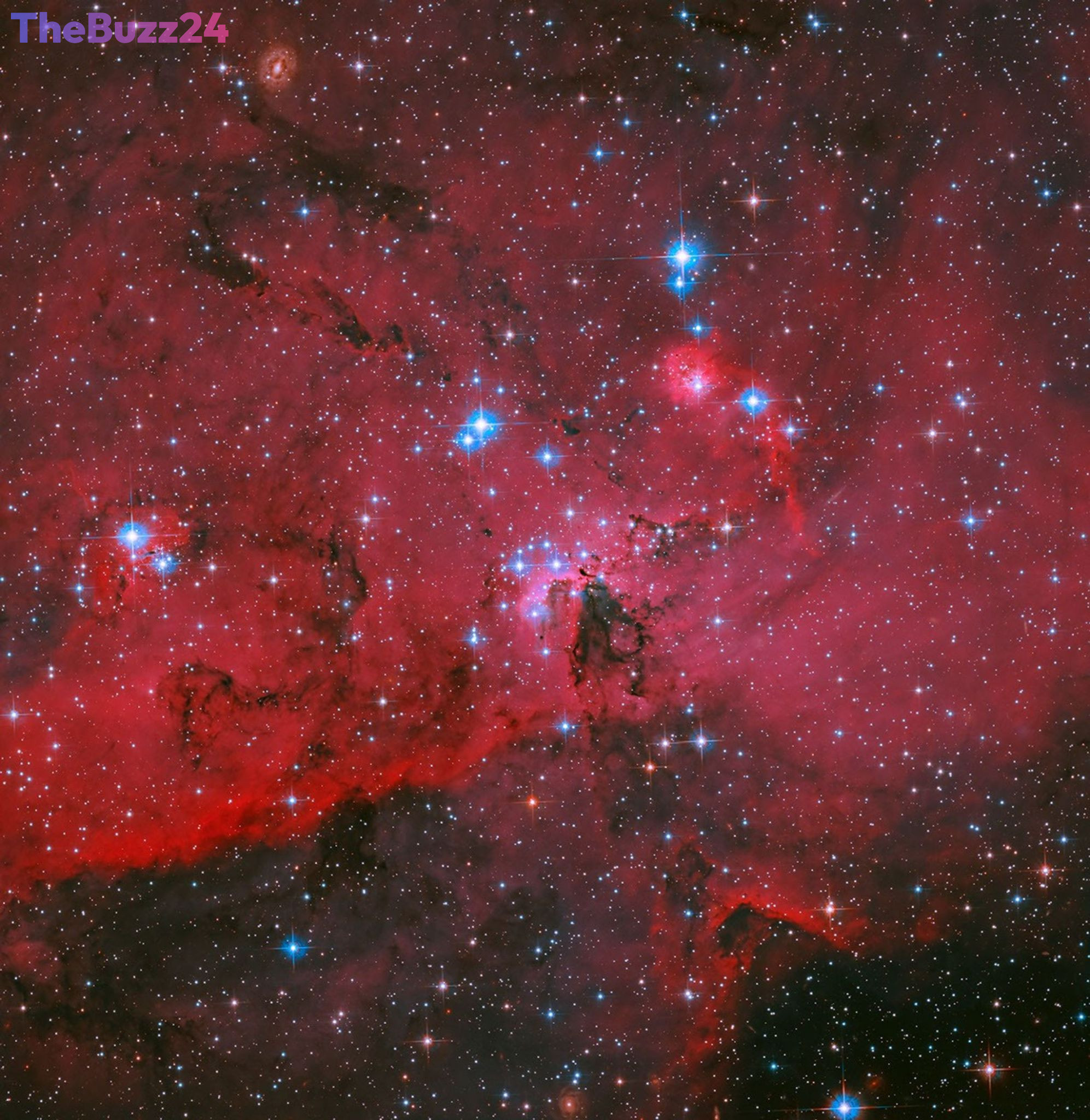
The Hubble Space Telescope has unveiled a breathtaking vista within the Large Magellanic Cloud, showcasing the stellar nursery known as LH 95. This dynamic region is a vibrant tapestry of gas and dust, dramatically illuminated and heated by a dense cluster of newly formed stars. The image reveals brilliant blue and white stars set against a striking crimson backdrop of incandescent gas, painting a vivid picture of cosmic creation.
LH 95 is situated in the Large Magellanic Cloud, a satellite galaxy gravitationally bound to our own Milky Way. Within this stellar association, a diverse population of stars exists, ranging from low-mass infant stars still in their formative stages to colossal, massive blue giant stars. This cohabitation highlights the complex and active environment where stars are born and evolve.
The detailed observations from Hubble provide an unprecedented look into the processes occurring within such stellar nurseries. The interplay of light and matter in LH 95 offers valuable insights for astronomers studying star formation, galactic evolution, and the conditions necessary for the emergence of planetary systems. The clarity of the image underscores the enduring power of space-based observatories in expanding our understanding of the universe.
Key Takeaways
- Hubble Space Telescope has captured a detailed image of the stellar nursery LH 95 in the Large Magellanic Cloud.
- The region is characterized by a mix of young, low-mass stars and massive blue giant stars, alongside glowing gas and dust.
- The image provides valuable data for understanding star formation and galactic evolution.
Editor’s Analysis & Impact
This stunning image from the Hubble Space Telescope not only offers a visually spectacular glimpse into a distant stellar nursery but also provides crucial data for astrophysical research. The detailed observation of LH 95, with its diverse stellar population and energetic gas clouds, allows scientists to refine models of star formation and the early stages of galactic development. Such findings contribute to our broader understanding of how stars, and potentially planetary systems, come into being, impacting fields from cosmology to astrobiology. The continued operation of observatories like Hubble remains vital for pushing the boundaries of our cosmic knowledge.
Frequently Asked Questions
Q: What is the Large Magellanic Cloud?
A: The Large Magellanic Cloud is a dwarf galaxy that orbits the Milky Way, our own galaxy. It is one of the closest galaxies to the Milky Way and is a significant site for astronomical observation.
Q: What is a stellar nursery?
A: A stellar nursery is a region in space where stars are born. These areas are typically composed of dense clouds of interstellar gas and dust, which collapse under gravity to form new stars.
Q: Why is observing stellar nurseries important?
A: Observing stellar nurseries is crucial for understanding the processes of star formation, the evolution of galaxies, and the conditions under which planets, including those that might support life, can form.
AI Disclosure: This article is based on verified data and official reports. Our Team and AI have cross-referenced every financial detail with primary sources to ensure total accuracy.
More from this Category