Hubble Unveils Cosmic Bridge: Rare Transitional Galaxy NGC 1266 Offers Evolutionary Insights
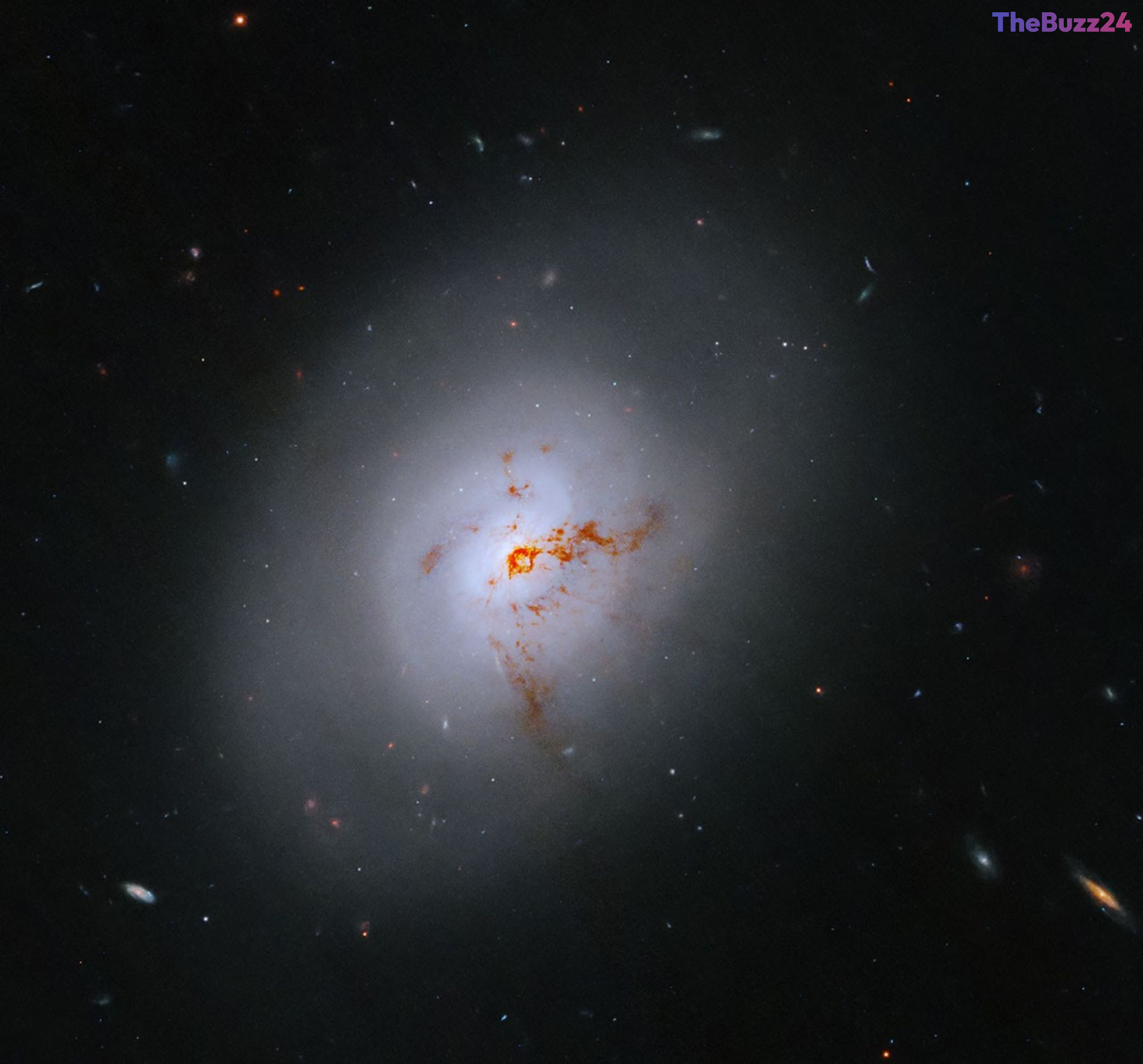
The venerable Hubble Space Telescope has delivered a captivating new perspective on NGC 1266, an enigmatic galaxy that serves as a crucial link in the cosmic evolutionary chain. Situated roughly 100 million light-years from Earth within the constellation Eridanus, this celestial body presents a striking appearance: a luminous, dense core encased within a flattened disk. Intriguingly, it conspicuously lacks the well-defined spiral arms typically associated with such galactic structures. Instead, its central regions are partially obscured by intricate, reddish-brown filaments of dust, adding to its mysterious allure.
Astronomers classify NGC 1266 as a lenticular galaxy, a distinct category representing an intermediate stage in galactic evolution, bridging the gap between spiral and elliptical galaxies. While these transitional systems share the characteristic lens-shaped profile and prominent central bulge found in spirals, they are notable for their absence of active star-forming regions and the clear, sweeping arms of their counterparts. This latest observation by Hubble vividly captures the galaxy’s diffuse outer reaches, where the faint glow of distant background galaxies — appearing as vibrant red, blue, and orange specks — punctuates the vast expanse of deep space.
This detailed imagery provides researchers with invaluable data, enhancing our comprehension of how galaxies transform over cosmic timescales. By meticulously examining the structural characteristics of lenticular galaxies like NGC 1266, scientists can more accurately map the complex processes that lead to the cessation of star formation and the profound changes in galactic morphology. The image powerfully illustrates the delicate interplay between dust and light that defines these pivotal transitional systems, offering a significant data point in the ongoing quest to unravel the mysteries of galactic development.
Key Takeaways
- The Hubble Space Telescope has captured new images of NGC 1266, a unique lenticular galaxy located 100 million light-years away.
- NGC 1266 is classified as a transitional galaxy, bridging the evolutionary gap between spiral and elliptical galaxies, and notably lacks active star formation.
- This observation provides critical insights into galactic evolution, helping scientists understand how galaxies cease star formation and change their morphology over time.
Editor’s Analysis & Impact
The observation of NGC 1266 by the Hubble Space Telescope significantly contributes to our understanding of galactic evolution, a cornerstone of astrophysics. While not impacting traditional financial markets, this discovery reinforces the immense value of long-term space missions and advanced observational instruments. It underscores the ongoing need for investment in space science, driving innovation in optics, data processing, and theoretical modeling. Future outlook involves combining such optical data with multi-wavelength observations from telescopes like the James Webb Space Telescope to build more comprehensive models of galaxy life cycles. The broader implication is a deeper appreciation for the universe’s dynamic nature, offering clues about the ultimate fate of galaxies, including our own Milky Way, and refining our cosmic narrative.
Frequently Asked Questions
Q: What is a lenticular galaxy?
A: A lenticular galaxy is a type of galaxy that serves as an evolutionary bridge between spiral and elliptical galaxies. It possesses a lens-shaped disk and a central bulge, similar to spirals, but lacks the distinct spiral arms and active star-forming regions typically found in them.
Q: Why is NGC 1266 considered important for astronomers?
A: NGC 1266 is crucial because it offers a unique opportunity to study the processes of galactic evolution. By observing its transitional characteristics, astronomers can gain insights into how galaxies cease forming new stars and undergo significant changes in their overall structure and morphology.
Q: Where is the galaxy NGC 1266 located?
A: NGC 1266 is situated approximately 100 million light-years away from Earth, residing within the constellation Eridanus.
AI Disclosure: This article is based on verified data and official reports. Our Team and AI have cross-referenced every financial detail with primary sources to ensure total accuracy.
More from this Category