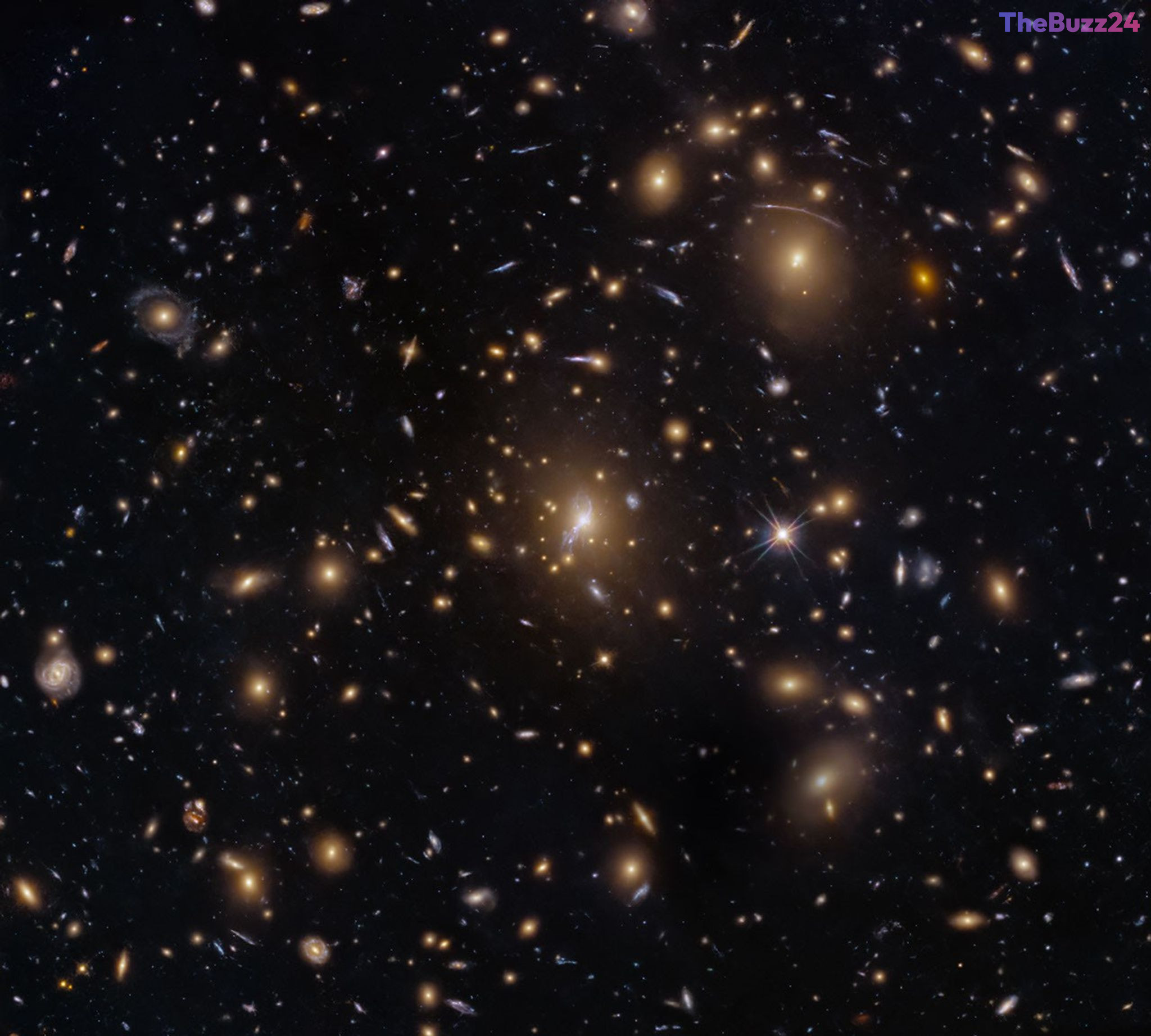
Hubble Telescope Captures Stunning View of Massive Galaxy Cluster MACS0329-0211
The Hubble Space Telescope has provided a breathtaking new look at the galaxy cluster MACS0329-0211, revealing a dense collection of celestial structures that resemble a swarm of bees. This cluster serves as a critical subject for astronomers studying the evolution of the universe, acting as a natural gravitational lens that magnifies light from even more distant, ancient galaxies that would otherwise remain hidden from view.
Within the cluster, observers can identify a diverse array of galactic forms, ranging from large, oval-shaped elliptical galaxies to thin, edge-on spiral and lenticular galaxies. The image also captures face-on spiral galaxies with clearly defined, curving arms. Notably, the upper-right quadrant of the frame displays faint, distorted arcs—evidence of gravitational lensing, where the massive gravity of the cluster bends and magnifies the light of background objects. A particularly striking feature near the center of the image shows intersecting white curves forming a distorted figure-eight pattern, likely another distant galaxy being warped by the cluster’s immense gravitational pull.
This observation was conducted as part of a specialized program targeting X-ray bright galaxy clusters. By utilizing both the Advanced Camera for Surveys and the Wide Field Camera 3, the telescope was able to collect data across both visible and infrared light spectrums. This multi-wavelength approach is essential for researchers to map the complex structure of these clusters and gain deeper insights into the fundamental mechanics of the cosmos.
Key Takeaways
- The Hubble Space Telescope captured a detailed image of the galaxy cluster MACS0329-0211, which acts as a natural gravitational lens.
- The cluster contains a variety of galaxy types, including elliptical, spiral, and lenticular, providing a snapshot of cosmic structural evolution.
- Researchers used both visible and infrared light sensors to analyze the cluster, helping to better understand the nature of massive galactic structures.
Editor’s Analysis & Impact
The continued productivity of the Hubble Space Telescope, even decades after its launch, remains a cornerstone of modern astrophysics. By focusing on massive galaxy clusters like MACS0329-0211, researchers are not merely cataloging distant objects; they are utilizing the universe’s own gravitational properties to peer into the deep past. This ‘natural telescope’ effect is vital for studying the early stages of galaxy formation. As we transition into an era of even more powerful observatories, the data gathered by Hubble serves as a foundational baseline. The ability to synthesize multi-wavelength data—combining X-ray, visible, and infrared observations—is increasingly critical for AI-driven analysis in astronomy, allowing scientists to map dark matter distributions and refine cosmological models regarding how the universe has expanded and structured itself over billions of years.
Frequently Asked Questions
Q: What is gravitational lensing?
A: Gravitational lensing occurs when a massive object, such as a galaxy cluster, bends the fabric of space-time with its gravity. This causes light from more distant objects behind it to be magnified and distorted, allowing astronomers to see galaxies that are otherwise too faint to detect.
Q: Why is MACS0329-0211 important to astronomers?
A: MACS0329-0211 is significant because it is an X-ray bright galaxy cluster. Studying these clusters helps scientists understand how the large-scale structure of the universe evolved and provides a laboratory for observing the effects of gravity on light across vast cosmic distances.
AI Disclosure: This article is based on verified data and official reports. Our Team and AI have cross-referenced every financial detail with primary sources to ensure total accuracy.
More from this Category