The Cosmic Mystery of Messier 64: Unraveling the Black Eye Galaxy’s Counter-Rotating Secrets
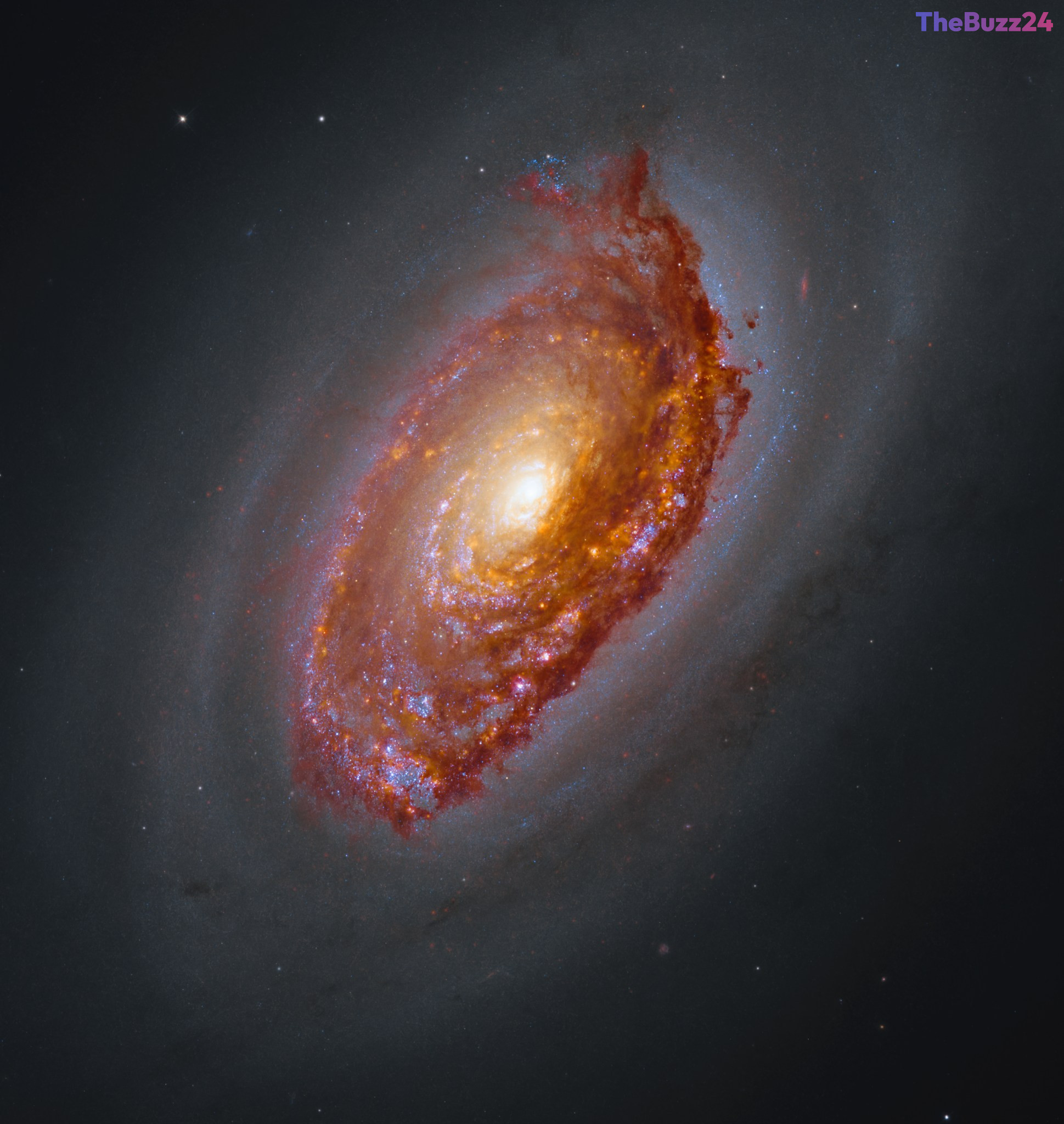
Messier 64, widely recognized by astronomers as the Black Eye Galaxy, remains one of the most visually striking and scientifically intriguing objects in the night sky. Its defining feature is a prominent, dark band of dust that partially obscures its brilliant, glowing core, creating the appearance of a bruised or ‘black’ eye. Beyond its aesthetic appeal, the galaxy is a subject of intense study due to its highly unusual internal dynamics.
Recent composite imagery, synthesized from data captured by the Hubble Space Telescope and the James Webb Space Telescope, has provided a clearer look at the galaxy across multiple wavelengths. While Hubble captures the galaxy in ultraviolet, visible, and near-infrared light, the James Webb Space Telescope contributes near- and mid-infrared data, allowing researchers to peer through the dense dust clouds that characterize the galaxy’s structure.
The most baffling aspect of Messier 64 is its internal motion. Observations reveal that the gas in the galaxy’s outer regions rotates in the opposite direction to the gas and stars located in its inner core. This counter-rotation is a rare phenomenon in spiral galaxies and suggests a violent history. Scientists hypothesize that this bizarre behavior is the lingering signature of a major galactic collision that occurred over a billion years ago, when Messier 64 absorbed a smaller satellite galaxy, fundamentally altering its rotational mechanics.
Key Takeaways
- Messier 64, known as the Black Eye Galaxy, features a distinct dark dust band that obscures its bright core.
- The galaxy exhibits a rare counter-rotating motion where outer gas moves in the opposite direction of its inner stars and gas.
- Astronomers believe this unique internal structure is the result of a galactic merger that took place more than a billion years ago.
Editor’s Analysis & Impact
The study of Messier 64 serves as a critical case study for understanding galactic evolution and the long-term effects of cosmic mergers. By utilizing multi-wavelength data from both the Hubble and James Webb telescopes, researchers are gaining unprecedented insight into how galaxies stabilize after significant gravitational disturbances. The counter-rotating gas disks provide a ‘fossil record’ of past interactions, offering a window into the chaotic history of our universe. As we continue to refine our models of galaxy formation, objects like the Black Eye Galaxy prove that the structural integrity of a galaxy is often the result of violent past events. This research not only enhances our knowledge of local galactic dynamics but also informs broader theories regarding how dark matter and gravitational forces shape the large-scale structure of the cosmos over billions of years.
Frequently Asked Questions
Q: Why is Messier 64 called the Black Eye Galaxy?
A: It is named the Black Eye Galaxy because of a prominent, dark band of dust that partially obscures its bright, glowing core, giving it the appearance of a bruised eye.
Q: What causes the strange internal motion in Messier 64?
A: The counter-rotating motion is believed to be the result of a merger between Messier 64 and a smaller satellite galaxy that occurred over a billion years ago.
AI Disclosure: This article is based on verified data and official reports. Our Team and AI have cross-referenced every financial detail with primary sources to ensure total accuracy.
More from this Category