Hubble Telescope Reveals Giant ‘Superbubble’ Carved by Stellar Fury
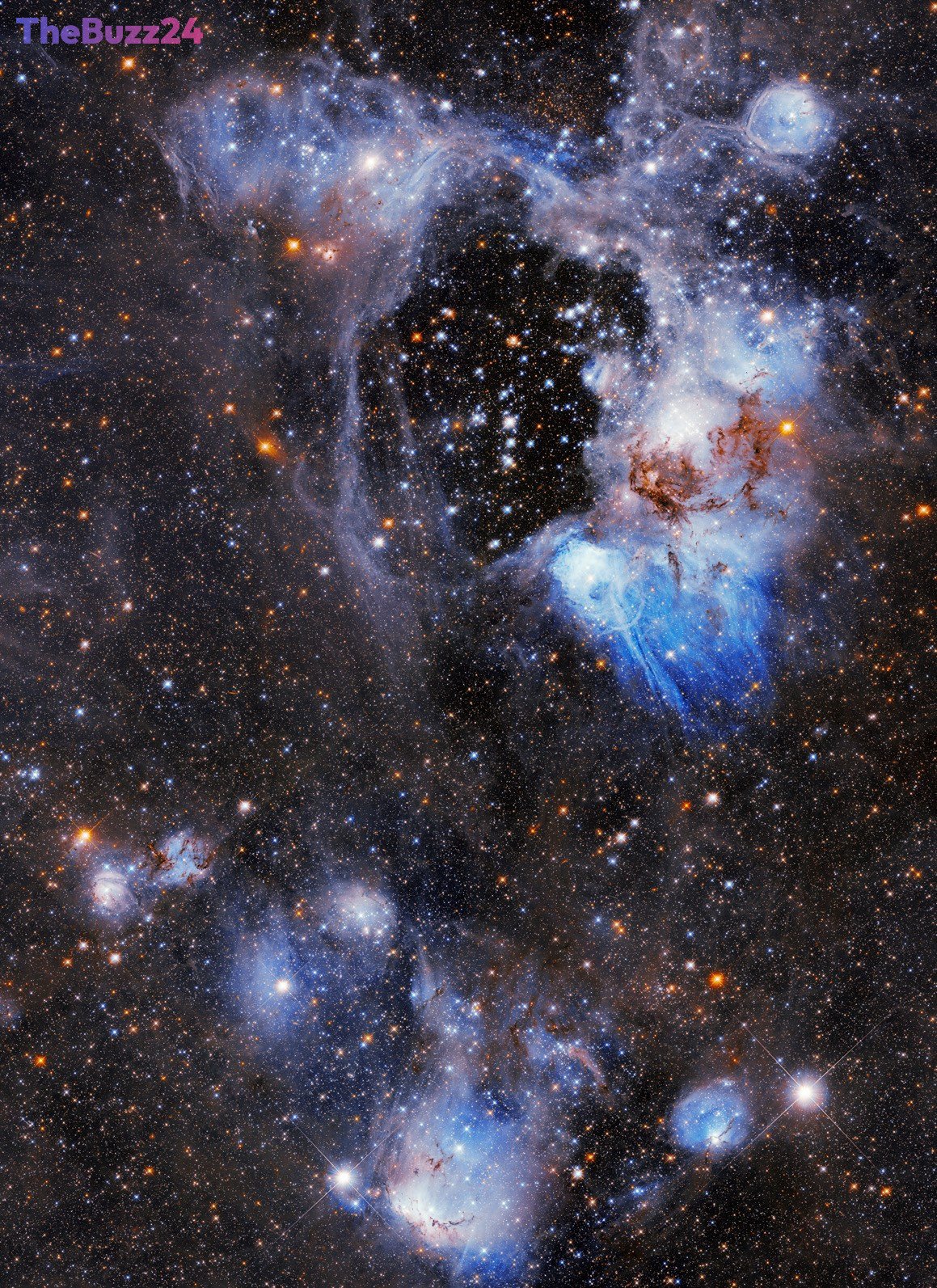
The Hubble Space Telescope has provided a stunning glimpse into the Large Magellanic Cloud, showcasing a colossal nebula known as N44. This celestial object is characterized by a dramatic central cavity, a ‘superbubble’ estimated to be approximately 210 light-years wide and 140 light-years tall. This immense void is not a natural formation but rather the result of intense activity from a cluster of brilliant stars residing at its core.
These energetic stars have profoundly shaped their environment. Through the relentless force of their stellar winds and the cataclysmic explosions of supernovae, they have effectively blown away much of the surrounding gas and dust. This process has sculpted the vast, empty space observed within N44, leaving behind a shell of denser material that outlines the edges of the superbubble.
The image, captured and released by NASA and the European Space Agency (ESA), highlights the dynamic and often violent nature of star formation and evolution within galaxies. The contrast between the glittering stars at the center and the vast, cleared-out void serves as a powerful visual representation of the immense forces at play in the cosmos.
Key Takeaways
- The Hubble Space Telescope has imaged the nebula N44 in the Large Magellanic Cloud.
- N44 contains a massive 'superbubble' approximately 210 by 140 light-years.
- This superbubble was created by the powerful stellar winds and supernovae of stars at its center.
Editor’s Analysis & Impact
The discovery and detailed imaging of superbubbles like N44 offer invaluable insights into galactic evolution and the lifecycle of stars. These phenomena are crucial for understanding how matter is distributed within galaxies, influencing subsequent star formation. The immense energy expelled by massive stars not only clears out vast regions but also enriches the interstellar medium with heavier elements, seeding the next generation of stars and planetary systems. Studying such structures helps astronomers refine models of galactic dynamics and the chemical enrichment processes that are fundamental to the universe’s ongoing development.
Frequently Asked Questions
Q: What is a superbubble?
A: A superbubble is a large cavity in interstellar space, typically tens to hundreds of light-years across, created by the combined effects of stellar winds and supernova explosions from a cluster of massive stars.
Q: Where is the Large Magellanic Cloud located?
A: The Large Magellanic Cloud is a satellite galaxy of the Milky Way, visible from the Southern Hemisphere and located about 160,000 light-years away from Earth.
Q: How does stellar wind create a superbubble?
A: Massive stars emit powerful streams of charged particles called stellar winds. When multiple massive stars are in close proximity, their combined stellar winds can push surrounding gas and dust outwards, creating a large, expanding bubble. Supernova explosions within the cluster further accelerate this process.
AI Disclosure: This article is based on verified data and official reports. Our Team and AI have cross-referenced every financial detail with primary sources to ensure total accuracy.
More from this Category