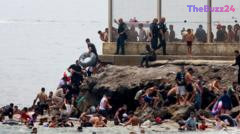
Humanitarian Crisis Unfolds as Hundreds of Migrants Swim to Spanish Enclave of Ceuta
A significant wave of migration has strained local resources in Ceuta, Spain’s North African enclave, as hundreds of individuals successfully crossed over from Morocco over the past week. Utilizing inflatable rings, makeshift flotation devices, and swimming across coastal waters, migrants navigated the treacherous journey to reach European soil, while others breached border fence gates.
Local leadership has sounded the alarm, describing the situation as a severe humanitarian and security emergency. Officials report that reception centers for unaccompanied minors are currently operating significantly above their intended capacities. In response to the escalating crisis, high-ranking Spanish government officials are scheduled to visit the territory to assess the situation and coordinate emergency interventions with local authorities.
Authorities point to human trafficking networks as a driving force behind the recent influx, alleging that these groups are exploiting recent legal rulings regarding maritime interceptions to encourage undocumented crossings. While security forces continue to reinforce physical barriers and surveillance along the border, Spain and Morocco are actively working on bilateral agreements to expedite the repatriation of individuals who entered the territory unlawfully. Meanwhile, the surge has sparked broader European debates regarding border security, with international calls for heightened protective measures to manage migration pressures at the European Union’s sole land borders on the African continent.
Key Takeaways
- Hundreds of migrants swam or breached fences to enter Spain's North African enclave of Ceuta from Morocco.
- Local leaders report that reception facilities are severely overwhelmed, creating a humanitarian emergency.
- Spanish authorities and Morocco are collaborating on expedited deportations while facing pressure over regional border security.
Editor’s Analysis & Impact
The recent surge of migration into Ceuta underscores the persistent geopolitical and humanitarian challenges at the borders between the European Union and North Africa. This event not only places immediate strain on local municipal resources and security forces but also reignites diplomatic tensions surrounding border control frameworks. As human trafficking networks continue to adapt to legal landscapes and maritime enforcement, European nations face mounting pressure to balance humanitarian obligations with rigorous border defense strategies. The long-term implications point toward increased bilateral cooperation between Spain and Morocco, alongside broader debates within the EU regarding migration management and Schengen zone policies.
Frequently Asked Questions
Q: What is Ceuta and why is it a focal point for migration?
A: Ceuta is a Spanish enclave located on the northern coast of Africa, sharing a land border with Morocco. Because it represents European Union territory on the African continent, it has historically been a primary destination for individuals attempting to migrate to Europe.
Q: How are migrants managing to cross into Ceuta?
A: Migrants have utilized various methods to cross, including swimming across coastal waters, using inflatable rings and flotation devices, and occasionally breaching gates along the border security fences.
Q: What measures are being taken by the Spanish government?
A: Spanish authorities are increasing security, collaborating closely with Morocco to strengthen border enforcement, and working on agreements to quickly return individuals who have entered the enclave unlawfully.
AI Disclosure: This article is based on verified data and official reports. Our Team and AI have cross-referenced every financial detail with primary sources to ensure total accuracy.
More from this Category