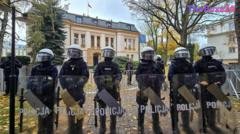
Riot Police Deployed in Warsaw Amid High-Stakes Stand-Off Over Poland’s Top Court
Riot police have been deployed outside Poland’s Constitutional Court in Warsaw as a profound political and legal crisis intensifies. The tense stand-off pits the administration of Prime Minister Donald Tusk against the right-wing Law and Justice (PiS) party, centering on control and legitimacy of the nation’s highest judicial body. The intervention unfolded shortly after the Justice Minister moved to strip the court’s top leaders of their legal immunity to pursue criminal charges.
The confrontation escalated rapidly when President Karol Nawrocki interrupted an international trip to Senegal, cutting his journey short to personally enter the constitutional tribunal. Demonstrators gathered outside the heavily guarded building as authorities worked to prevent unauthorized access. The court’s administration condemned the government’s maneuvers as an unconstitutional overreach, while Prime Minister Tusk defended the actions as a necessary step to restore judicial independence following years of controversial reforms enacted during the previous administration.
Tusk’s administration has long argued that the PiS-era appointments compromised the impartiality of the tribunal, pointing to prior rulings from major European courts. However, the aggressive tactics have also drawn sharp criticism from legal scholars and observers who warn that bypassing established legal norms to settle political disputes could inflict long-term damage on Poland’s democratic institutions. With upcoming parliamentary elections on the horizon, the battle over the judiciary remains a central and deeply polarizing issue in Polish politics.
Key Takeaways
- Riot police were deployed at Poland's Constitutional Court amid an escalating conflict between Prime Minister Donald Tusk's government and the judiciary.
- Justice officials sought to strip top court leaders of their immunity to face criminal charges, prompting President Karol Nawrocki to abruptly return to Warsaw.
- While the government frames the actions as a restoration of the rule of law, legal experts and critics warn that the measures risk causing severe, long-term damage to democratic institutions.
Editor’s Analysis & Impact
The ongoing constitutional crisis in Poland highlights the immense difficulty of dismantling deeply entrenched judicial reforms enacted by previous administrations. While Prime Minister Tusk’s administration aims to realign the nation’s courts with European Union standards of judicial independence, the use of police intervention and executive pressure sets a precarious precedent. This confrontation threatens to further polarize the electorate ahead of upcoming elections and risks triggering a prolonged constitutional deadlock. For investors and international observers, the instability underscores the fragility of institutional checks and balances in Central Europe, potentially impacting long-term economic confidence and legal predictability in the region.
Frequently Asked Questions
Q: Why were riot police deployed at the Constitutional Court in Warsaw?
A: Police were deployed to maintain order and prevent demonstrators from entering the building during an escalating stand-off between Prime Minister Donald Tusk's government and the leadership of Poland's highest court.
Q: What is the core disagreement between Donald Tusk and the PiS-backed leadership?
A: Tusk's government is attempting to reverse judicial changes made by the previous Law and Justice (PiS) administration, which critics and European courts argue compromised the independence and impartiality of Poland's judiciary.
AI Disclosure: This article is based on verified data and official reports. Our Team and AI have cross-referenced every financial detail with primary sources to ensure total accuracy.
More from this Category