The Culinary Ballot: How Fish Became a Political Weapon in West Bengal
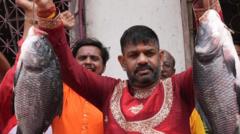
In the high-stakes electoral arena of West Bengal, a surprising campaign prop has emerged as a symbol of regional identity: fresh fish. Candidates from both the Bharatiya Janata Party (BJP) and the Trinamool Congress have increasingly incorporated fish into their public rallies, elevating a common dietary staple into a potent emblem of cultural heritage and political loyalty. This trend underscores a growing divide in the state, where the competition for votes has become deeply intertwined with the defense of traditional Bengali customs.
The Trinamool Congress, led by Chief Minister Mamata Banerjee, has leveraged the imagery of fish and rice to frame itself as the ultimate guardian of Bengali culture. By emphasizing these dietary staples, the party seeks to portray its political rivals as outsiders attempting to impose foreign, vegetarian-centric norms that clash with the local way of life. This narrative serves to cast the opposition as a threat to the fundamental lifestyle and values of the state’s residents.
Conversely, the BJP has attempted to steer the discourse toward governance and economic accountability. Party leadership has characterized the focus on dietary habits as a tactical distraction from the current administration’s failures, particularly regarding the state’s inability to achieve self-sufficiency in local aquaculture. By shifting the conversation to the management of the fishing industry, the BJP aims to neutralize the cultural narrative and refocus the electorate on issues of development and economic policy.
Sociologists note that the prominence of fish in this election cycle is far from a mere gimmick; it reflects the deep-rooted significance of the resource in a region where over 65% of the population consumes fish weekly. Because fish is woven into the fabric of local literature, social class, and history, it serves as an ideal vessel for emotional political messaging. As the election approaches, the discourse continues to oscillate between substantive policy debates and symbolic gestures, illustrating that in West Bengal, the path to the ballot box is frequently paved with the symbols of everyday life.
Key Takeaways
- Fish has emerged as a primary symbolic tool in West Bengal elections, representing regional identity and cultural heritage.
- The Trinamool Congress uses the fish narrative to frame opponents as outsiders, while the BJP attempts to pivot the discussion toward economic governance and aquaculture policy.
- The integration of food culture into political campaigns highlights the power of identity politics in mobilizing voters within the region.
Editor’s Analysis & Impact
The weaponization of food culture in West Bengal serves as a prime example of how identity politics can be utilized to mobilize voters in highly polarized environments. By tapping into the emotional resonance of daily traditions, political parties effectively bypass complex policy discussions to establish a visceral connection with the electorate. This strategy has significant implications for the future of regional campaigning, suggesting that cultural preservation will remain a dominant theme in Indian state elections. While this approach is highly effective for base mobilization, it risks overshadowing critical discussions regarding economic development, infrastructure, and governance. Moving forward, the success of this ‘culinary politics’ will likely serve as a case study for political strategists looking to leverage local customs to define the ‘insider vs. outsider’ narrative in diverse democratic landscapes.
Frequently Asked Questions
Q: Why is fish being used as a political symbol in West Bengal?
A: Fish is a fundamental staple of the Bengali diet and culture, making it a powerful symbol of regional identity and traditional values that parties use to build an emotional connection with voters.
Q: How do the political strategies of the BJP and Trinamool Congress differ regarding this issue?
A: The Trinamool Congress uses the imagery of fish to defend local heritage against perceived external influence, whereas the BJP attempts to shift the focus toward the government's economic management and the state's failure to achieve self-sufficiency in the fishing industry.
AI Disclosure: This article is based on verified data and official reports. Our Team and AI have cross-referenced every financial detail with primary sources to ensure total accuracy.
More from this Category