Inside the Pre-IPO Perps Market: What Speculators Say About Anthropic’s Upcoming Public Debut
As the countdown to Anthropic’s highly anticipated public offering continues, financial speculators are actively building exposure through pre-IPO perpetual futures markets. Across multiple platforms including Entropy, TradeXYZ, and OKX, open interest has surpassed $260 million. This capital reflects intense market interest in estimating the AI company’s true valuation ahead of its official debut on the Nasdaq under the ticker ANT.
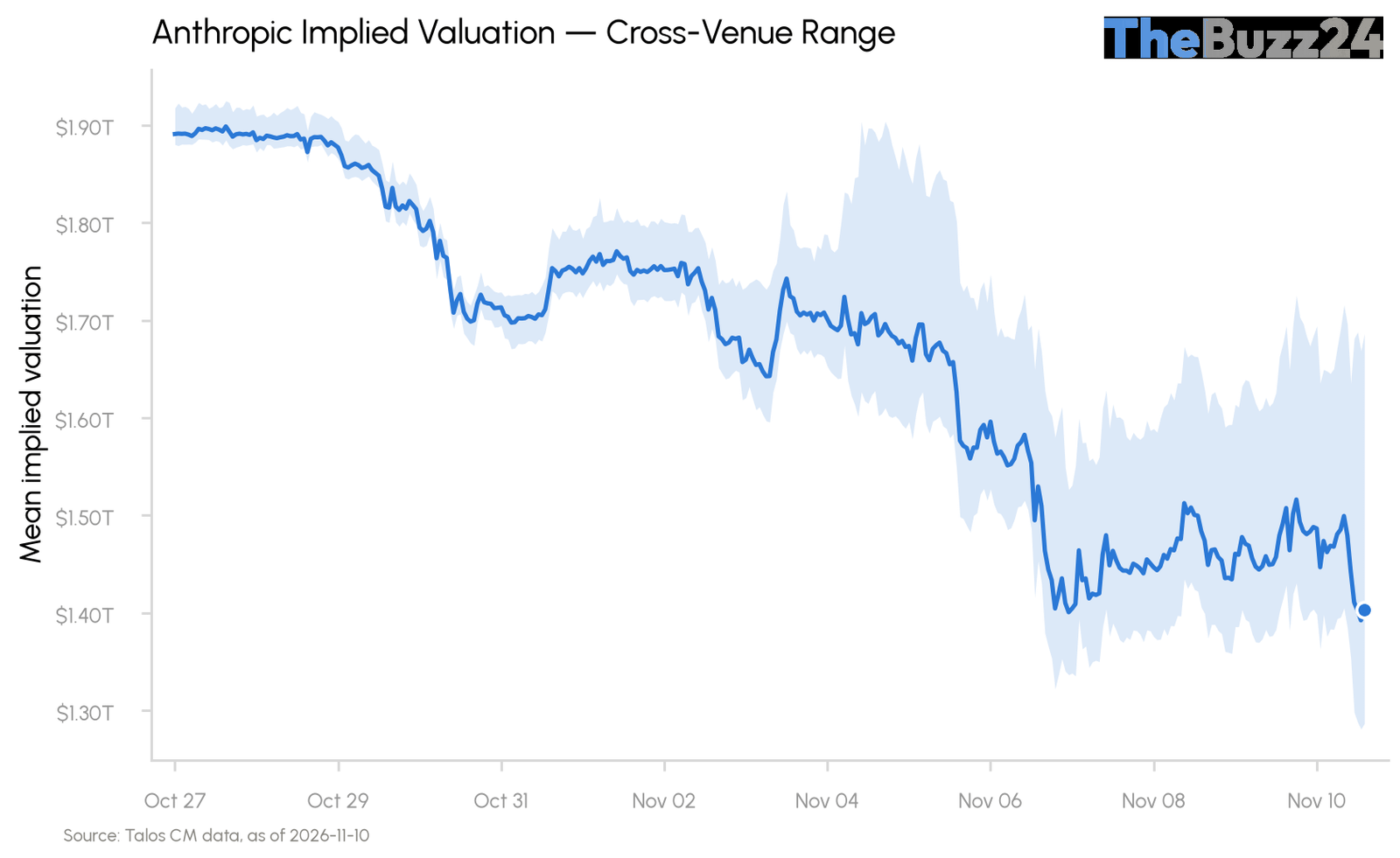
Market-implied valuations for Anthropic currently hover around $1.4 trillion, a figure that has slightly retreated from previous highs. However, different exchanges utilize varying settlement rules and share count denominators, creating distinct price behaviors. For instance, TradeXYZ prices each contract using a narrow denominator consisting solely of Class A common stock, acting as a baseline for the industry. Meanwhile, OKX incorporates a broader common share count and utilizes periodic rebases, while Entropy applies a fully diluted valuation model that incorporates unexercised options and restricted stock units.
Analyzing historical precedents reveals how these pre-IPO perpetual markets function as price discovery mechanisms. Drawing comparisons to previous high-profile public offerings like SpaceX, pre-IPO perps often overestimate the initial trading day pop by roughly 17%. Nevertheless, these derivatives provide retail and institutional investors with early access to pre-listing momentum. As the conversion date approaches, pricing across all disparate platforms is expected to converge cleanly with the official publicly traded share price.
Key Takeaways
- Open interest across pre-IPO perpetual futures markets for Anthropic has exceeded $260 million.
- Different trading venues utilize varying share count denominators and settlement rules, leading to nuanced price discrepancies across platforms.
- Historical data from past tech IPOs like SpaceX indicates that pre-IPO perps tend to overestimate initial public trading pops by around 17% before converging with real market prices.
Editor’s Analysis & Impact
The maturation of pre-IPO perpetual futures markets represents a paradigm shift in how retail and institutional capital interacts with late-stage private companies. By allowing traders to speculate on valuations long before the S-1 filing translates into public shares, these derivatives offer unprecedented price discovery. However, the lack of standardized settlement mechanics—evident in the differing share denominators used by platforms like TradeXYZ, OKX, and Entropy—introduces structural complexity and potential volatility. Looking forward, as regulatory frameworks evolve and more private giants utilize pre-IPO perps, these instruments may become permanent fixtures of corporate finance, bridging the gap between venture capital and public markets while setting new benchmarks for valuation transparency.
Frequently Asked Questions
Q: What is the current market-implied valuation for Anthropic in pre-IPO markets?
A: Pre-IPO perpetual markets currently value Anthropic at approximately $1.4 trillion, though individual exchange valuations vary based on their specific settlement methods and share count assumptions.
Q: How do share counts impact pre-IPO perpetual contracts?
A: Different exchanges use different denominators—such as Class A shares only versus fully diluted shares including options and RSUs—when calculating per-share values. This causes temporary price discrepancies across platforms until they ultimately converge upon public listing.
Q: Are pre-IPO perpetual markets accurate predictors of initial public offering prices?
A: While they provide valuable early price discovery, historical data shows they tend to overestimate the initial first-day trading pop (by roughly 17% in cases like SpaceX) before rapidly aligning with the underlying stock price during open market hours.
AI Disclosure: This article is based on verified data and official reports. Our Team and AI have cross-referenced every financial detail with primary sources to ensure total accuracy.
More from this Category