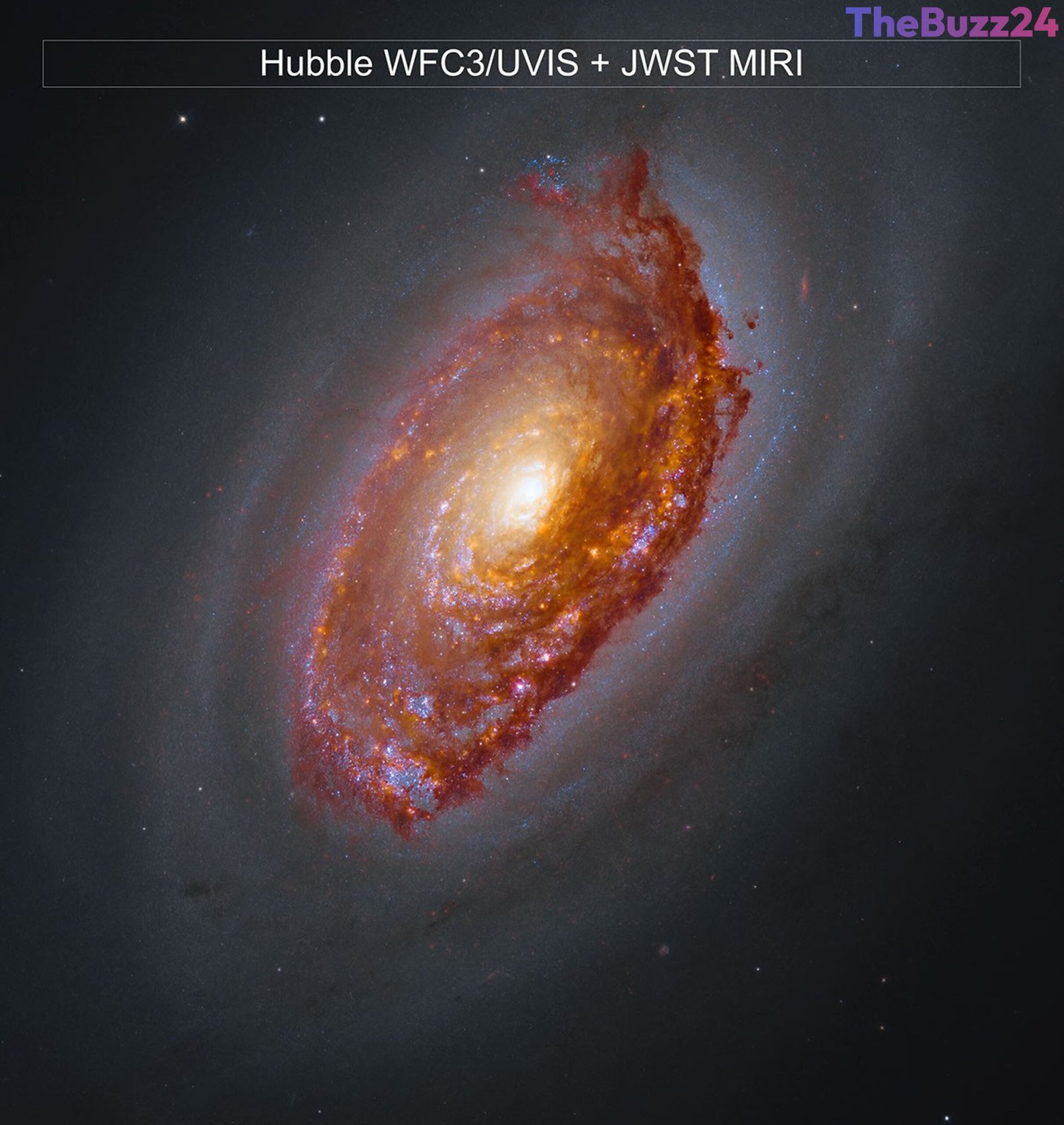
James Webb Space Telescope Reveals Hidden Details of the Black Eye Galaxy
Combining the observational power of both the Hubble and James Webb space telescopes, astronomers have unveiled a striking new composite view of Messier 64, widely recognized as the Black Eye Galaxy. Located relatively nearby in the cosmos, M64 earned its dramatic nickname from a prominent, dark band of dust that partially obscures its intensely bright core. While visible-light imagery emphasizes the shadowy dust lanes, infrared observations reveal how this cosmic dust absorbs and reradiates energy from surrounding stellar nurseries.
At the heart of M64 lies a fascinating and unusual dynamic: the galaxy’s inner and outer gas regions rotate in opposite directions. This strange counter-rotation creates intense friction and compression zones where the opposing gas currents collide, fueling active and robust star formation. Scientists believe this peculiar motion is the lingering signature of an ancient galactic collision, suggesting that M64 absorbed a smaller companion galaxy in its distant past.
Historically, spiral galaxies were frequently viewed as evolving through peaceful, isolated processes. However, the complex structure of M64 served as pivotal evidence that galactic mergers are a fundamental part of cosmic evolution, a phenomenon mirrored in the history of our own Milky Way. The latest infrared data captured by advanced space-based instruments continues to refine our understanding of how cosmic dust, gas dynamics, and galactic interactions shape the life cycle of galaxies across the universe.
Key Takeaways
- The James Webb Space Telescope and Hubble have captured a detailed new composite image of Messier 64, known as the Black Eye Galaxy.
- M64 features inner and outer gas regions that rotate in opposite directions, a rare phenomenon caused by a historical galactic merger.
- The compression zones created by these counter-rotating gas currents spark intense regions of new star formation.
Editor’s Analysis & Impact
The integration of multi-spectral data from premier observatories like the James Webb Space Telescope continues to redefine our comprehension of galactic evolution. By moving past the traditional assumption that spiral galaxies develop in isolation, astronomers are leveraging objects like Messier 64 as cosmic laboratories to study the violent history of galactic mergers. As infrared and high-resolution imaging technologies advance, the scientific community gains unprecedented insights into stellar genesis, interstellar dust composition, and the structural mechanics of the universe. These discoveries not only enrich our astronomical archives but also provide critical context for mapping the evolutionary trajectory of our own Milky Way galaxy in an expanding universe.
Frequently Asked Questions
Q: Why is Messier 64 called the Black Eye Galaxy?
A: M64 is nicknamed the Black Eye Galaxy because of a prominent dark band of absorbing cosmic dust that stretches across one side of its bright core.
Q: What causes the counter-rotation in M64?
A: The opposing rotation of the inner and outer gas regions is believed to be the result of an ancient merger between M64 and a smaller galaxy.
Q: How do Hubble and James Webb views differ for M64?
A: While Hubble highlights visible structures like pink star-forming regions and dark dust lanes, Webb's infrared instruments detect the dust glowing as it absorbs and re-emits light from newborn stars.
AI Disclosure: This article is based on verified data and official reports. Our Team and AI have cross-referenced every financial detail with primary sources to ensure total accuracy.
More from this Category