Mapping Alien Worlds: The Future of Exoplanet Surface Imaging
A groundbreaking proposal is currently under development to revolutionize how humanity observes distant exoplanets. By utilizing a sophisticated technique known as optical Very Long Baseline Interferometry (VLBI), researchers aim to move beyond mere detection and begin resolving the actual surface features of Earth-like planets orbiting nearby stars. This ambitious project seeks to capture visible light images of alien continents, providing a new window into the potential habitability of worlds far beyond our solar system.
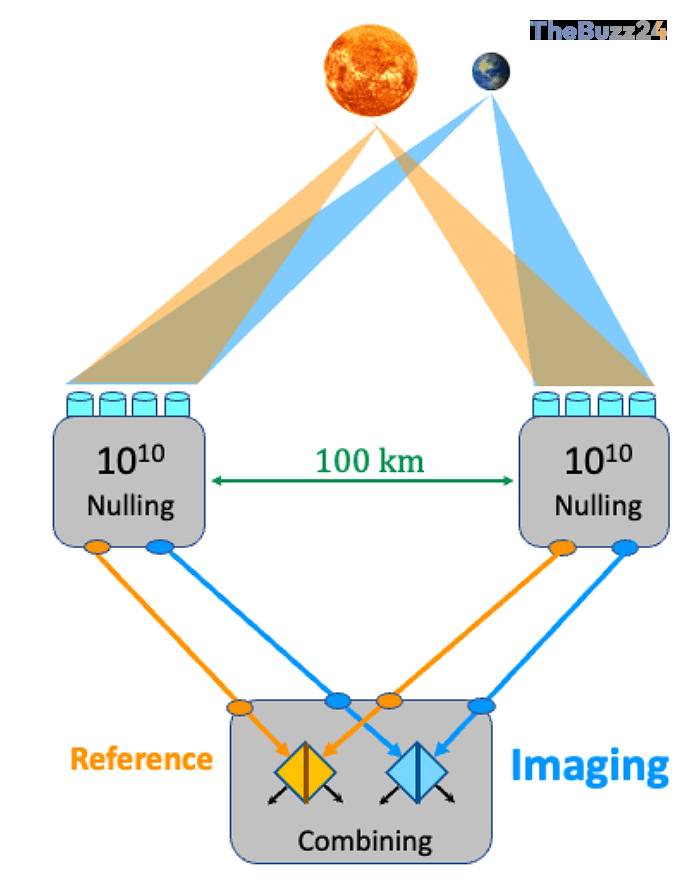
The technical innovation hinges on a two-stage process. First, scientists are developing a “dynamic hierarchical nulling” interferometer. This device is designed to isolate the faint light of an exoplanet from the overwhelming glare of its host star, achieving a contrast ratio of 10^10 or better. By effectively suppressing the star’s light, the system can isolate the planet’s signature for detailed observation.
To achieve the necessary angular resolution, the second stage involves deploying two such nulling systems on spacecraft positioned approximately 100 kilometers apart. By utilizing Michelson interferometric imaging, these spacecraft will act as a single, massive telescope. The system is designed to use the star’s light as an interference phase reference, ensuring precise imaging capabilities. This project, supported by advanced concept funding, represents a significant leap forward in space exploration technology and aligns with long-term goals to characterize Earth-like environments across the galaxy.
Key Takeaways
- Researchers are developing a 'dynamic hierarchical nulling' interferometer to separate exoplanet light from stellar glare with extreme precision.
- The project proposes using two spacecraft separated by 100km to function as a massive interferometer for high-resolution imaging.
- The ultimate goal is to resolve surface features and map continents on Earth-like exoplanets in the visible light spectrum.
Editor’s Analysis & Impact
The pursuit of direct imaging for exoplanets marks a transition from the ‘discovery era’ of exoplanetary science to an ‘analytical era.’ While current telescopes like the James Webb Space Telescope have provided incredible data on atmospheric compositions, the ability to resolve surface features would be a paradigm shift in astrobiology. The technological hurdle of maintaining a 100km baseline between two spacecraft while performing sub-nanometer interferometry is immense, requiring breakthroughs in formation flying and laser metrology. If successful, this technology would not only confirm the existence of landmasses on other worlds but could potentially identify biosignatures or technosignatures on a planetary scale. This project represents a high-risk, high-reward investment that could redefine our understanding of our place in the universe and provide the first visual evidence of alien geography.
Frequently Asked Questions
Q: What is dynamic hierarchical nulling?
A: It is a specialized interferometric technique designed to suppress the intense light of a host star, allowing the much fainter light of an orbiting planet to be isolated and studied.
Q: Why do the spacecraft need to be 100km apart?
A: The distance between the spacecraft creates a massive synthetic aperture, which is necessary to achieve the high angular resolution required to resolve small surface features on a planet located light-years away.
AI Disclosure: This article is based on verified data and official reports. Our Team and AI have cross-referenced every financial detail with primary sources to ensure total accuracy.
More from this Category